
Machine translation in intelligence work is now standard at the collection stage. Analysts run foreign-language material through Google Translate, Yandex, Baidu and, for Romanised Arabic, Yamli. When I was both a student and an instructor at the U.S. Army’s Defense Language Institute Foreign Language Center (DLIFLC), we joked that a bad translation had been run past “Ustadz Google.” It was easy to spot who did their homework with Google Translate. That joke has since become a workflow outside the schoolhouse, and often in the heat of operations.
Early models handled a few sentences at a time with accuracy, but paragraphs were too much for them to translate effectively. Today they process whole articles in seconds, and the output reads like fluent English. Built into that habit is an assumption that the tool carries meaning from one language to another with acceptable fidelity. I think that assumption is wrong, and the output gives you no way of seeing it.
Mistranslated words are the lesser problem; a well-trained analyst catches those with a physical dictionary at their side. The larger problem is grammar. Each platform carries structural biases from the language its model learned in, and those biases decide what happens to certainty, conditionality, intent and completion when the target language has no direct equivalent. A Russian verb that leaves an operation’s outcome open becomes an English verb that reports success. An Arabic jussive (a verb mood used for commands and conditions) carrying a conditional command becomes a plain statement, and intent starts to read as fact. Add dialect and idioms that only native speakers know, and it gets worse. Way, way worse.
That is the argument of this article. Linguistic relativity, the idea that the language a thinking system works in shapes what it can represent, applies to translation engines as much as to people. As a result, machine translation in intelligence produces errors that look like clean English. Below, I trace those distortions through four tools, identify the grammatical categories most at risk in Arabic, Russian and Mandarin, and set out a triage framework that decides which translated passages reach a human linguist.
Learn the stage where this goes wrong. Translation is a named step of intelligence processing, where raw collection becomes material an analyst can use. Grey Dynamics’ accredited Intelligence Cycle Fundamentals program covers it in Intelligence Processing Fundamentals, alongside direction, collection, analysis and dissemination. Explore the program →
Linguistic Relativity Explains Why No Translation Tool Is Neutral
“The limits of my language mean the limits of my world.” Ludwig Wittgenstein
Every analyst who has worked with foreign-language material has met a frustrating mistranslation, whether in open-source news, social media posts or captured enemy material (CEM). Colloquial words get mangled or misattributed to their classical counterparts, idioms come out too literal, and the output plainly means something other than the original. Those are the relatively easy nuances to spot and fix with additional effort. The dangerous errors in machine translation for intelligence come out as fluent, grammatically correct English that misrepresents the source’s intention and overall meaning.
Nobody flags them, because nothing looks broken, and without a native speaker checking the work, everything is “good enough.” The translation reads well, passes editorial review and goes into the product. Somewhere in the middle, the structure the source language used to express uncertainty became one that English reads as fact, simply because the two languages differ.
My argument is that this problem follows a pattern, and a better dictionary will not fix it. It comes from the architecture of the translation tools, from the thought patterns built into the source languages, and from something cognitive scientists have studied for nearly a century: the language a thinking system works in constrains what that system can represent.
What the Sapir-Whorf hypothesis claims
The Sapir-Whorf hypothesis, more precisely called linguistic relativity, holds that the language a person thinks in influences what they can think at all. Its strong form, that language determines thought entirely (linguistic determinism), has largely been set aside. The weak form, which holds that language systematically shapes cognition and that speakers of different languages perceive and categorise the world differently as a result, has a solid base of empirical support.
The intelligence community already accepts a version of this idea. We value area specialists and cultural advisors partly because they understand how a Russian military planner frames a problem differently from an American one, or how an Arabic political statement uses register, formality and Quranic word choice to signal its audience and intent in ways no native English speaker will grasp. What we have not done in any systematic way is turn the scrutiny we drill into analysts in the schoolhouse onto the tools that produce the translated text in the first place. Analysts get rudimentary language training and are sent on their way, LLMs they use be damned.

Where the theory overreaches
Linguistic relativity carries philosophical problems of its own. Some critics argue that it pigeonholes speakers of a language into one way of thinking, which can invite praise or prejudice. Kuuk Thaayorre, an endangered Indigenous language spoken in Pormpuraaw on the western Cape York Peninsula in Queensland, does not use words like left and right to describe space; its speakers use cardinal directions instead and stay oriented with an almost supernatural sense of direction. Lera Boroditsky and Alice Gaby found that Pormpuraawans even lay time out from east to west, whichever way they happen to be facing.
Others hold that because Mandarin cannot express the subjunctive mood, its speakers are constrained in counterfactual thinking: reasoning about what could have happened, contrary to what did. Syntax alone cannot settle whether a Mandarin speaker has that ability, and I would be hard pressed to find anyone who could state with certainty that any native Mandarin speaker lacks it. Plenty of people whose languages do contain a subjunctive fail to think counterfactually for reasons that have nothing to do with linguistics. Some things transcend language.
Nuance
What linguistic relativity can explain is nuance: differences in how people conceive of self, community, life and death. Even the direction a language is written in, right to left, left to right or top to bottom, can shape how its speakers lay time out in space. Experiments comparing English speakers with Mandarin speakers from mainland China and Taiwan, whose writing runs in different directions, found that writing direction affects how people map time onto space. The Amele language of Papua New Guinea has separate forms for today’s past, yesterday’s past, the remote past and the habitual past, plus two futures, and 32 possessive classes. No CEM I know of comes from Amele sources, but the lesson transfers: dig into the linguistic nuance of whatever language you are working, and linguistic relativity is the reason to do it.
The same logic applies to the machine translation systems that intelligence analysts rely on. A model trained mostly on English text organises meaning the way English does. Hand it Arabic, Russian or Mandarin and it imposes the categories it has, which are English ones. Calling it a neutral intermediary gives it too much credit.
Every Translated Intelligence Source Passes Through Three Linguistic Frames
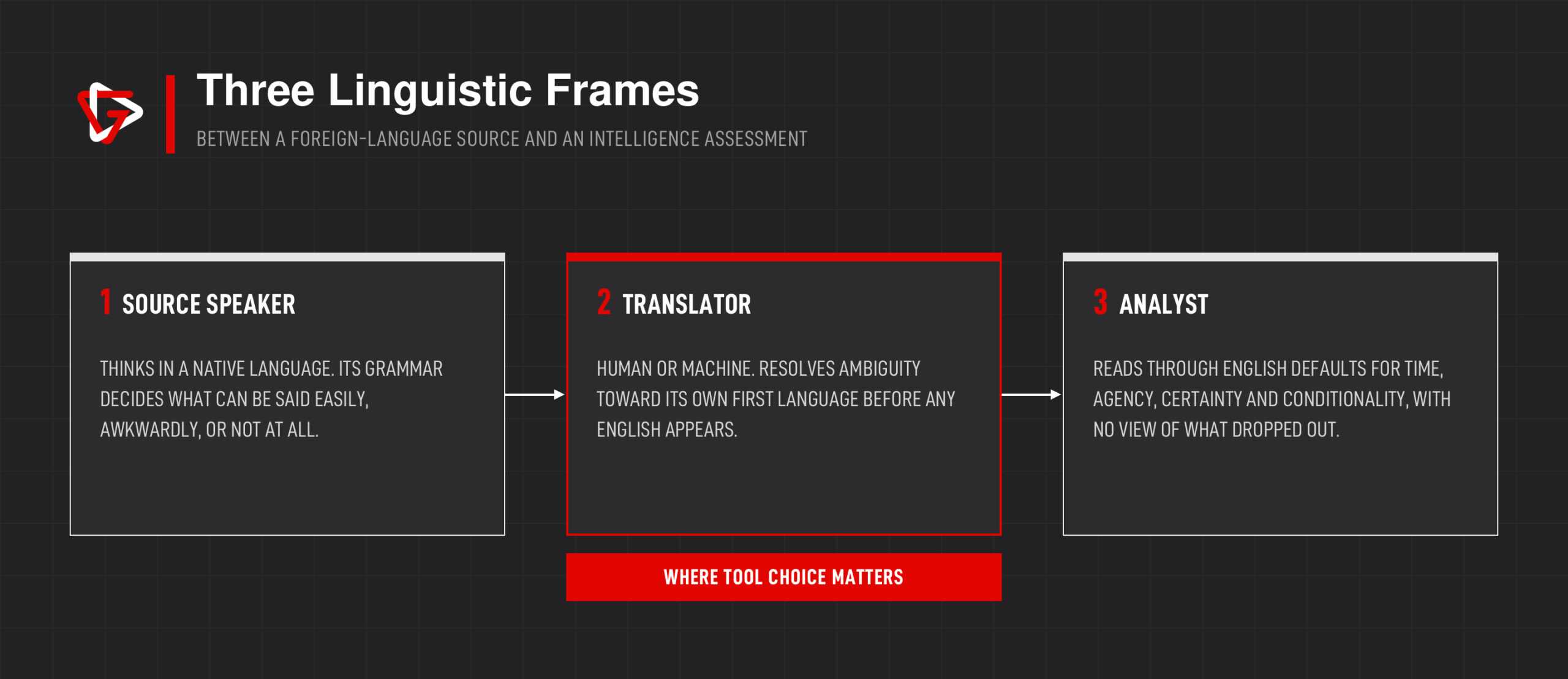
A translated intelligence source passes through at least three distinct linguistic frames before it reaches the analyst’s assessment. I tell my students this every single class.
The source speaker’s frame
First, the author of the original text thought in their native language, with its grammatical affordances and constraints. What they could express easily, what they could express only awkwardly and what they could not express at all shaped what they wrote. A sub-layer sits inside this frame: a non-native English speaker writing in English structures the text differently than they would in their first language, blending thoughts formed in one language with the grammar of another.
The translator’s frame
This is the frame to consider when ingesting local news that someone has already translated into English before it reaches you. Human or machine, the translator brings their own native linguistic bias to the task. A native English speaker who reads Arabic fluently still tends to resolve ambiguity in the direction English prefers, and a machine translation model does the same. I am a native English speaker who has consistently scored 3/3 on the Interagency Language Roundtable (ILR) scale for Modern Standard Arabic (MSA), and 2 to 2+ in several dialects (From Yemeni to Sudanese), for over a decade, and I can attest to this blind spot in my own abilities. Few native English speakers surpass that level of General Professional Proficiency; college-educated native speakers dominate levels 3+ to 5. Trust me, I have tried for years to score a 3+, to no avail.
The analyst’s frame
Finally, the analyst reads the English through English defaults for time, agency, certainty and conditionality, with no view of what dropped out at the earlier stages.
Most of this article deals with the second frame, because that is where machine translation enters the intelligence workflow and where guidance can change outcomes. An analyst still has to understand all three to handle translated material competently.
Grammar, Not Vocabulary, Is Where Machine Translation Distorts Intelligence
Language training in intelligence focuses mostly on vocabulary: knowing that a term has several meanings, knowing the connotations a word picks up in a political or religious register, spotting an idiom. Classical Arabic has more than 300 recorded names and epithets for the lion (a 2026 study catalogues 324), but telling whether someone means an actual lion or a person with a lion’s character is not that difficult. Syntax is the harder half.
Languages differ in more than their words. They differ in whether a concept gets grammatically encoded at all, and in which categories exist to mark it. When one language forces a speaker to mark a distinction that another treats as optional, translating between them means making a choice the original author never had to make. In machine translation for intelligence, that choice is where analyst error comes in.
After 64 weeks of language school (plus a smattering of two semesters of college Arabic), much of my cryptologic linguist training focused on “gisting,” where an analyst writes down the gist of whatever passage or communication they are listening to. Gisting extracts main ideas and themes efficiently, but when the product of your gist could decide whether missiles are fired, exact translation deserves the closest attention.
As an aside, over the years I have watched Occam’s Razor get trained out of analysts, who search for cryptic meaning in simple phrases where none exists. Sometimes the wedding is a wedding, and the flowers are flowers. There is no secret meeting to exchange weapons. I wish that were not a real-world example, but it is, and it is one more reason exact translation matters.
Arabic: mood and modality encode intent that English flattens
DLIFLC uses standard Arabic morphology charts to teach the 10 trilateral verb forms, or measures. The charts break down how prefixes, suffixes and gemination (doubling a consonant) alter a three-letter root to create causative, reciprocal, reflexive or passive meanings, alongside their participles and verbal nouns (masdar). I hate this chart (with love), mostly because I am poor at straight memorisation. It kept me up at night during training, usually because homework meant filling it in for every new verb I learned, but it proved effective.
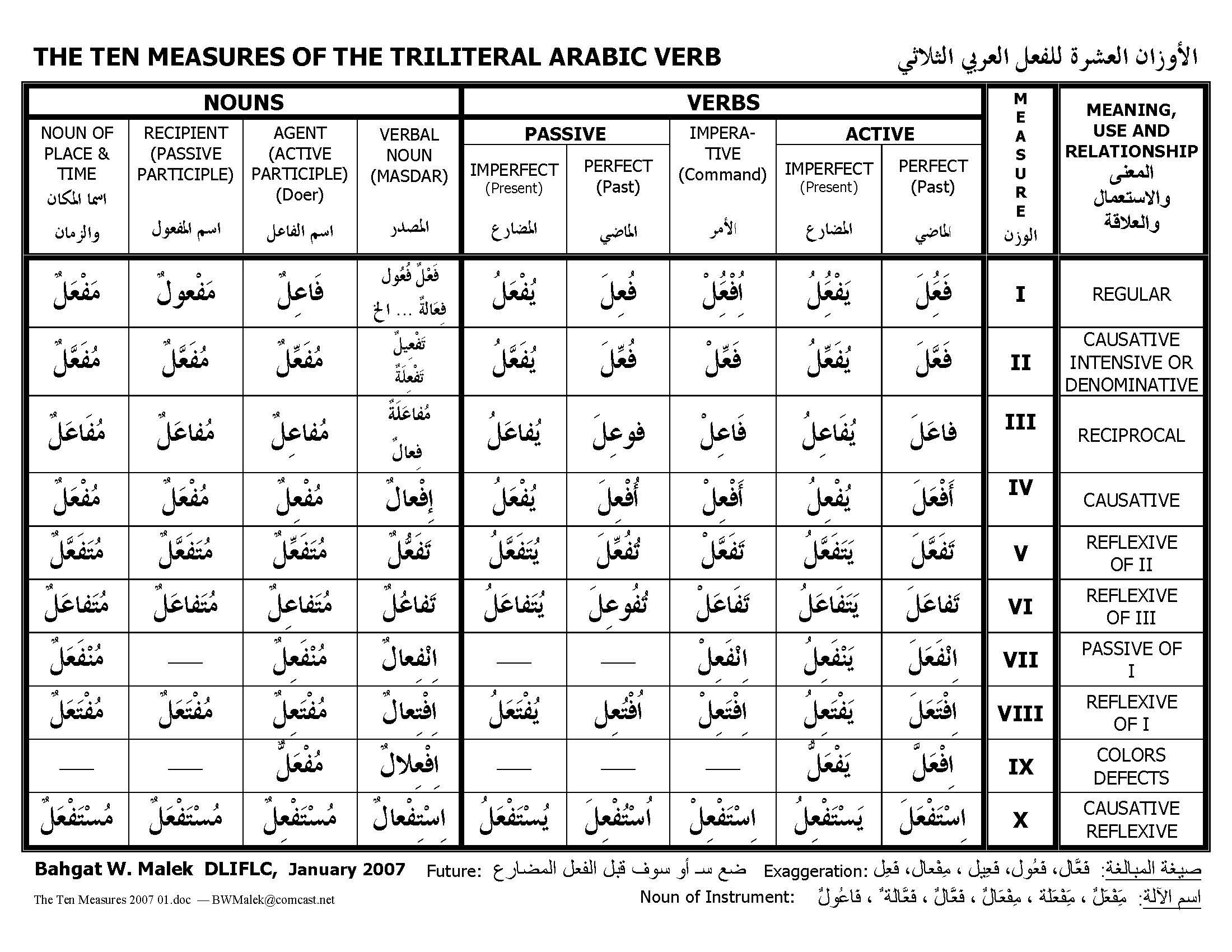
Each form a verb takes carries distinct semantic weight, and none maps cleanly onto English’s comparatively flat modal system. William Wright’s standard grammar of Arabic sets out separate moods for the imperfect verb, among them the indicative, subjunctive and jussive, each with uses English has no verb form to mark. Arabic encodes non-factivity (will, intention, desire, prediction, likelihood, possibility and necessity) through mood and modality in ways that differ from English at the level of grammar. If the system fails to identify and render the mood marking, an Arabic statement explicitly framed as the speaker’s hope or intention can emerge from a translation pipeline as a declarative English sentence with no modal qualification at all.
The problem compounds at the dialect level, where the gap between what a source writes and what a translation model can read is widest. Egyptian Arabic, for example, illustrates this clearly. The word 3ish (عيش) is the Egyptian term for bread, but it carries a deeper cultural meaning: bread was historically life itself, and the word keeps that weight in daily use. When an Egyptian source writes about someone’s ability to put 3ish on the table, they are describing livelihood and provision, what MSA expresses as rizq (رزق), not access to food. A model that has not trained on Egyptian idiom, or that normalises the input toward MSA and renders 3ish as khobz (خبز, the Levantine and MSA word for bread) before translating, produces English about bread. The actual claim was about economic survival.
The “3” in 3ish is not a typo. Writing numbers inside words is a distinct way of transliterating Arabic called Arabizi, which the Arabizi section below picks up inside the deromanisation pipeline.
Russian: aspect decides whether an operation succeeded
Russian has two grammatical aspects, perfective and imperfective, and they are not optional. Every Russian verb in the past and future tense carries one of them, and the grammar requires the speaker to choose.
The perfective marks an action as completed successfully. The imperfective marks an action as ongoing, habitual, reversed or of uncertain outcome. For intelligence analysis, that means a Russian sentence reporting that a subject “took an exam” in the perfective implies he passed. The same sentence in the imperfective implies the result is unknown or the action was not carried through.
In contrast, English has no equivalent grammatical category. It approximates aspect through syntax (“had done” versus “was doing”) and lexical context, and those approximations are inexact and context-dependent. Research comparing the two aspectual systems confirms that Russian conveys completion morphologically, as a property of the verb itself, while English relies on constructions that require interpretation. When machine translation renders a Russian imperfective as an English simple past, it discards the signal an intelligence analyst most needs: whether the action succeeded.
For an analyst reading a report about an operation, a supply movement or a command decision, the difference between “attempted” and “completed” is the core analytical question, and it is not up for debate.
Mandarin: mood and evidentiality are spread across the sentence
The earlier claim that Mandarin lacks a subjunctive is a simplification, but it points to a real structural difference. Mandarin does not use inflectional morphology to mark grammatical mood. It expresses hypothetical, counterfactual and conditional meanings through particles, adverbs and discourse-level context rather than verb forms.
The consequence is that signals for conditionality and uncertainty in Mandarin text sit across a sentence, and sometimes across several sentences, rather than in one grammatical marker. However, neural machine translation systems capture morphological signals more reliably than distributed discourse signals. A Mandarin conditional that depends on the relationship between a sentence-initial adverb and a final particle can come out in English as a simple declarative if the system fails to parse the link between them.
Mandarin also marks the speaker’s source of information and degree of certainty with evidential expressions that have no direct English equivalent. The distinction between “I know this because I saw it” and “I know this because I was told” is optional in English but routinely marked in Mandarin. When machine translation flattens that distinction, the intelligence analyst cannot assess the source’s epistemic basis for the claim.

Machine Translation Tools in Intelligence: Google, Yandex and Baidu Each Think in Their Training Language
Google Translate: English gravity in a shared model
Google’s published architecture for Google Translate is a multilingual neural machine translation system in which a single model handles all language pairs. A token prepended to the input specifies the target language; the encoder, decoder and attention mechanism are shared across every language. Google’s own research on this system found evidence of what it called a “universal interlingua representation” forming inside the model when it processes cross-lingual pairs. The Google Translate of today is far removed from the version I used at DLIFLC in 2013 and 2014.
That interlingua carries a bias. English dominates the training data for large language models, and NLP researchers have documented the resulting English-centric bias repeatedly. Recent work has traced the mechanism inside the models: they convert hidden states into high-resource language representations (in practice, English) in the early layers, reason in the middle layers and map back to the target language only near the end.
In effect, Google Translate likely thinks in English and then dresses the output in the requested language. On an Arabic-to-English job, the Arabic becomes an English-weighted internal representation before any English is generated, so a system already organised around English handles the grammatical categories that Arabic encodes and English lacks. You can get every word right and still end up with a structurally English reading of an Arabic text. If you have ever read any Mahmoud Darwish, you know how impossible this can be.
For machine translation in intelligence, some language pairs suffer more than others. Google performs well on European pairs with large parallel corpora. Arabic-to-English and Mandarin-to-English combine a bigger training-data imbalance with wider structural gaps between source and target grammar.
Yandex: the strongest reader of Russian aspect
Yandex Translate now draws on YandexGPT, Yandex’s own large language model family. Yandex’s translation team describes building a document translation model on YandexGPT and deploying it in Search, the Smart Camera and the Yandex Browser translator, and Russian tech press reported that Yandex Translate itself was retrained with a YandexGPT-family model. Yandex starts from a Russian-heavy base: according to its documentation for YaLM-100B, the large model it released before YandexGPT, 75% of the training corpus was Russian-language text, with the remaining 25% drawn from English datasets. Yandex also reports that its YandexGPT-based model placed first for English-to-Russian quality on DiBiMT, an independent benchmark that tests how systems translate ambiguous words. Mind the direction, though: that result runs English into Russian, the opposite of most analyst work.
This matters for machine translation in intelligence work on Russian sources. Yandex holds stronger native representations of Russian grammar, the aspect system included, than any Western model, and an analyst working Russian sources will generally get more accurate aspect from Yandex than from Google. When I teach this in an operational context, you would be surprised how often students working Russian problem sets do not know Yandex exists. Making it their first-option translation tool would change how reliably those analysts read whether an action was completed.
Yandex and Arabic
Outside Russian, however, the picture changes. Yandex’s Arabic coverage is thin. Its training data for Arabic, Persian and Central Asian languages is not documented in anything like the detail available for Russian, and on Arabic-to-English it cannot compete with Google on MSA and does worse on dialect. Use it on Arabic and you get a model whose primary frame is Russian, working in a language family it has seen relatively little of.
A secondary consideration for analysts: Yandex is a Russian company, and Yandex Translate processes queries on Russian infrastructure. That data-handling question sits outside the scope of this article, but it belongs in any organisational policy discussion about tool selection.
Baidu: built for Mandarin, anchored in Chinese knowledge
Baidu’s translation capability sits inside the ERNIE model family. ERNIE 3.0 trained a 10-billion-parameter model on a 4-terabyte corpus of plain text and a large-scale knowledge graph. It brings the knowledge graph in through a pre-training task the paper calls universal knowledge-text prediction: the model sees an encyclopedia sentence alongside the matching knowledge-graph triple, with parts of each masked, and has to predict what is missing. The multilingual extension, ERNIE-M, extends coverage to 96 languages using cross-lingual alignment against a Chinese-anchored representation.
Baidu is the best-resourced platform for Mandarin-to-English. Its training data gives it stronger representations of Mandarin syntax than any Western model, including the discourse-level evidential and conditional constructions described above.
Its limits mirror Yandex’s. Arabic coverage depends on cross-lingual transfer from Chinese and English anchors, and Russian coverage is adequate but well behind Yandex. Run Arabic or Russian through Baidu and the internal representation is organised around Chinese and English categories.
The knowledge graph adds a machine translation risk specific to intelligence work. ERNIE anchors its representations of people, places and organisations in Chinese-language knowledge bases. Entities that show up often in Chinese sources are well represented. An entity that matters in Arabic or Russian reporting but barely appears in Chinese sources risks being mishandled, with the model falling back on the nearest referent it knows.
The Censorship Layer
There is also a censorship layer. Citizen Lab researchers tested five translation services available in China, Baidu’s among them, and found that every one applies automatic censorship rules that partly or completely omit content, almost always without telling the user. Baidu’s version drops the offending sentence and translates the rest, so the English arrives looking complete, with a line missing and nothing to show it was ever there. Whether the same rules fire on queries from outside China is something to test, not assume.
Which machine translation tool to use for intelligence work in each language
The question students ask me most is which model has the deepest native-language training data for the source language. Russian is best served by Yandex, keeping the data-handling caveat in mind. Baidu gives the best structural fidelity for Mandarin. With Arabic, Google is the strongest resource but also carries the heaviest English gravity. Nothing handles dialectal Arabic well, save for a native speaker who can detect country, regional and even city-specific variation.
| Service | Model / engine | Best-case use | Worst-case use |
|---|---|---|---|
| Google Translate (translate.google.com) | Google Neural MT (GNMT); Gemini-based “Advanced” mode for select pairs since late 2025 | Widest language coverage (133+); quick gist-level comprehension of any language | Idiomatic expressions; cultural nuance; intelligence-reporting-grade accuracy |
| Yandex Translate (translate.yandex.com) | Yandex NMT, with YandexGPT-based translation models in Translate, Search and Browser | Russian and CIS/Slavic languages; Cyrillic-script content and transliteration | Non-CIS language pairs; Arabic/Farsi nuance; limited reliability outside Eurasia |
| Baidu Translate (fanyi.baidu.com) | Baidu ERNIE-based NMT (proprietary Chinese LLM stack) | Simplified/Traditional Chinese pairs; Chinese-English technical and business documents | Non-Chinese language pairs; politically sensitive sentences may be silently omitted |
| Yamli (yamli.com) | Rule-based and machine-learning transliteration engine (not full NMT) | Romanised Arabic (Arabizi) input to Arabic script; SOCMINT and informal dialect decoding | Full translation between languages; non-Arabic scripts; structured documents |
Arabizi and Yamli Add a Second Layer of Guesswork Before Translation Even Starts
I give Arabizi special attention here, mainly because I am a classically trained Arabic analyst.
Much Arabic-language open-source content is not written in Arabic script. It is written in Arabizi: an informal system that uses Latin characters and numerals to represent Arabic sounds, born where conventional Arabic keyboards were unavailable or inconvenient. The practice emerged in the 1990s and remains widespread in social media, messaging applications, forums and the informal online communication that is often most analytically relevant.
Arabizi varies by dialect and by user. Egyptian Arabizi differs from Levantine Arabizi, which differs from Gulf Arabizi, and individual users vary within each region. A Lebanese user and an Egyptian user will write the same Arabic phrase with different Latin representations.
Numbers In Place Of Letters
Arabizi also uses numbers in place of Arabic letters. For collection, that means a large share of Arabic social media and messaging, exactly where informal operational chatter, sentiment and reporting tend to live, needs a deromanisation step before anyone can translate it. In the Arabic digital world, the tool most associated with that step is Yamli, an invaluable tool I teach my students every class. The table below shows the common numeral substitutions.
| Numeral | Arabic letter | Name | Sound | Example (Arabizi → Arabic) |
|---|---|---|---|---|
| 2 | ء | Hamza | Glottal stop (the catch in “uh-oh”) | insha2 allah → إن شاء الله (“God willing”); 2amal → أمل (“hope”) |
| 3 | ع | Ayn | Voiced pharyngeal fricative (no English equivalent) | 3ain → عين (“eye”); ma3ak → معك (“with you”) |
| 5 | خ | Kha | Voiceless velar fricative (like Scottish “loch”) | 5aled → خالد (“Khalid”); 5alas → خلاص (“done/finished”) |
| 6 | ط | Ta (emphatic) | Emphatic T (deeper than regular T) | 6areeg → طريق (“road”); 6ayyib → طيب (“okay/good”) |
| 7 | ح | Ha | Voiceless pharyngeal fricative (sharp, whispered H) | 7abeeb → حبيب (“beloved”); 7elo → حلو (“sweet/beautiful”) |
| 8 | ق | Qaf | Emphatic Q (uvular stop; a “g” sound in some dialects) | 8alb → قلب (“heart”); 8ahwa → قهوة (“coffee”) |
| 9 | ص | Sad | Emphatic S (deeper than regular S) | 9aba7 → صباح (“morning”); 9adee8 → صديق (“friend”) |
Numeral conventions vary by region and by user, which is part of the problem this section describes. The table follows common Gulf and Levantine usage, and the variants matter. Many Egyptian and urban Levantine writers use 2 for ق, because they pronounce it as a glottal stop (2alb for قلب); North African writers commonly use 9 for ق rather than ص; and some writers use 8 for غ (ghayn). A deromanisation tool that assumes one convention will misread the others.
Yamli predicts words, and its predictions likely lean toward urban Egyptian, Levantine and Gulf users
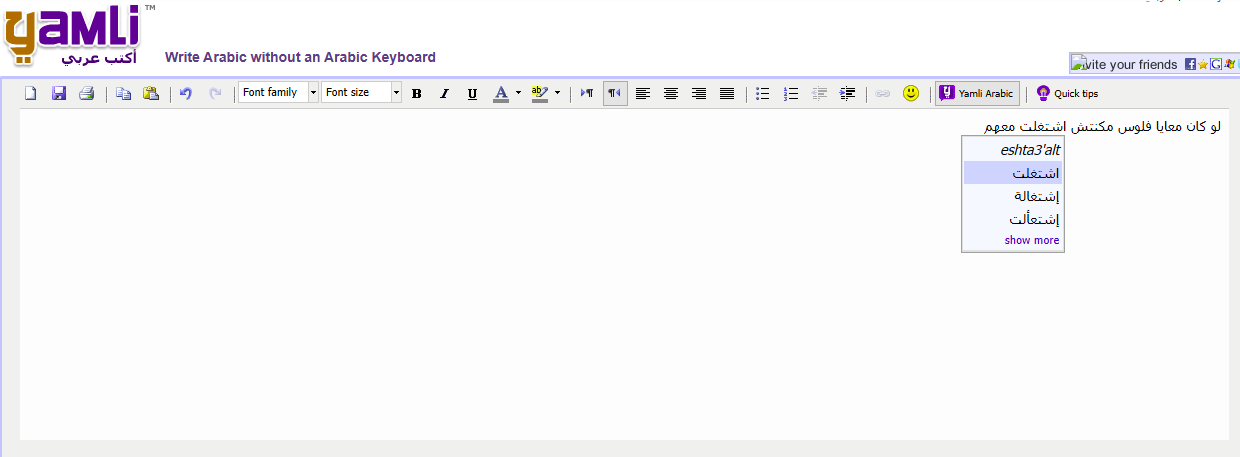
Yamli is not a translation engine. Lebanese entrepreneurs Habib Haddad and Imad Jureidini founded it in 2006 and launched it publicly in 2007. It is a probabilistic transliteration system: it converts Arabizi into Arabic script by predicting the most likely Arabic word from an ambiguous string of Latin characters. Its model was adaptive, learning from user interaction to improve accuracy on the dialect inputs it encountered most often.
Yahoo licensed Yamli’s technology in 2012 and integrated it into Arabic-language products across the Middle East and North Africa (MENA), including Yahoo Maktoob Mail, Messenger, Search and forums. That integration likely shaped Yamli’s training distribution. When Yahoo bought Maktoob in 2009, the bulk of the portal’s users were in Egypt, Jordan, Kuwait, Saudi Arabia and the United Arab Emirates. The users generating the interaction data that refined Yamli’s model were therefore likely urban, digitally connected Arabic speakers in Egypt, Jordan and the Gulf states.
For analysts like you and me, that likely means Yamli leans toward those users’ dialect patterns. Arabizi from rural Syria, Yemeni conflict zones, Libyan tribal networks or Iraqi dialect groups is likely underrepresented in the data that shaped the model. When Yamli meets dialectal Arabizi it does not recognise, it falls back on its most probable output, which likely tilts toward Lebanese and Gulf patterns and toward MSA as the reference.
Each stage of the Arabizi-to-English pipeline makes a choice the author never made
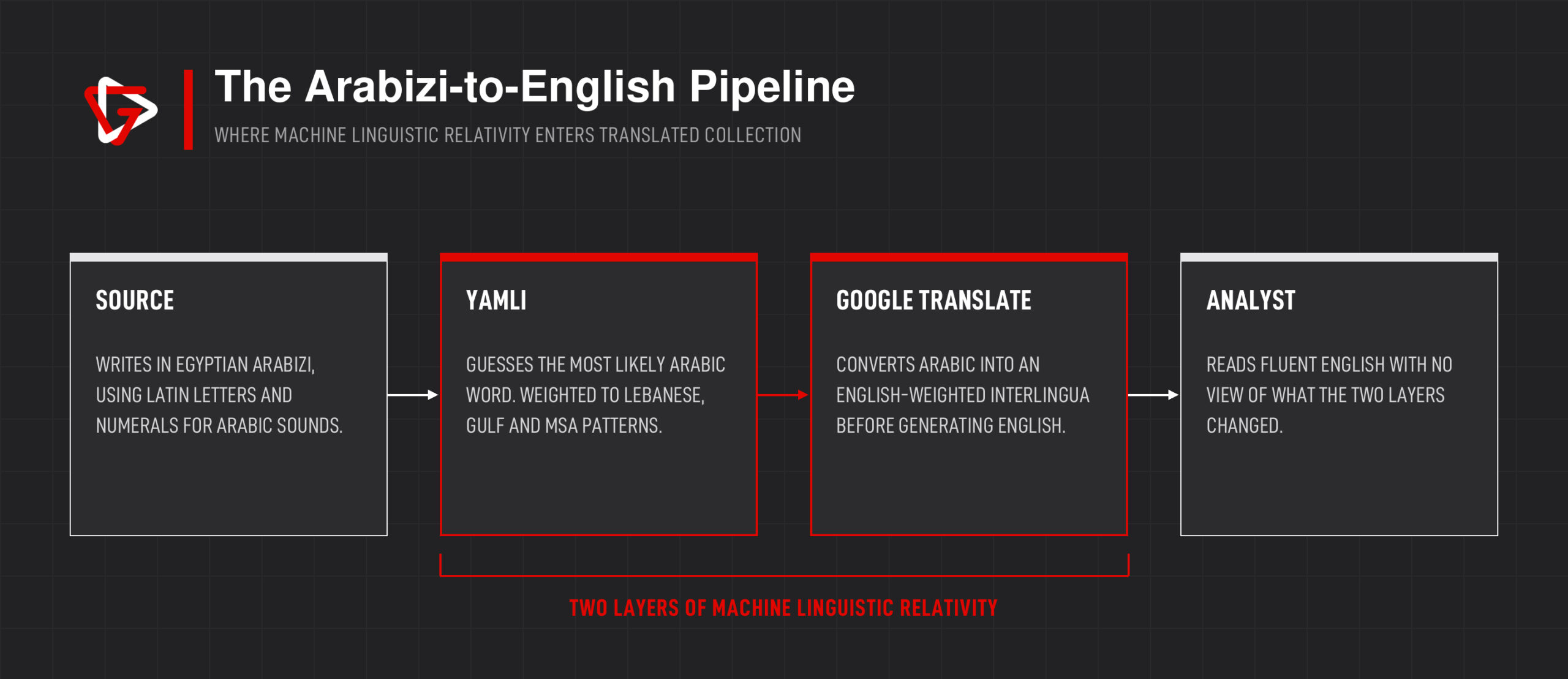
A typical machine translation pipeline for Arabizi in intelligence collection runs in four steps:
- A source writes in Egyptian Arabizi.
- Yamli converts the Arabizi to Arabic script, choosing which Arabic word each Latin string represents on probabilities weighted toward certain dialects.
- Google Translate processes that script, already a probabilistic approximation of the dialect original, through a model that converts Arabic representations into English-weighted ones before it writes a word.
- The analyst reads English that may differ greatly from what the source intended to convey.
Diglossia compounds all of this. MSA and the spoken dialects differ in sound, vocabulary, morphology and syntax. MSA is the language of formal media, official statements and classical texts. The dialects are what people use in daily life and on social media, which is most of what we collect. When Yamli normalises dialect toward MSA, the spelling changes, and so can the register, the implied social setting and sometimes the meaning.
A worked example: the custodial interrogation
Here are three real-world test sentences I teach every class. A non-Arabic-speaking intelligence analyst is tasked with translating audio or video files from Arabic to English and is left to their own devices, without a cultural advisor or cleared translator. The audio comes from local police interrogating a suspect in custody in an Arabic-speaking country. The commander needs to know who the man is, and why he was caught working with the targeted organisation.
Lost In Translation
Without knowing what the individual is saying, the analyst opens Yamli and types in Arabizi as the suspect begins to tell his story.
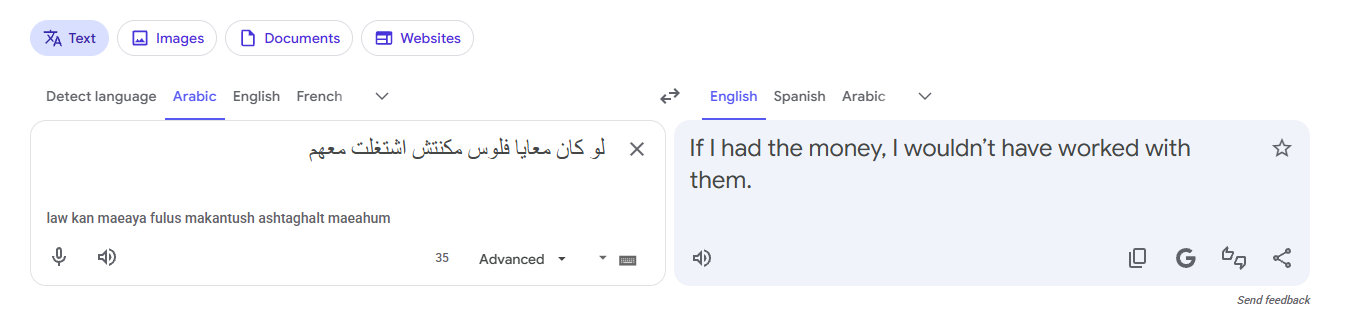
- Counterfactual: Arabizi: law kan ma3aya floos makontesh eshta3’alt ma3ahom (لو كان معايا فلوس ماكنتش اشتغلت معاهم). Correct meaning: “If I’d had money, I wouldn’t have worked with them.” That is an admission that he did work with them. Watch for English that turns it into a future conditional or a denial.
- Intent vs. Action: Arabizi: kont hasafer ma3ahom Libya (كنت هسافر معاهم ليبيا). Correct meaning: “I was going to travel with them to Libya,” with the trip possibly never happening. Watch for “I traveled with them.”
- The 3ish Idiom: Arabizi: ana bashta3’al ma3ahom 3ashan akl el3eish (أنا بشتغل معاهم عشان أكل العيش). Correct meaning: “I work with them to make a living.” Watch for “to eat bread,” and for Yamli turning 3eish into عايش (“alive”).
Once the analyst has typed what they heard, they paste it into Google Translate. The suspect said [ARABIZI], which in Egyptian Arabic means [CORRECT ENGLISH]. Google returned “[OUTPUT].” [AND WHAT THAT MEANS OPERATIONALLY.] Nothing in the output flags the error. It reads as clean, confident English, and an analyst without the language has no reason to doubt it. The same method works on Arabizi taken from social media posts, text messages, forums and chatrooms, pasted into Yamli to render full Arabic text.
Tradecraft for Machine Translation in Intelligence: Treat Output as a Lead, Not a Finding

Hold explicit uncertainty and name the platform
Treat machine output as a starting point. Analysts work under time and resource pressure, and machine translation earns its place at the collection stage, so nobody is suggesting you stop using it, certainly not me. The discipline is to hold explicit uncertainty about any translated text a competent human translator has not checked, and to weigh it accordingly in your judgements. You are an intelligence analyst after all, trained to see and read between the lines.
In practice, any intelligence product citing machine translation should say so and name the platform. The platform matters because each one carries predictable biases for each language pair. An assessment resting on Google’s Arabic-to-English output deserves a different confidence weighting from one resting on Yandex’s Russian-to-English output, because each platform’s biases fall differently on each pair.
Run consequential material through two platforms
When machine-translated material will carry real weight in an intelligence judgement, run it through at least two platforms and compare. Where they disagree, you have found the places where the source contains structures the systems handle differently, and those are usually the places where grammatical meaning is most at risk.
For Arabic, compare Google and Yandex. Russian calls for Yandex and Google, while Mandarin calls for Baidu and Google. Pay the most attention to disagreements over verb phrases, modals and conditionals, since those are the categories where source and target grammar differ most.
Know the danger categories for your language
If you work Arabic, Russian or Mandarin areas of operation (AOs), keep the categories from the grammar section in front of you and treat machine-translated text in those categories with caution.
- Arabic: treat any dialect text, whether Egyptian, Levantine, Gulf or otherwise, with caution; dialect idiom and culturally loaded vocabulary rarely survive machine translation with their truest meaning intact. A word can be morphologically correct and still carry a meaning the translation misses. If the analysis rests on a specific word choice, a modal claim about intent or conditionality, or an idiom, stop and get a human translator on it before it goes into a product. In the end, your reputation is tied to every product you make.
- Russian: check every past- or future-tense statement of action for aspect. Ask whether the action is reported as completed and successful, or as attempted with the outcome unknown. If that distinction matters to the question you are answering, machine output will not settle it. Get a translator.
- Mandarin: evidential constructions and conditionals spread across a sentence need human review. Whether the author saw something or only heard about it may or may not survive translation, and the English will not tell you which.
Match the platform to the source language
Use the platform with the strongest native-language training data for your source language: Yandex for Russian, with the data-handling caveat, and Baidu for Mandarin. For Arabic, Google is the best resource for MSA, and nothing handles dialect reliably.
In Arabizi-heavy collection, remember that every deromanisation step makes probabilistic choices weighted toward urban, Gulf and Levantine patterns. Material from underrepresented dialect groups picks up more errors before translation even starts.
Keep the original beside every translation
Keep the original text next to every translation and add it to the final product as an annex. This is basic source hygiene. With the original on file, a human translator can review it without anyone going back to collection, and you have an audit trail.
Translation Triage Decides Which Intelligence Passages Reach a Human Linguist
One phone exploitation, a scrape of a Telegram channel or a week of collection against a dialect-heavy target can produce thousands of foreign-language items, and qualified translators are the scarcest resource you have. Cross-platform comparison and linguist review both cost time. Triage decides where that time goes. Yet in most intelligence shops, the first read that drives triage is itself a machine translation.
That is a known risk, not a hypothetical one. Marianna Martindale’s University of Maryland dissertation, written by a researcher who has built and deployed machine translation for the U.S. government since 2003, found that fluency accounts for most of a monolingual reader’s judgement that a translation is believable. She then tested a practical countermeasure, giving analysts output from more than one translation system, in a user study built to mimic intelligence triage, with working intelligence analysts as participants.
Army doctrine solved this before machine translation existed
Army document exploitation doctrine worked through a version of this problem long before machine translation. FM 34-52 had screeners sort captured documents into four categories by intelligence value and time sensitivity, from Category A for time-sensitive, reportable information to Category D for material that appeared to have no intelligence value.
Two details in that scheme deserve attention. Nothing went into Category D until document translation specialists had examined it thoroughly, so a screener’s first impression never got the last word. And higher echelons could recategorise documents, because information goes stale and requirements change. Machine-assisted triage should work the same way: let the cheap first pass promote material, but never let it throw anything away.
The manual also separated full, extract and summary translations, and noted that a linguist working in a language they had not formally trained in could often produce a usable summary but not an accurate full translation. That is roughly where machine translation sits for most of the intelligence material we feed it. It will give you a usable summary of almost anything, and an accurate full translation of less than its fluency suggests. A big part of triage is knowing which of the two is in front of you.
Make the handling decision before anything touches a tool
Before anything touches a translation tool, decide which tools you can use. Every public service processes input on its provider’s infrastructure. The Yandex section raised that for Russia, but it applies just as much to Baidu, to Google and to any commercial large language model. Captured enemy material, partner reporting, detainee statements and anything with personal data about a source may not be lawful or safe to paste into a public web form.
Make the handling call first, because it limits everything after it. If an item can only be processed on an approved offline system, you may lose the two-platform comparison, and that limitation belongs in the triage record and in the confidence you attach to the translation. When in doubt, find a cleared linguist.
Pin down language, script, variety and register
Pin down four things about each item before you translate it: language, script, variety and register. Each one changes which tool fits and how far you can trust the output.
Language and script set the stage. Arabic material can arrive in Arabic script, in Arabizi or both in the same message, and North African sources routinely switch between Arabic and French mid-sentence. If a tool labels Latin-script text from an Arabic-speaking source as English or French, check it yourself; it may be Arabizi that needs deromanisation before translation can start.
Variety is where machines are weakest. At the 2024 Nuanced Arabic Dialect Identification (NADI) shared task, the best system identified country-level dialects with a macro-averaged F1 score of 50.57, and the best dialect-to-MSA translation system scored 20.44 BLEU. Treat an automated dialect label as a guess. Note in the triage record who confirmed it, and if nobody on the team can, count that as linguistic risk.
Register changes how meaning travels. A sermon, a military order, a news report and a voice note to a cousin each encode certainty and intent differently. Religious register needs extra care in Arabic, because formulaic expressions do not behave like ordinary statements. In shā’ Allāh (إن شاء الله) is the obvious case. In everyday speech it often signals politeness or a soft deferral (usually a deferral, in my experience); elsewhere it carries real conditional weight. Machine translation renders both as “God willing” and leaves the analyst to decide which one the speaker meant, usually without the context to do it.
Score each item on intelligence value and linguistic risk
Place each item on two axes: its potential value against current requirements, and its linguistic risk. Value comes straight from the requirements: does the item touch a priority intelligence requirement, contain a selector of interest or carry time-sensitive reporting? Linguistic risk comes from dialect, Arabizi, modal and conditional constructions, Russian aspect on consequential verbs, Mandarin hearsay markers and any passage where the analysis rests on a single word. Put the two together and you have the treatment. Table 1 is one scheme that works.
Table 1. Translation Triage Tiers and Minimum Treatment
| Tier | Typical material | Minimum treatment | Permitted use in a product |
|---|---|---|---|
| 1 | Time-sensitive threat reporting; statements of intent or capability; anything that will inform targeting, detention or legal action | Human translation of the decisive passages by a linguist performing at ILR translation level 3 or above; original retained | May support key judgements, with translation method stated |
| 2 | Material likely to be cited in a finished product; moderate-value material with high linguistic risk | Two-platform machine comparison; linguist review of divergent and flagged passages | May support judgements, with platform, date and review status stated |
| 3 | Background and situational awareness; sentiment; high-volume social media | Single-platform machine gist, labelled as a gist | Context only; never the sole support for a judgement |
| 4 | Appears to have no intelligence value after screening | Logged and retained in the original; not translated | Not cited; eligible for re-triage |
The ILR threshold in Tier 1 is there on purpose. The ILR’s translation performance descriptions are separate from its reading and listening proficiency scales, and they place the point where the necessary skills come together for a reasonably accurate, reliable translation at Level 3. A good proficiency score is not, on its own, a translation credential. Audio has its own descriptions; at Level 3, a translator can produce reasonably accurate translations of conversations with some complexity on topics beyond everyday matters. The custodial audio in the worked example would need to meet that bar before it went anywhere near a commander’s decision.
Two Rules
I have two rules for moving between tiers. First, machine screening can promote an item, but it never demotes one a human put higher. Ever. Second, high linguistic risk bumps an item up one tier even when its value looks modest, since the value was judged from a machine translation in the first place. Tier 4 deserves the same suspicion. FM 34-52 left its no-value category to translation specialists, which is rarely practical at today’s volume of collection, so retention takes its place. Nothing in Tier 4 gets deleted; save it for review.
Features that bump an item up a tier
Some features should bump an item up a tier no matter what the screener first thought. What follows is a starting list for Arabic, Russian and Mandarin, and every team should build on it for its own target set.
Arabic
Watch the conditional particles. Arabic separates the kinds of conditions that English squeezes into a single “if.” Law (لو) marks a hypothetical or counterfactual; in (إن) and idhā (إذا) mark conditions the speaker treats as possible or expected. Translate a law clause as a plain “if,” and a speaker’s “if we had the weapons” can start to read like a plan. Check hearsay forms such as qīla (قيل, “it was said”) and claiming verbs such as zaʿama (زعم), which often signals that the speaker doubts the claim, against the original. Do the same with any statement of future action, any command aimed at a third party and anything in a dialect your team cannot confirm.
Russian
Check aspect on any past- or future-tense verb describing how an operation, a delivery, a payment or an order turned out, since the imperfective can describe an attempt without implying success. Reported-speech particles such as mol (мол) and yakoby (якобы, “allegedly”) mark a claim as someone else’s, or as doubtful. When the English drops them, the claim is upgraded by default.
Mandarin
Check hearsay and inference markers such as 听说 (tīngshuō, “I heard that”), 据说 (jùshuō, “it is said/reported”) and 好像 (hǎoxiàng, “it seems that”) against the English. Mandarin also drops subjects freely, so the engine has to invent an English subject the source never gave. If your question is who did something, that pronoun is the machine’s guess. News writing adds a further trap. Corpus research on Mandarin news reports found that new information often appears first as a bare assertion and only picks up its evidential marking later in the text. Triage from the headline or first paragraph and you can take reported information as established fact, because the qualifier sits further down the page.
In all three languages, two platforms disagreeing on a verb phrase, a modal or a conditional is a trigger by itself, as is any passage where you notice a judgement hanging on one word.
Selector extraction: where machine translation does its quietest damage
Selector extraction is where machine translation in intelligence does its most subtle damage. Pull names, phone numbers, handles, dates and place names from the source text, normalise them and then search. An Arabic name has many valid romanisations (Muhammad, Mohammed, Mohamed, Mohamad and others), and the engine picks one. Search only its spelling and you miss whatever was filed under the others. Search the original script and the common romanisations together.
Numbers go wrong in both directions. Arabic material may use Eastern Arabic numerals (٠١٢٣٤٥٦٧٨٩), and Persian and Urdu have their own variants, so a phone-number pattern written for Western digits will walk right past them. Arabizi does the reverse: digits inside words, like the 3 in 3ish or the 7 in 7abibi, can get scraped up as pieces of numbers. Normalise digits before you run extraction and eyeball the hits.
Dates may be Hijri, Iranian Solar Hijri or another local system. The engine might leave them alone, convert them or garble them. Record the date exactly as written next to any conversion.

Say in the product how every source was translated
Readers of your final product never see your triage record, so the product has to carry the parts that matter. Intelligence Community Directive (ICD) 203 requires analytic products to describe the quality and credibility of their sources, data and methods, and to express and explain the uncertainty behind their judgements. Expressing uncertainty is something I harp on in the Grey Dynamics OSINT course, as well as the other course I teach. How a source was translated is part of that. Every source line resting on foreign-language material should say whether it was human-translated, machine-translated and reviewed, or machine-gisted, and give the platform and date. Call a gist a gist. Say you do not know when you do not. Always remember Socrates’ famous phrase.
The platform sourcing line now needs more detail than it used to. In late 2025 Google started offering a Gemini-based “Advanced” mode next to its standard “Fast” mode for a handful of language pairs, and in December 2025 it announced a wider Gemini upgrade to Translate aimed at idioms, slang and conversational language. Two analysts who both write “Google Translate” may have used different models. Record the platform, the mode if there is one, and the date.
FM 34-52 also required reports to cite the serial number of the captured document they drew on, so one document could not be counted twice as independent confirmation. That rule transfers straight to open-source work. A machine-translated post that bounces across a dozen channels is still one source, and the log is where you state that.
Re-triage the archive and keep score
New reporting can turn a Tier 3 item into a Tier 1 item months after collection, which is why keeping originals matters more than deleting them. When a new selector or requirement comes up, search the retained originals in their own language and script, and do not stop at the machine-translated archive.
Also, keep score on how often human review changes the meaning of a machine translation, broken out by language, dialect, platform and type of material. A few months of that tells you where machine output holds up at Tier 3 and where it routinely falls apart, and it gives you evidence for moving whole categories of material between tiers. It answers, for your own target set, the question this article can only answer in general terms.
Outlook: Machine Translation in Intelligence Will Likely Get More Fluent, Not More Neutral
Google’s move to Gemini-based translation in late 2025, aimed explicitly at idioms, slang and conversational language, shows the direction of travel. Over the next 12 to 24 months, LLM-based machine translation will likely reduce the visible errors intelligence analysts catch today, such as mangled idioms and over-literal slang. It is highly unlikely to remove the grammatical flattening described in this article on the same timeline. The English-centric internal representation that recent research has traced sits in the architecture, not the vocabulary, and dialect identification remains weak: the best system at NADI 2024 identified country-level Arabic dialect with a macro-averaged F1 score of 50.57.
The practical consequence is that the error will likely become harder to see. As output grows more fluent, fewer passages will look wrong, and the cues that currently prompt an analyst to call a linguist will appear less often. Martindale’s work explains why: fluency is what makes a monolingual reader believe a translation, so the better the English reads, the less reason an analyst has to doubt it. Teams that keep score on how often human review changes a machine translation’s meaning will be the ones able to tell whether a new model has improved fidelity or only fluency.
I hold this judgement with moderate confidence. It rests on published research into model internals, shared-task results, user research on how monolingual readers judge machine translation, and vendor announcements, not on systematic testing of the newest models against the grammatical categories above. Benchmark results showing that a current model reliably preserves Russian aspect, Arabic mood and Mandarin evidentials in English output would require me to revisit it.
Conclusion: Machine Translation in Intelligence Is Useful, but Never Neutral
Machine translation in intelligence has made multilingual analysis far faster and far more accessible. It has also brought in a class of error that the output does not show and standard quality control does not readily catch. That error does not come from a bad dictionary. It comes from the categories each platform’s training language makes available, from the English gravity of shared multilingual architectures, and from the distortion that piles up when dialect passes through deromanisation before translation. Linguistic relativity, a theory built to describe human minds, turns out to describe the machines just as well.
Picture three analysts. One reads a machine-translated Arabic report and assesses intent. A second reads a Russian report and decides whether an operation was completed. A third reads a Mandarin report and weighs how confident the source was in their own claim. All three are working from text filtered through another language’s categories, and usually none of them knows which categories were applied or what was lost on the way.
So keep using the tools, and use them knowing what each platform does. Hold working uncertainty about translated material nobody has validated, and make sure the grammatically consequential passages in high-stakes products reach a human translator. Triage is how a team finds those passages. The tools are always useful, but never neutral.
Build the processing discipline this article describes. Translation, screening and collation sit at the heart of intelligence processing, the stage that turns raw collection into material an analyst can trust. Grey Dynamics’ accredited Intelligence Cycle Fundamentals program takes you through every stage of the cycle, with translation covered in Intelligence Processing Fundamentals and uncertainty and cognitive bias in Intelligence Analysis Fundamentals. Self-paced, online, around 30 hours of study, and no prior intelligence training required. Enrol in Intelligence Cycle Fundamentals →
Sources
- EBSCO Research. “Linguistic relativity (Sapir-Whorf hypothesis).” Research Starters: Language and Linguistics.
- Boroditsky, Lera, and Alice Gaby. “Remembrances of Times East: Absolute Spatial Representations of Time in an Australian Aboriginal Community.” Psychological Science, 2010.
- Bergen, Benjamin K., and Ting Ting Chan Lau. “Writing Direction Affects How People Map Space onto Time.” Frontiers in Psychology, Vol. 3, 2012.
- Roberts, John R. Amele Grammar. PhD thesis, University College London, 1986. Published as Amele, Croom Helm, 1987.
- Nichols, Johanna, and Balthasar Bickel. “Possessive Classification.” In Dryer, Matthew S., and Martin Haspelmath (eds.), WALS Online, Chapter 59.
- Hammoudi, Omar, Ahmed Aarab, and Abdelouahab Rgoud. “Classical Arabic zoosynonymy: a source of zoological knowledge among Arabs. The case of lion synonyms.” Anthropozoologica, Vol. 61, No. 7, 2026, pp. 139–144.
- Wright, William. A Grammar of the Arabic Language. Vol. 2. Cambridge University Press, 1967. Cited in: Salman, M. B., and Salih, O. I. “Mood of Verbs in both Arabic and English Languages: A Contrastive Study.” Journal of Tikrit University for Humanities, Vol. 29, No. 10, 2022.
- Mitchell, T. F., and El-Hassan, S. A. Modality, Mood and Aspect in Spoken Arabic. Cited in: Aldawsari, H. “Translatability of English and Arabic Hypothetical/Conditional Constructions.” ERIC.
- Comrie, Bernard. Aspect. Cambridge University Press, 1976. Cited in: Makarchuk, I., and Bykova, O. “Russian Verbal Aspect and the Activation of Event Knowledge.” Language and Cognition, November 2025.
- Xasanshina, Albina Ramilevna. “Russian Perfective and Imperfective Verb Aspects and Their English Tense Equivalents.” International Multidisciplinary Journal for Research and Development, Vol. 12, No. 12, December 2025.
- Johnson, Melvin, et al. “Google’s Multilingual Neural Machine Translation System: Enabling Zero-Shot Translation.” Transactions of the ACL, Vol. 5, 2017.
- Xu, Wenda, et al. “Deconstructing Self-Bias in LLM-generated Translation Benchmarks.” arXiv, September 2025.
- Lu, Yukang, et al. “Unlocking Multilingual Reasoning Capabilities of LLMs and LVLMs via Representation Engineering.” arXiv, November 2025.
- Yandex. “YaLM-100B.” GitHub.
- Karpachev, Nikolai. “Как мы создавали новый LLM-переводчик Яндекса” (How we built Yandex’s new LLM translator). Habr, Yandex company blog.
- Rozetked. “«Яндекс Переводчик» дообучили с помощью YandexGPT” (Yandex Translate fine-tuned with YandexGPT).
- Sun, Yu, et al. “ERNIE 3.0: Large-scale Knowledge Enhanced Pre-training for Language Understanding and Generation.” arXiv, July 2021.
- Baidu Research. “ERNIE-M: Multilingual Model Learns 96 Languages.”
- Ruo, Samuel, Jeffrey Knockel, and Zoë Reichert. “Lost in Translation: Characterizing Automated Censorship in Online Translation Services.” Free and Open Communications on the Internet, Issue 2, 2024, pp. 93–101.
- Harrat, Salima, et al. “Arabizi vs LLMs: Can the Genie Understand the Language of Aladdin?” arXiv, April 2025.
- Haddad, Habib. “Habib Haddad of Yamli.com: Increasing Innovation and Lowering the Cost of Failure for the Arabic Web.” Knowledge at Wharton, September 2010. See also: Arab News, “Yamli Aids Access to Arabic Online Content,” November 2007.
- Wamda. “Yahoo! Acquires a License to Yamli’s Technologies.” May 2012.
- InternetNews. “Yahoo Targets Arab World With Maktoob Purchase.” August 2009.
- Alabdullah, Abdullah, et al. “Advancing Dialectal Arabic to Modern Standard Arabic Machine Translation.” arXiv, July 2025.
- Martindale, Marianna J. “When Good MT Goes Bad: Understanding and Mitigating Misleading Machine Translations.” PhD dissertation, University of Maryland, 2024.
- Department of the Army. FM 34-52, Intelligence Interrogation, Chapter 4: “Processing Captured Enemy Documents.” 28 September 1992.
- Abdul-Mageed, Muhammad, et al. “NADI 2024: The Fifth Nuanced Arabic Dialect Identification Shared Task.” ArabicNLP 2024.
- Interagency Language Roundtable. “ILR Skill Level Descriptions for Translation Performance.”
- Interagency Language Roundtable. “ILR Skill Level Descriptions for Audio Translation Performance.”
- Tantucci, Vittorio. “The Multimodal Marking of Evidentiality: Pragmemes of Circumstantial Inference and Mandarin Written News Report.” In Pragmemes and Theories of Language Use. Springer, 2016.
- Office of the Director of National Intelligence. Intelligence Community Directive 203: Analytic Standards. 02 January 2015.
- Mezha.Media. “Google Translate gets Gemini support for more accurate translations.” 04 November 2025.
- Slator. “Google Translate Gets Major Gemini Boost.” December 2025.