
Executive Summary
The DPRK-Russia munitions economy, established after 2022, has transformed North Korea from a sanctions-constrained stockpile state into a military-industrial partner. Pyongyang has converted Cold War ammunition reserves into hard currency, fuel security, and advanced Russian technology. Russia, in turn, has integrated the DPRK into a military-industrial ecosystem that is generating capital, operational learning and technological advancement.
The relationship has produced concrete, observable advancements with North Korea improving ballistic missile guidance through live combat feedback. Additionally, Pyongyang established a nascent space launch capability enabled by Russian technical assistance, and put the Korean People’s Army (KPA) through its most significant doctrinal modernization yet.
Taken together, these developments represent a critical shift in the DPRK’s strategic posture both globally and on the Korean peninsula itself. Without a revamped multilateral enforcement regime, Western sanctions are no longer able to meaningfully constrain this new munitions economy. This economy sustains Moscow’s advance in Ukraine and fundamentally upgrades Pyongyang’s operational capabilities and defense production at home.
Key Judgements
KJ-1. North Korea has converted a perishable Cold War munitions stockpile into durable strategic capital for domestic production and modernization of stockpiled munitions and advanced military technologies.
- The Ukrainian GUR recorded zero North Korean shell deliveries to Russia in September 2025, and October showed only limited transfers. During the 2023–2024 period, Pyongyang’s provision to Moscow of approximately 6.5 million shells substantially depleted old DPRK stockpiles. [source, source]
- Kim Jong Un, during December 2025 factory visits, ordered expansion of production for “2026 operational requirements.” In 2024, the Bank of Korea recorded the highest growth ever in the DPRK heavy/chemical sector (10.7%). Together, these developments point to a transition from drawdown to new production. [source, source, source]
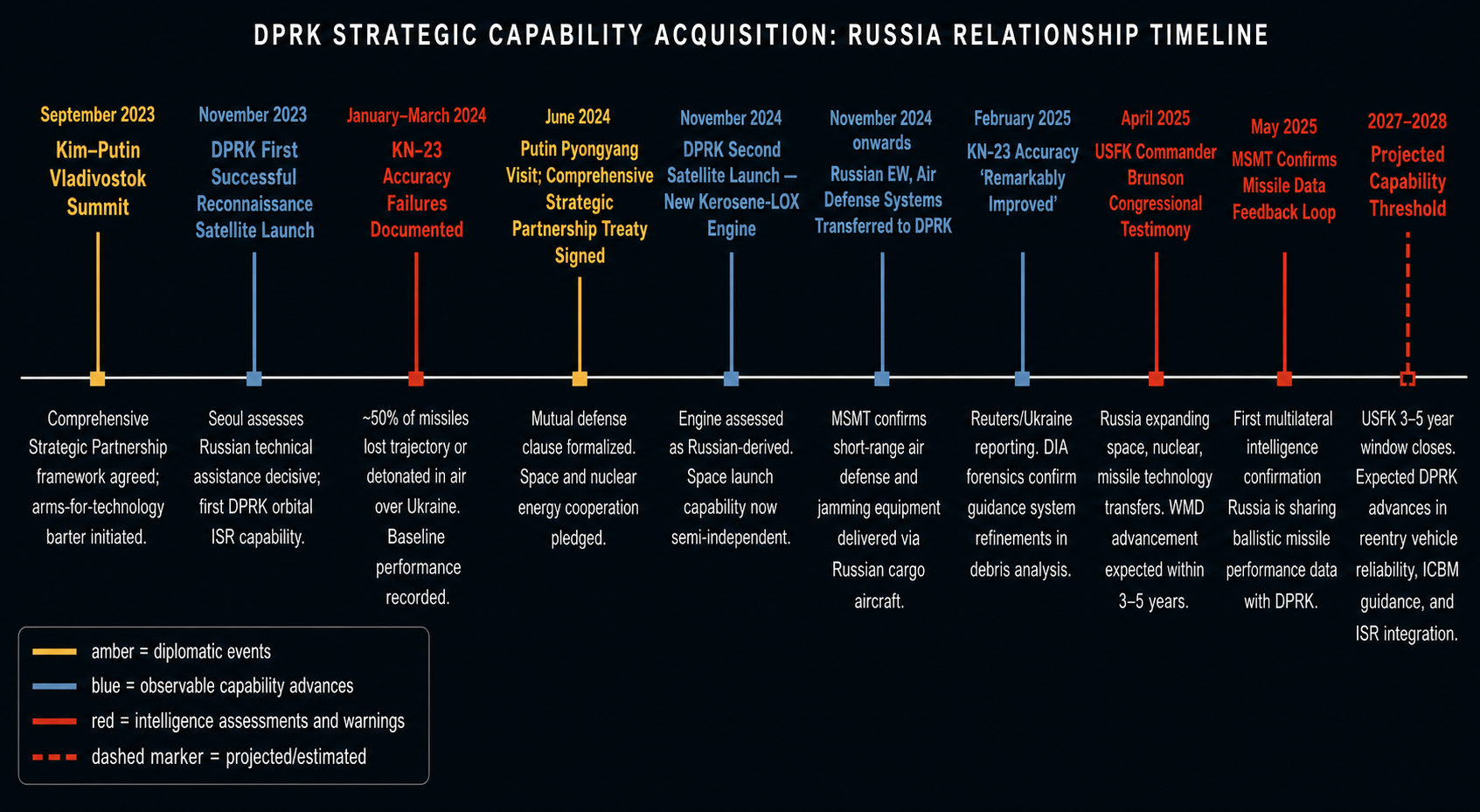
- According to Ukrainian authorities, DPRK KN-23 missiles transferred to Russia early on had failure rates of ~50%. According Anatolii Khrapchynskyi, Deputy Director General of a company specializing in electronic warfare and 38North analysis, the DPRK KN-23s transferred in 2025 showed remarkably improved accuracy, reflecting not just feedback integration, but a deep change in defense technology produced and shipped by the DPRK. [source, source]
KJ-2. Russia has likely provided DPRK with a functioning and lucrative alternative financial architecture that partially insulates Pyongyang from Western sanctions for the foreseeable future.
- According to data by the Korea Institute for Defence Analyses (KIDA), DPRK arms transfers to Russia generated about $20 billion in revenue from the period of August 2023 – March 2025. Technology transfers account for an estimated $630 million, while providing military personnel accounts for $280 million. [source]
- The Central Bank of Russia orchestrated a scheme routing funds through MRB Bank in Russian-occupied South Ossetia to establish covert correspondent accounts for DPRK’s Foreign Trade Bank and Korea Kwangson Banking Corporation (KKBC). Fuel exports are explicitly paid for through these accounts, confirming an institutional state-level payment design. [source, source, source]
- According to Organized Crime and Corruption Reporting Project (OCCRP) research, Promsvyazbank (a Russian state defense bank) issued approximately 1 billion rubles in loans to a front fuel trading company called Southern Railway Expedition (SRE) in 2024. SRE routed these payments to the Toplivno-Bunkernaya Kompaniya (TBK) (a shipping company in the Far East), matching precisely North Korean tanker arrivals at TBK terminals. At the same time, SRE reported exponential revenue gains after 2022. This indicates Russian MoD financial infrastructure is directly embedded in the oil-for-arms exchange regime between the DPRK and Russia. [source]
- The Russian Financial Corporation Bank JSC (RFC) (which is already a US-designated sanctioned entity) established Stroytreyd LLC in 2023, specifically to receive and repatriate frozen DPRK assets held in defunct Russian banks. This is effectively a one-time capital transfer that unlocked previously immobilized reserves for Pyongyang. [source]
- Russia’s March 2024 veto of the UN Panel of Experts and the subsequent open operation of sanctioned DPRK tankers in Chinese waters confirms that the evasion architecture now operates with impunity. [source]
KJ-3. DPRK has acquired militarily significant technology through the Russia relationship that will likely advance its strategic weapons programs within the next five years, with satellite and missile guidance improvements already visible.
- The Multilateral Sanctions Monitoring Team (MSMT) in May 2025 explicitly stated Russia “provided data feedback on ballistic missiles, leading to improvements in missile guidance performance.” This is the first multilateral intelligence-backed confirmation that Russian operational use of KN-23/24 in Ukraine has produced a direct technical feedback loop to Pyongyang’s weapons engineers. [source]
- The MSMT additionally confirmed transfer of Russian short-range air defense systems and advanced EW/jamming equipment via Russian cargo aircraft into DPRK. These are capabilities that directly complicate US and ROK strike planning against DPRK nuclear and missile infrastructure. [source, source]
- USFK Commander General Brunson testified in April 2025, that Russia is “expanding sharing of space, nuclear, and missile-applicable technology, expertise, and materials” and that this cooperation “will enable advancements of DPRK’s WMD program across the next three to five years.” [source]
- Seoul assesses DPRK’s November 2023 reconnaissance satellite launch as directly enabled by Russian technical assistance. The May 2024 follow-on launch used a new kerosene-LOX engine assessed as Russian-derived, indicating space launch technology transfer is already at least somewhat operational. [source, source, source]
KJ-4. The Russia relationship has likely shifted DPRK’s conventional warfighting posture from a mass-assault doctrine to a nascent combined-arms model, improving the Korean People’s Army’s effectiveness on the Korean Peninsula on a timeline of 2–4 years.
- KPA forces deployed to Kursk suffered ~40% casualties within three months. Units were then withdrawn, retrained, and redeployed with updated doctrine incorporating drone countermeasures, small-unit networked operations, and offensive UAV integration. [source, source]
- Ukraine’s Defense Intelligence assessed that as of February 2026 the KPA was one of only three armies globally with practical full-scale unmanned warfare experience. This is a capability that is directly transferable to the Korean Peninsula operational environment. [source]
- RUSI data published in April 2026 confirmed that the KPA is institutionalizing Kursk lessons. This is done through new training incorporating incident footage. Writing of new training manuals for KPA training outside of Russian expeditionary forces and Storm Corps is another way of integration. [source, source]
- Russia has provided DPRK with new Choe Hyon-class destroyer-enabling weapon technology. According to INDOPACOM Commander Paparo statements in April 2025, submarine design assistance, and AI-enhanced drone systems is also part of Russia’s offers to the DPRK. This suggests the conventional modernization extends beyond infantry doctrine into naval and air domains. [source, source, source, source]
Statement on Analysis
We have moderate to high confidence in our analysis. The first two judgments utilize strong converging streams of evidence from commercial satellite imagery, OCCRP financial records and official Ukrainian intelligence assessments along with debris analysis from battlefield-used munitions in Ukraine.
On the other hand, while the two last judgments are similarly well-supported, there are several gaps that open source intelligence cannot close. Firstly gaps exist regarding the extent of doctrinal integration in the KPA and secondly regarding the level of technological advances within DPRKs strategic weapons program. Two main assumptions support our analysis. 1) Ukrainian battlefield reporting on DPRK munitions performance is broadly reliable despite source bias. 2) observed capability improvements are primarily Russian-assisted rather than indigenously developed. Developments that would change the analysis include resumed large-scale transfers from new production confirming KJ1’s industrial transition argument. A Ukrainian ceasefire severing the operational feedback loop central to the Russian-DPRK relationship would also affect the analysis.