
1.0 Introduction
NATO now has a name for it. It’s cognitive warfare. Formalized in 2025 doctrine after input from more than twenty member states, it describes synchronized efforts to shape attitudes and decision-making across an adversary’s population. Watch the news for a week and you’ll see it practiced: Russian disinformation networks working European elections, Chinese influence operations courting diaspora communities, Iranian-linked accounts stoking unrest from the Gulf to Gaza. The vocabulary is new. The craft is not.
Most countries have three services; Britain used to have four. The Political Warfare Executive (PWE) spent 1941 to 1945 lying for a living. Fake German radio hosts, forged ration books, counterfeit horoscopes, and rumours were sent travelling anywhere between Stockholm to Istanbul with singular purpose.
None of the glory or the blame went to the PWE. Its official history sat suppressed for over fifty years. Even now, most people will talk about the Special Operations Executive (SOE), or the MI6, or Bletchley but rarely will they know who ran the longest sustained psychological warfare campaign of the modern era.
That silence is our story here. Political warfare; the bending of enemy morale and enemy minds without firing a shot. This type of warfare never sat comfortably with British self-regard. PWE’s own staff seemed faintly embarrassed by what they did. But they did it well. This article sets out what PWE was, how it worked, the Whitehall knife-fights that ate more hours than the war itself, and why the department that mastered deception disappeared the moment the truth stopped being useful.
2.0 History and Symbol
2.1 Early History
PWE had ancestors. In 1918 the Department of Enemy Propaganda at Crewe House, under Lord Northcliffe, pioneered leaflet drops and loudspeaker surrender appeals against the Central Powers. This was genuinely effective work that the government closed within months of the Armistice, on the assumption that propaganda belonged to a war which none planned to repeat.
Sir Campbell Stuart was recalled at the 1938 Munich crisis and installed at Electra House (hence “Department EH.”) MI6’s Section D also started its own subversion schemes. The BBC expanded foreign broadcasting, and a Ministry of Information was drawn up on the side. By the time war broke out, five separate bodies focused on influence operations existed, but there was no coordination between them.
2.2 Early Changes and Consolidation
The July 1940 creation of the SOE was meant to fix this. Subversion and sabotage were to be placed under one minister, propaganda folded into SOE’s SO1 branch, and sabotage into SO2. But nothing was really fixed. SO1 and SO2 fought each other for money and turf, and SO1’s feud with the Ministry of Information ran on regardless. Whitehall built another compromise. This was the PWE and it was announced to the Commons on 11 September 1941.
The new arrangement detached SO1 from SOE and fused it with the BBC’s European services and the Foreign Publicity Department of the Ministry of Information. They were operating under Foreign Office cover as the Political Intelligence Department (PID) which was the name PWE used whenever it needed to appear in public at all. This was because the Executive itself was never openly acknowledged. Woburn Abbey in Bedfordshire became its main base, with a London office eventually established at the BBC’s Bush House by the end of 1942.
From there PWE tracked the war. From February 1944 the department also took on a second mission. They were training the political warfare officers who would staff the liberation and occupation of Western Europe, a task large enough to reshape its own training pipeline. After D-Day, most of PWE’s overt staff transferred to Psychological Warfare Division (PWD)/SHAEF, leaving the rump to run black* propaganda. From late 1944, PWE staff would also re-educate German prisoners. Germany surrendered in May 1945. Almost immediately PWE’s reason to exist was gone. The department was wound up within months. Its files were split between the Foreign Office Research Department and locked storage, where it sat for thirty years.
*”Black” propaganda is usually defined as influence material made to look like it is coming from another source. “Grey” propaganda is influence material that obscures attribution. “White” propaganda is influence material coming from a true, identified source (like Voice of America, Radio Free Europe, etc.)
2.3 Patch
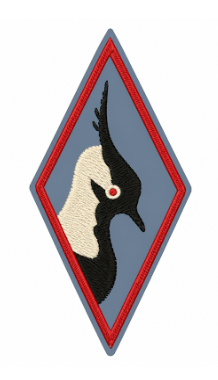
The Peepwit, a pun on the Political Warfare Executive’s initials. [Digitized by Grey Dynamics]
[source]
3.0 Organisation
3.1 Place Within the British War Machine
The PWE was launched under a “triumvirate.” These were the Foreign Secretary Anthony Eden, Minister of Information Brendan Bracken, and Minister of Economic Warfare Hugh Dalton (later replaced by Roundell Palmer, 3rd Earl of Selborne, when Dalton moved to the Board of Trade). Nominally they were overseen by an Executive Committee chaired by Sir Robert Bruce Lockhart. Lockhart was a diplomat-turned-journalist who had already run one improbable career as Britain’s secret man in Bolshevik Moscow. Three ministers proved two too many.
Dalton and Bracken barely spoke, and the Ministerial Committee ran, in Bruce Lockhart’s phrase, “out of gear.” A parliamentary mauling in February 1942 forced Dalton out. From 20 March 1942, the PWE answered to two ministers instead of three. The Executive Committee was scrapped, and Bruce Lockhart became Director-General outright. This was a job he held for the rest of the war. In terms of positioning, the PWE as an organization needed SOE to deliver its black material, the BBC for broadcasting infrastructure, MI6 for intelligence, and the Foreign Office for political cover.
3.2 Financing
PWE operated on Foreign Office and Treasury funds through the wartime secret vote mechanism used across Britain’s clandestine departments. Unlike SOE, whose wartime expenditure has been reconstructed in some detail by historians, PWE’s specific budget figures were not preserved or released in such detail. What survives instead is just evidence of scale of operation and therefore of cost. Examples include leaflet print runs in the hundreds of millions, a training pipeline turning out hundreds of officers, and a 500-kilowatt transmitter. These imply substantial budgeting needs and costs, but give no specific numbers.
3.3 Key Figures
Sir Robert Bruce Lockhart — Director-General from 1942, former diplomat and intelligence officer, chaired the Executive Committee before consolidating authority in his own hands.
Sefton Delmer — ran the Special Operations Directorate’s black propaganda work from Woburn Abbey and Milton Bryan, the presiding voice behind Gustav Siegfried Eins and Soldatensender Calais.
Richard Crossman — headed the German and Austrian directorate’s propaganda before moving to PWD/SHAEF; later a Labour cabinet minister.
Rex Leeper — instrumental in setting up SO1 before PWE existed, later British Ambassador to Greece.
Sir Ivone Kirkpatrick — former Berlin diplomat and Rudolf Hess interrogator, controlled the BBC’s European Service.
Lieutenant Colonel R.L. Sedgwick — commandant of the PWE Training School from January 1943, delivered more than half its lecture programme himself and coined the department’s “Fourth Fighting Arm” framing.
Ellic Howe — typography specialist behind PWE’s forged German documents and ration books.
David Garnett — novelist commissioned to write PWE’s official history, suppressed for over fifty years.
3.3 Recruitment
PWE recruited through personal and professional networks, direct approaches to universities, and its own dedicated Training School. The latter was initially run out of Woburn Abbey and, from December 1943, at purpose-built facilities in Brondesbury, northwest London. Courses ran roughly three weeks, packing in over sixty lectures at around four hours a day. Two days off a week were absorbed by reading and practical broadcast exercises. Instructors were deliberately sought from the fighting services rather than academia, on the theory that practical experience mattered more than theory. However, university men ended up teaching regardless.
Requirements for recruitment varied. Above all, cultural and linguistic fluency in a target country pushed PWE toward heavy reliance on refugees from Nazi-occupied Europe as instructors and staff. PWE’s dependence on continental refugees for area expertise made it, in practice, one of the more internationally staffed secret departments of the war. That internationalism deepened further from February 1944, when PWE began training officers for the Allied Military Government for Occupied Territories (AMGOT) alongside its British intake.
4.0 Tactical-Operational Information
The PWE’s operational logic ran on both borrowed and counterfeit identities and acknowledged ones. Its black stations invented personas like Gustav Siegfried Eins, a snarling fictional SS loyalist. Soldatensender Calais was dressed head to toe as an authentic Wehrmacht broadcaster. Nachrichten für die Truppe was a forged front-line newspaper wearing the masthead of a real German publication. Its printed output counterfeited official German symbols liike ration-book stamps, watermarks, astrological iconography directly.
4.1 Operations
PWE ran distinct campaigns theatre by theatre. Each was tailored to local conditions:
Madagascar (Operation Ironclad / Streamline Jane, 1942)
PWE’s first real seat at the planning table for a major operation. The department vetoed the use of Free French and South African troops on political grounds. They prepared leaflets and press directives before the assault, and rushed material onto the ground fast enough to blunt Vichy’s counter-propaganda before it could take hold. The department’s own official historian later called the result “surprisingly satisfactory,” and it became the case study PWE pointed to for how fast political warfare had to move to matter.
North Africa (Operation Torch, November 1942)
PWE’s largest leaflet operation to date: over 22 million leaflets dropped on France in four days, out of 25 million prepared, alongside proclamations and messages from Roosevelt and Eisenhower. PWE operated in a “handmaid” role to the American OWI, responsible for printing but with little control over content.
Tunisia (early 1943)
Front-line propaganda here was essentially a one-man show. A single British intelligence officer, working without a directive, wrote his own leaflets. He ran his own POW interrogations for material, and discovered that leaflet shells fired directly onto enemy positions outperformed air-dropped leaflets scattered by wind. After dropping 10,000 leaflets on one Austrian regiment, seven deserters crossed the lines within five days. By April 1943, 85 percent of enemy prisoners had read PWE material. Head office was unimpressed regardless, and his methods were never adopted more widely.
Sicily and Italy (Operations Husky and Avalanche, 1943)
This was a carefully timed two-stage campaign. A hard line before the landings (no promises, just the certainty of defeat), softening into appeals to Italians as a liberated people rather than a conquered one once the invasion was underway. Eisenhower wanted the switch made earlier for tactical effect. The Foreign Office won the argument for holding the line, worried about running out of road before the actual assault. Roughly half the Sicilian civilian population is recorded as having read PWE leaflets during the landings. The department claimed a hand in the Fascist Grand Council’s vote against Mussolini later that summer.
The Dodecanese
A smaller, harder campaign run under the same broad political-warfare principles as Italy. It was folded into PWE’s own later teaching material as a case study in coordinating propaganda across a fragmented, multi-island front.
The Transport Sabotage Campaign (1942–43)
Not radio or leaflets but instruction: a sustained “go-slow” and sabotage campaign against occupied Europe’s railways and waterways. It was credited with roughly 1,400 rail incidents and 40 major waterway disruptions across a single autumn.
The Leaflet War on Germany
Scaled dramatically across the war. Royal Airforce leaflet drops on Germany rose from 47 million in 1940 to 253 million in 1943, before American aircraft took over an increasing share. A parallel campaign into the Balkans, flown out of newly captured Bari, dropped 982 million leaflets in nine months.
Deception Support (Operation Cockade, 1943)
PWE and SOE were tasked with using propaganda to reinforce a feint invasion of France, intended to draw German attention and cover for the real buildup elsewhere. French reaction to the underlying deception ran hostile enough that PWE ultimately pulled back from its planned messaging. This was a rare case of the department choosing silence over signal.
Overlord and the run-up to D-Day (1944)
PWE’s largest and most technically ambitious campaign. Soldatensender Calais was a secret British black propaganda radio station during World War II and instrumental here. It was extended and from November 1943, run off the newly available Aspidistra transmitter. Nachrichten für die Truppe, an airborne forged newspaper, was dropped nightly to German forces in northern France from 25 April 1944 by the US Air Force. Two days before the landings, field commanders requested last-minute surrender leaflets for the German defenders. PWE had anticipated the request and had them ready. On D-Day itself, a new broadcast series, The Voice of SHAEF, gave the Supreme Allied Commander a direct channel to occupied civilians for the first time.
Allied Military Government of Occupied Territories (AMGOT) and post-Overlord training
PWE’s largest single institutional undertaking, training political warfare officers from February 1944 for the invasion, liberation, and eventual occupation of Western Europe.
4.2 Core Purpose
The PWE’s aim was to damage enemy morale, sustain the morale of occupied and allied populations, and achieve the “ideological disarming” of Germany. That purpose broadened as the war went on. Lectures on the Low Countries, Norway, and France reveal a second objective. This was to position Britain as the dominant post-war trading and political partner in liberated Europe, not merely as its liberator. Total war had made every civilian a legitimate target of persuasion. The PWE’s core purpose evolved from winning the war to shaping the peace that would follow it.
[source]
4.3 Tactics
PWE’s tradecraft rested on a split. Strategic propaganda included building belief over time. It was aimed at getting an audience to draw the desired conclusion on its own. An example of this is the Soldatensender Calais. On the other hand, tactical propaganda was conducted through narrower, and faster material. It was designed to trigger a specific, immediate action once the ground had been prepared. The Madagascar operation is a good example of this type of tactical tradecraft. Trainees were taught accordingly. Strategic propagandists worked safely, with better intelligence and time to refine a message. But, they never knew for certain who they had reached. Tactical propagandists worked close to the target with immediate feedback, but on thinner, less reliable intelligence.
The black radio doctrine ran on a similar logic of embedded credibility. Genuine music, sport, and accurate war news, interspersed with morale-sapping rumour designed to feel like an insider’s leak rather than a broadcast lecture. A convincing station gave a caught listener a plausible excuse. At the more unsettling end of the toolkit, PWE impersonated dead German soldiers, sending their families food parcels carrying pacifist messages as though from beyond the grave.
5.0 Conclusion
Victory in Europe changed the PWE. By January 1948, the Foreign Office under Ernest Bevin had stood up the Information Research Department to fight the Cold War with the same weapons. It was staffed heavily by PWE alumni. The IRD’s first director, Ralph Murray, had run PWE’s Balkans desk. IRD grew to several hundred strong at its peak before the press caught up with it and it closed in 1977. The PWE, in other words, never really died. It was scattered, parts of it absorbed by other entities, and changed beyond recognition.
The strategic-versus-tactical propaganda split that PWE drilled into its trainees at Brondesbury trails onto today’s division between long-running narrative-shaping information campaigns and the short, fast, tactical messaging that floods a single news cycle. From Gulf War leaflets to Kosovo, Afghanistan, and Iraq, to the present argument over social media disinformation and state-linked “troll farms,” the toolkit persists even as the technology behind it changes.