
1.0 Introduction
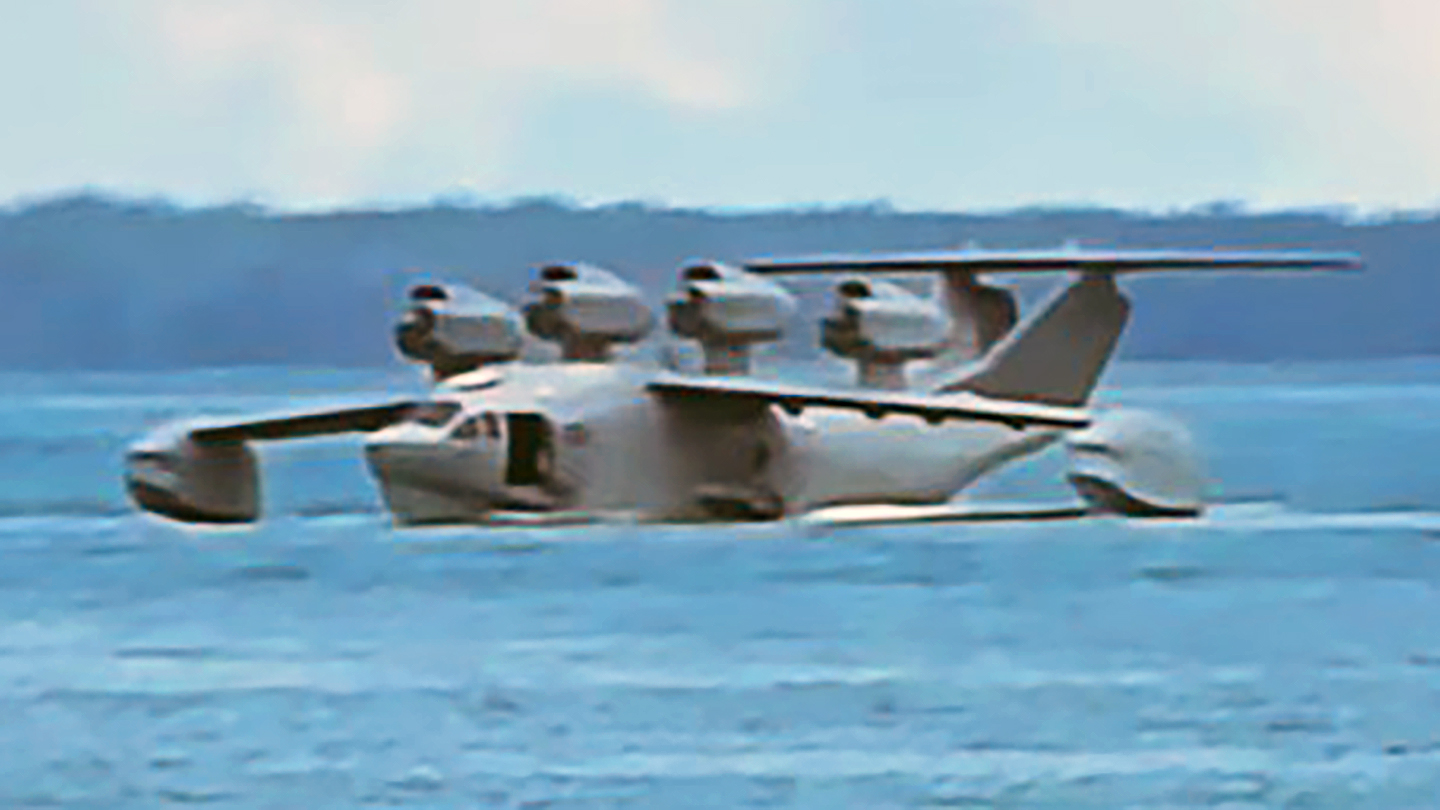
Late June 2025 fully revealed the emergence and face of a new and mysterious Chinese vessel, dubbed the “Bohai Monster.” This appears to be an ekranoplan. Observers originally spotted it with its nose section obscured, sitting on a pier on the Bohai Sea. In July an image revealing the full ekranoplan surfaced in the media.
This technology is highly important for military operations in the Western Pacific and South China Sea. Such technology is not really adopted by global navies currently but was an object of experimentation for the Soviets. Nevertheless, the US has indicated interest by developing its own ekranoplan designs since 2023.
Its theoretical application in logistical support across the vast maritime expanses of the Pacific could be a significant boon to the PLAN and any other force operating therein. This is in line with Chinese interests and developments on naval warfare technology as highlighted in the September 2025 military parade in Beijing. The PLA’s focus on naval arms and technology developments from surface and underwater warfare to logistics and naval aviation capabilities is evident. This project suggests the extent of Chinese innovation and focus on Western Pacific warfare operations.
1.1 What is an Ekranoplan?
An ekranoplan is classified as a wing-in-ground-effect vessel (WIGE) or a ground-effect vehicle (GEV). It is in essence a glider, usually over water, but that can sometimes function over plains. In this case, the Bohai Monster is clearly a WIGE vessel meant to function over water.
According to the International Maritime Organization (IMO), the Soviet Union developed the first ekranoplan. Known as the Lun-class ekranoplan, it—and other platforms like it—are classified as maritime vessels. This is due to the ekranoplans gliding and operating just above the surface of the water.
1.2 What does Bohai look like?
1.3 Development and History of the Ekranoplan
The ekranoplan idea began in the Soviet Union during the Cold War. Engineers pursued WIG vehicles that fly a few meters above water to gain huge lift and speed while remaining hard to detect. The best-known experimental prototype was the KM or “Caspian Sea Monster” of the 1960s. That work later produced the Lun-class operational craft in the 1980s. Both demonstrated the promise and the practical limits of large ground-effect ships.
Interest in WIG/ekranoplan concepts revived this decade. In 2025 Chinese images showed the Bohai Monster prototype, reigniting comparisons to Soviet designs and prompting close attention from analysts about possible military roles. This is signaling Beijing’s renewed experimental push into the concept and the expansion of innovation in naval warfare concepts and technology.
Meanwhile the U.S. moved from concept to funded design activity earlier. DARPA launched the Liberty Lifter effort in 2022. In 2023 DARPA awarded Phase-1 contracts to competing teams as it sought a heavy-lift seaplane/X-plane that could exploit ground effect for long-range logistics. Nevertheless, they cancelled the project in 2025.
2.0 China’s Ekranoplan
2.1 Potential PLAN Role
The Bohai Monster offers the PLAN a high-speed, low-altitude transport and logistic option along its coast and among its island holdings. Because of its wing-in-ground effect (WIG) design, it can fly just above the surface of water. This significantly reduces drag, increases lift, and enables greater efficiency than ships. At the same it keeps under or near the radar horizon, making it harder to detect.
Its structure—with four engines mounted above the wings, wingtip floats (sponsons), a stepped flying-boat hull, and joined V-tail—suggests that China is shaping it for missions like rapid resupply, logistics to remote or island garrisons, personnel transport, potentially even search & rescue or downed-aircrew recovery, especially within the South China Sea, Taiwan Strait, and other littoral zones.
However, there are also significant constraints and tactical trade-offs. Sea state (it needs relatively calm waters), weather, and vulnerability in contested environments kranoplan’s will likely limit the ekranoplan’s utility. Its low-altitude flight delivers stealth against naval radars to some extent, but it remains at risk from shore-based sensors. This is especially true close to coasts or islands, and from anti-air and anti-ship threats.
Also, a lack of certain capabilities, such as the ability to beach or disembark directly onto a shore, may limit flexibility in amphibious operations. This means that although useful for rapid movement in certain zones, it may not replace more versatile assets. Scaling up from prototype or demonstrator to operational fleet size could also prove costly and technically challenging.
2.2 Pacific Theater & Operational Compatibility
In the wider Pacific theater, the Bohai Monster could complement the PLAN’s push for rapid regional mobility. Its use could be most pronounced across the South China Sea and first island chain. Its ability to move troops or supplies quickly between bases or artificial islands could reinforce China’s anti-access/area-denial (A2/AD) posture. This could also enhance amphibious operations against adversaries in complex naval environments and terrains, such as Japan’s southern island territories, or the Philippine archipelago.
Yet, its operational compatibility in a contested Pacific environment is questionable: U.S. and allied surveillance networks, long-range precision weapons, and sea-control assets would likely expose the ekranoplan’s vulnerabilities. Thus, while it may bolster China’s regional logistics and gray-zone presence, its role in high-end conflict would remain constrained.
3.0 Comparative Designs
3.1 Liberty Lifter
The Liberty Lifter was a DARPA initiative begun in mid-2022 with the goal of creating a WIG hybrid that could take off and land from water, handle relatively rough seas, and fly close to the ocean surface but also climb to altitudes up to about 10,000 ft when needed. Designs were solicited from two teams (General Atomics + Maritime Applied Physics, and Aurora Flight Sciences + partners) with the aim of achieving the lift capacity of large airlifters and long endurance over water.
However, by June 2025, DARPA formally concluded the Liberty Lifter program. No full-scale prototype will be built under DARPA’s auspices. The agency claims the technical and simulation work showed the concept is viable. Now the idea is to transition the learned technologies to other industry or military platforms rather than continuing as a DARPA demonstrator.
3.2 Russian Plans?
Russia continues to explore ekranoplan or ground-effect vehicle (GEV) concepts. However many of them are at the design or prototype stage rather than full operational fielding. One example is the A-050, being developed by the Central Hydrofoil Design Bureau. The vision? A modern multipurpose ground effect vehicle with updated avionics, capable of carrying missile armaments, with a takeoff weight in the tens of tons and a cruising speed on the order of 250-300 km/h with extended range.
Another is the A-300-538, a proposed double-decker ekranoplan project, which would have a very large takeoff weight (~350 metric tons), carry payload of around 64 metric tons or up to ~550 passengers, with a range of some 3,000 km. There are also past projects like “Chaika” (Seagull). These aim at passenger/cargo transport roles, though their status is less clear. Many seem to be stalled or only partially developed.
[source]
4.0 Conclusion
The Bohai Monster highlights China’s growing naval innovation and ambition. Its operational value lies mainly in regional logistics and gray-zone operations. Yet vulnerabilities and environmental limits constrain its role in high-end conflict. Ekranoplans remain experimental, but their reemergence signals evolving maritime competition. This competition seems to be zeroed in on the Pacific, as the next great theater of potential large-scale operations, and thus the next great theater of technological innovation.