
The Estonian Internal Security Service, also known as KAPO (Kaitsepolitsei – Kaitsepolitseiamet), is the internal national security service of Estonia. Operating under the authority of the Estonian Ministry of Internal Affairs, KAPO’s primary responsibilities involve the protection of Estonia’s internal security against a variety of threats. With its origins under the pre-WW2 and pre-Estonian SSR, it has a long history of internal security operations and continues to monitor threats to the stability of the Estonian state.
Images Sourced From: Postimmees, Warsaw Institute,
1 History and Symbols of KAPO
1.1 Early History of the Estonian Security Police (1918-1941)
1.1.1 Formation of the Security Police (1918-1920)
On 24 February 1918, the Republic of Estonia, under the Salvation Committee of the Estonian National Council, declared independence from the Russian Empire. Immediately after this declaration, the German Empire occupied Estonia for nine months. Under this occupation, the Estonian police were established on 12 November 1918.
However, this was short-lived as the Soviet Red Army invaded on 28 November, and the outbreak of the Estonian War of Independence put a halt to the reconstruction efforts. During the conflict, the investigation of political crimes as well as intelligence and counterintelligence duties, were placed under the Military Information Collection Department of the General Staff Government.
In July 1919, the Government of the Republic of Estonia initiated a project to create a law enforcement agency to deal with crimes against the state. This was to be the Security Police.
1.1.2 Security Police (1920-1930)
The Security Police (Kaitsepolitsei) and additionally, its activities, were legalised through the Order of the Security Police of the Republic of Estonia, signed by the Prime Minister Jaan Tõnisson and the Minister of the Interior Aleksander Hellat on 12 April 1920. However, the Security Police did not begin its actual work until 1 May 1920, when its HQ in Tallinn opened.
In 1924, when the police agencies were merged to strengthen general law enforcement capabilities, the Security Police was assigned as a completely separate department under the Police HQ, where it remained until 1940.
From 1925, the Security Police was called the Political Police, and it developed coordination and cooperation with the criminal police, other state agencies of Estonia and foreign services, namely those of England and Finland.
The communist movement in Estonia was the main focus of the Political Police. This is due to the massive amounts of financial and human resources that the Russian Bolshevik Party and the general Comintern directed towards Estonia. As a result, hundreds of individuals who were accused of communist activities were brought before courts from 1920 to 1925.
On 1 December 1924, Estonian communists organised an armed uprising to take power. This coup failed, and 125 rebels were killed in Tallinn, and over 500 people were arrested. Following the coup, a mass trial period took place, which weakened the communist movement.
[source]
1.1.3 Security Police (1930-1935)
At the end of the mass trial period, the head of the Security/Political Police, Johan Sooman, shifted both his and his department’s focus towards preventing “political” crimes. Between 1930 and 1933, the number of people arrested on espionage charges rose rapidly, with the peak coming in 1933, when the police discovered 23 cases of espionage and imprisoned 51 suspected spies.
Although the communist threat was the main focus and prime source of discontent, right-wing extremism, including the activities of German National Socialists and Russian extremist-monarchist organisations, was also present.
Additionally, the activities of the right-wing extremist organisation, the Estonian Freedom Fighters Union (VAP), were considered a threat. This led to the VAP being shut down on 22 March 1934. At the end of 1935, the Political Police discovered VAP rebellion plans, which led to the imprisonment of the most important leaders.
[source]
Security Police Duties (1920-1940)
During the 1920-1940 period, the operational directive of the Security/Political police included countering:
- Subversive activities against the state by both organisations and individuals with left-wing extremist views
- Subversive activities against the state by both organisations and individuals with right-wing extremist views
- Foreign espionage
- Desertion
- Smuggling
- Terrorism
- Other serious crimes
[source]
1.1.4 Occupation of Estonia (1940-1941)
Following the occupation of Estonia by the Soviet Union on 17 June 1940, the Political Police were among the first organisations to be repressed by the new Soviet-backed authorities. In the first days of Soviet rule, Johan Sooman and additionally, other leaders of the Political Police were arrested and taken prisoner to Moscow or shot. The remaining employees of the political police were arrested and sent to Siberian prison camps, also known as gulags, during deportations in June 1941.
Around 90% of the former Security/Political Police officers died before the end of WW2 in which their families also suffered a similar fate.
[source]
1.2 Restoration of the Security Police (1991)
On 1 February 1991, the Estonian government issued Regulation No.24, and on 12 February, both the Estonian Security Police and the Security Police Bureau were established. The Security Police was established under the Ministry of the Interior, with the Bureau being subordinated to it.
This ‘new’ police organisation was tasked with combating organised crime and terrorism, protecting territorial integrity and state secrets, protecting scientific, technological and commercial secrets and also ensuring the safety of national cultural values, institutions and political/state figures.
[source]
1.3 State Security Police Board (1993-1997)
The State Security Police Board was brought into existence on 6 May 1993 following a resolution that was adopted by the Estonian Parliament on 21 April 1993.
In June 1993, several structural and jurisdictional resolutions were adopted by the Board and the Security Police, which defined how they would both operate under Estonian Law.
In 1995, the Security Police Board added a section to investigate crimes against humanity, and additionally, on 1 May 2001, the Board changed from a law enforcement agency to a security agency.
[source]
1.4 Coat of Arms
The coat of arms of KAPO is in the shape of a shield with a gryphon holding the national coat of arms of Estonia in its hands. The direction in which the gryphon is facing (left) is significant as it is supposed to symbolise both development and moving forward.
[source]

1.5 Flag and Motto of the Estonian Internal Security Service
The Flag of the Estonian Internal Security Service, adopted on 20 September 2000, features a blue background and additionally, the heraldic gryphon, which features in the coat of arms pictured above.

It contains the organisation’s motto:
“Virtute et constantia” – “With strength and constancy”
[source]
2 Organisation of KAPO
KAPO is led by the Director General of the Estonian Internal Security Service, who has three deputies. Subordinate units are known as departments and divisions.
2.1 Regional Departments
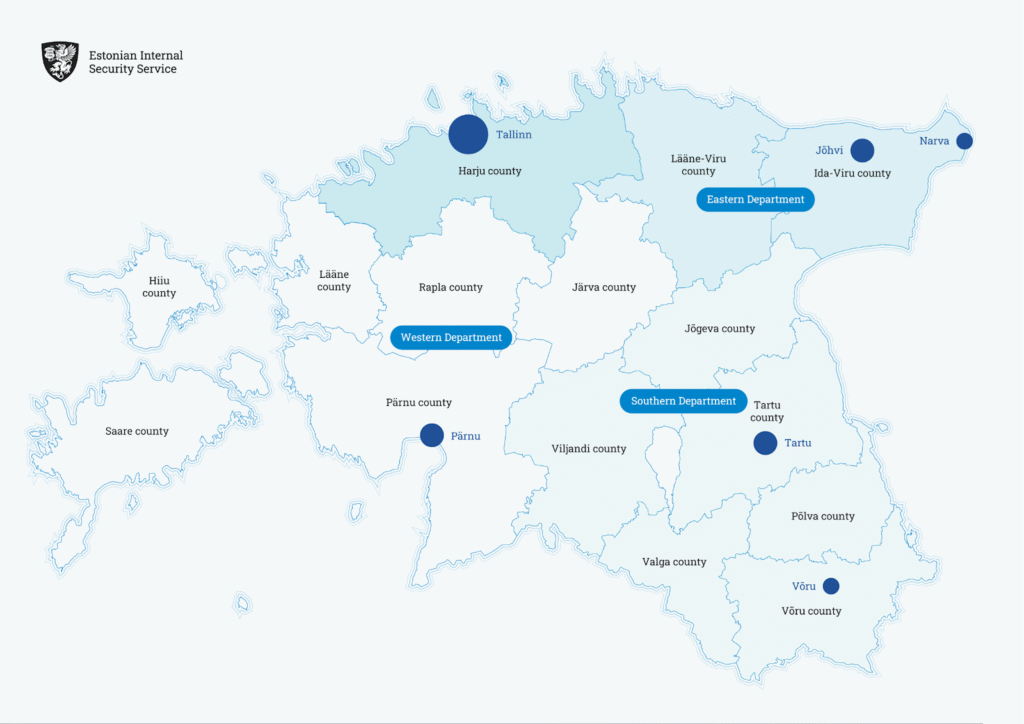
KAPO has three regional departments:
- Southern Department – Services the Valga County, Võru County, Viljandi County, Tartu County, Jõgeva County and Põlva County areas.
- Eastern Department – Services both the Lääne-Viru County and Ida-Viru County areas.
- Western Department – Services the Hiiu County, Saare County, Lääne County, Rapla County, Järva County, and Pärnu County areas.
2.2 Leaders of the Security Police and Political Police (1920-1940)
The predecessor organisation of KAPO, the Security and Political Police, had 10 leaders between 1920 and 1940. These were:
- Captain Helmut Veem – 1 May 1920-27 October 1920 – [source]
- Andres Puri – Acting Chief of the Security Police HQ – 27 October 1920-21 February 1921
- Eduard Alver – 21 February 1921-13 August 1921 – [source]
- Andres Purri – Acting Chief of the Security Police HQ – 13 August 1921-11 October 1921
- Eduard Andreas Lensin – 11 October 1921-5 January 1923 – [source]
- Johan Sooman – 5 January 1923-3 July 1924
- August Tenson – 3 July 1924-1 December 1924 – [source]
- Hugo-Johannes Möldre – 1924-1925
- Johan Sooman – 1924-1938 – [source]
- Konstantin Kirsimägi – 1938-1940 – [source]
2.3 KAPO Leaders since 1991
Following the establishment of KAPO in 1991, there have been several directors and deputy directors of the organisation:
- Jüri Pihl – Director of the Estonian Security Police – 1991-1993
- Jüri Pihl – Director General of the Estonian Security Police Board – 1993-2003
- Aldis Alus – Director General of the Estonian Security Police Board – 2003-2008
- Raivo Aeg – Director General of the Estonian Security Police Board – 2008-2013
- Aleksander Toots – Deputy Director General
- Arnold Sinisalu – Deputy Director General
- Eerik Heldna – Deputy Director General
- Arnold Sinisalu – Director General of the Estonian Security Police Board – 2013-2023
- Aleksander Toots – Deputy Director General
- Martin Arpo – Deputy Director General
- Martin Perling – Deputy Director General
- Margo Palloson – Director General of the Estonian Security Police Board – 2023-today
- Taavi Narits – Deputy Director General
- Andres Ratassepp – Deputy Director General
- Mari-Liss Tori – Deputy Director General
[source]
3 Fields of Work and the Tasks of KAPO
KAPO’s mission includes:
- Both the collection and processing of information to suppress activities aimed at changing the integrity of the state
- Collection and processing of information to suppress external intelligence activities against the state.
- Collection and processing of both intelligence and other information in order to prevent and combat terrorism
- Protection of state secrets
- Fighting against corruption
- Investigation of other offences.
[source]
3.1 Counterintelligence and Foreign Influence Activities
Due to being targeted by other foreign powers, namely Russia, one of the main activities that KAPO is engaged in is counterintelligence. The KAPO website goes into detail about how the agency is not solely focused on countering foreign agents but rather their activities regarding gaining access to sensitive data and institutions such as military bases.
[source]
3.2 Corruption
Another one of the main tasks of KAPO is the countering of corruption, especially corruption in the higher levels of local and national government.
[source]
3.3 Economic Security
Although economic security is not usually a focus of an intelligence agency, KAPO does indeed focus on it. The agency has highlighted both China and Russia as the main potential sources of economic insecurity for Estonia. This involves hidden capital, namely that which originates from Russia, which could be used to benefit a malicious entity within Estonia.
KAPO is also tasked with the enforcement of, and gathering of intelligence about, international sanctions. This includes preventing and investigating crimes linked to the violation of international sanctions against nations such as Russia.
[source]
3.4 Extremism & Terrorism
KAPO also has a counterextremism and counterterrorism mandate. Estonia considers both right-wing and left-wing extremism as national security threats.
[source]
3.5 Protection of State Secrets
Since its founding in 1991, a central task for KAPO has been the protection of state secrets.
[source]
3.6 Investigative Jurisdiction
KAPO’s investigative mandate includes:
- Crimes against humanity
- Genocide
- Crimes of aggression
- War propaganda
- Development and handling of prohibited weapons
- Failure to implement international sanctions
- Piracy
- Aircraft Hijacking
- Attacks against aviation security
- Murder (if committed with an explosive device/substance)
- Incitement of hatred, if:
- It causes the death of a person or damage to health or other serious consequences
- It is committed by a person who has previously been punished for such an act
- Embezzlement
- Breach of trust
- Violent activity directed against Estonia
- Treason
- Other Areas*
*Additionally, there are 48 other areas in which KAPO holds jurisdictional investigative powers, and the full list is available on the KAPO website.
[source]
4 Operations of and Prominent Spies Countered by KAPO
Despite a relatively recent founding, KAPO has been involved in several prominent incidents:
- Herman Simm – Herman Simm, a former chief of the Estonian Defence Ministry’s Security Department, is a convicted Russian spy and was the first agent who had been identified, tried and convicted of treason since Estonia’s independence. He had been recruited by the Russian Foreign Intelligence Service (SVR) in order to collect and forward classified Estonian and NATO information from 1995 to 2008, when he was arrested. [source]
- Viacheslav Morozov – Morozov was a professor of political science at the University of Tartu and was arrested in January 2024 under suspicion of being a Russian spy. He was both charged and convicted of this crime and sentenced to six years in prison. [source]
- Aleksei Dressen – Aleksei Dressen is a former KAPO officer who was convicted of treason for cooperating with the Russian FSB. He was arrested on 22 February 2012 at Tallinn Airport alongside his wife, who was about to board a flight to Moscow. A thumb drive full of information was seized at the scene, and Dressen was later sentenced to 16 years in prison. However, on 26 September 2015, he was handed over to Russia in exchange for Eston Kohver, another Estonian KAPO officer who had been detained in Russia in 2014. [source, source]
5 Supervision of KAPO
The activities of KAPO are supervised by the executive, judicial and legislative branches of the government of Estonia. This includes:
- Ministry of the Interior – Controls the activities of KAPO without interfering in criminal proceedings
- Prosecutor’s Office – controls the surveillance activities of KAPO in both criminal proceedings and criminal cases
- Judicial control – Surveillance operations must be approved by a court through a reasonable request from a prosecutor
- Chancellor of Justice – Ensures compliance with Estonia’s rights laws
- National Audit Office – Verifies the legality of budgetary funds used by KAPO
- Riigikogu Security Agencies Oversight Committee – conducts parliamentary oversight in accordance with the Estonian Security Agencies Act
[source]
6 Conclusion
KAPO, also known as the Estonian Internal Security Service, Kaitsepolitsei and Kaitsepolitseiamet, is the internal security and intelligence agency of Estonia. Due to the high threat level and prevalence of the activities of hostile foreign services in Estonia, KAPO is more active than ever. Although it was only recently established in 1991, it has been at the forefront of countering Russian activities in Estonia. With several jurisdictional capabilities, it is well-equipped to defend Estonia from a variety of threats.