
1.0 Introduction
On 14 January 2026, the U.S. Army unveiled the M1E3 (an experimental prototype of the future M1A3) at the Detroit Auto Show, raising questions over the future of the beloved Abrams main battle tank. It appeared in army green, a departure from desert tan, with an older M1A1 turret that peculiarly had a man-portable anti-tank Javelin launcher mounted to the Remote Weapon System (RWS). It also lacked sensors, viewing holes, and the Trophy Active Protection System (APS), which protects from anti-tank missiles and rocket-propelled grenades (RPGs) and is on the M1A2 SEPv3, the most modern, technologically advanced, and lethal variant of the U.S. Army’s main battle tank.
Despite its underwhelming appearance, the main focus of this technology demonstrator is on the crew, with much of the important changes being internal. It almost certainly is far from what the final, deployed M1A3 will look like, but it shows that tank design focus has changed from improving hardware to incorporating software.
This article explores the philosophy behind this prototype to explain why the Abrams upgrade programme has changed course and, hence, why the physical prototype seems like a step backwards. We examine the model alongside the discussion surrounding it at the show and online. Finally, we will consider other prototypes and variants—including the Abrams X, the M1A2 SEPv3, and even the M1 TTB—to illustrate what the M1A3 could look like in its final form.
2.0 Why Upgrade Abrams?
2.1 The changing battlefield
One of the biggest motivators for the M1 Abrams upgrade is the rise of guided munitions and ‘kamikaze’ drones used against them in Ukraine. 27 of the 31 U.S. supplied M1A1 Abrams tanks delivered in late 2023 were damaged, destroyed, captured, or lost in Ukraine by June 2025. Most of these were the result of the poor defence of the Abram’s roof, which was counter to most analyst’s expectations that the tanks would be a ‘game changer in the theatre’.
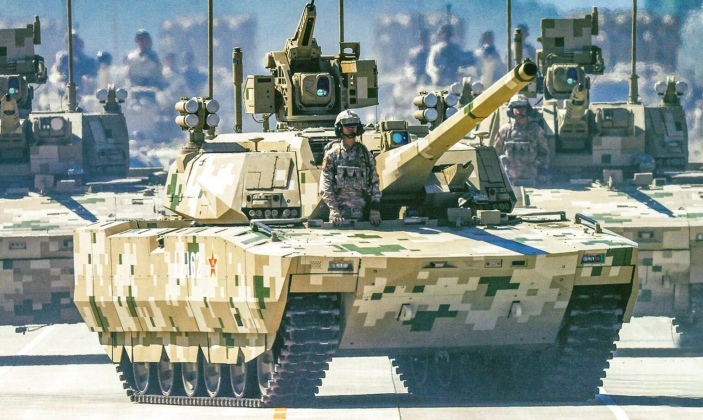
The ZTZ-100 (Type 100) main battle tank seen during the 2025 Victory Day Parade [image source]
Alongside this, some analysts argue that the unveiling of the Chinese Type 100 main battle tank on the September 3rd parade is putting pressure on the West to catch up with digital infrastructure. According to Military Watch Magazine, Western analysts believe that programmes like Abrams X and Challenger 3 will be inadequate to address recent technological developments by the time of their completion. For example, the Type 100 incorporates its sensors in a network with electronic warfare devices, artillery and planes and the crew use augmented reality interfaces to engage targets at long range. Despite the technology being nothing new, a scale up in the production of these tanks could represent a threat shift that needs to be addressed. However, at present, the M1E3 does not seem to be a direct counterpart to the Type 100, but rather a response to how Russia fights in Ukraine. The M1E3 aims to improve crew experience and incorporate software, making it easier to operate by any user. Thus, it is no surprise that the planned M1A2 SEPv4 variant was scrapped as the focus has changed to consolidating the Abrams upgrades into a new simpler platform.
2.2 Abrams for sale?
Much of the changes to the Abrams indicate a likely plan to export the platform to NATO allies. Properly integrating the SEP packages, transitioning to a non role-specific crew, and switching from JP-8 to diesel fuel are all aimed at simplifying operation and reducing the weight of the vehicle. Newer tanks like the French Leclerc and South Korean K2 offer a simpler, cheaper, and more versatile option for nations looking to purchase tanks. The same applies for the more expensive Leopard 2A7, which is also easier to operate than the Abrams. The M1E3 therefore looks to simplify logistics and align with the common tank criteria which is in demand, altogether making it a more competitive option since it is a proven platform.
2.3 No need to reinvent the wheel
In the interview with Colonel Howell, Director of Integration of CPE Ground and representative for the M1E3 prototype, one of the main points he mentions is about making the maximum returns from design elements introduced now. He explains that there is no need to change the 120mm cannon, the ammunition, the hull, and most of the protection scheme since it is still combat effective. But, as an example of the changes they are addressing, the turret pins were redesigned so the cannon and breach block can be more conveniently removed from the front, making maintenance faster and less tedious. He also does not rule out the future possibility of the XM360 cannon seen on Abrams X, but this is not the primary focus at the moment.
As such, instead of a ‘clean slate’ design, they are still using the original 1972/73 requirements set by the U.S. Army Generals which makes this vehicle inherently an Abrams. Over the years, the System Enhancement Packages (SEP) have attached additional technology to the M1A2 which have increased the weight of the vehicle substantially. Investment is better spent on accommodating new developments like drone warfare, AI, software and most importantly, to reduce the weight of the vehicle.
[source]
2.5 Why unveil the prototype now?
The main reason for the display is to demonstrate to taxpayers that a product improvement is underway. The publicity of the project also makes development easier, since prototypes and details will no longer have to be transferred in secret. Also, the location of the display is significant: the Detroit Auto Show, which typically displays classic cars, pays homage to the tank factories that used to be there and thus the families who worked with such technology. Critics argue that the prototype appears rushed, which is true in some respects and will be explored in the analysis (Section 3.0). But, this is more so the result of incorporating older parts – that are subject to change – to have a complete model to show.
[source]
3.0 Analysis of the Detroit Auto Show M1E3 Prototype:
3.1 Cockpit, Crew Stations, and Software
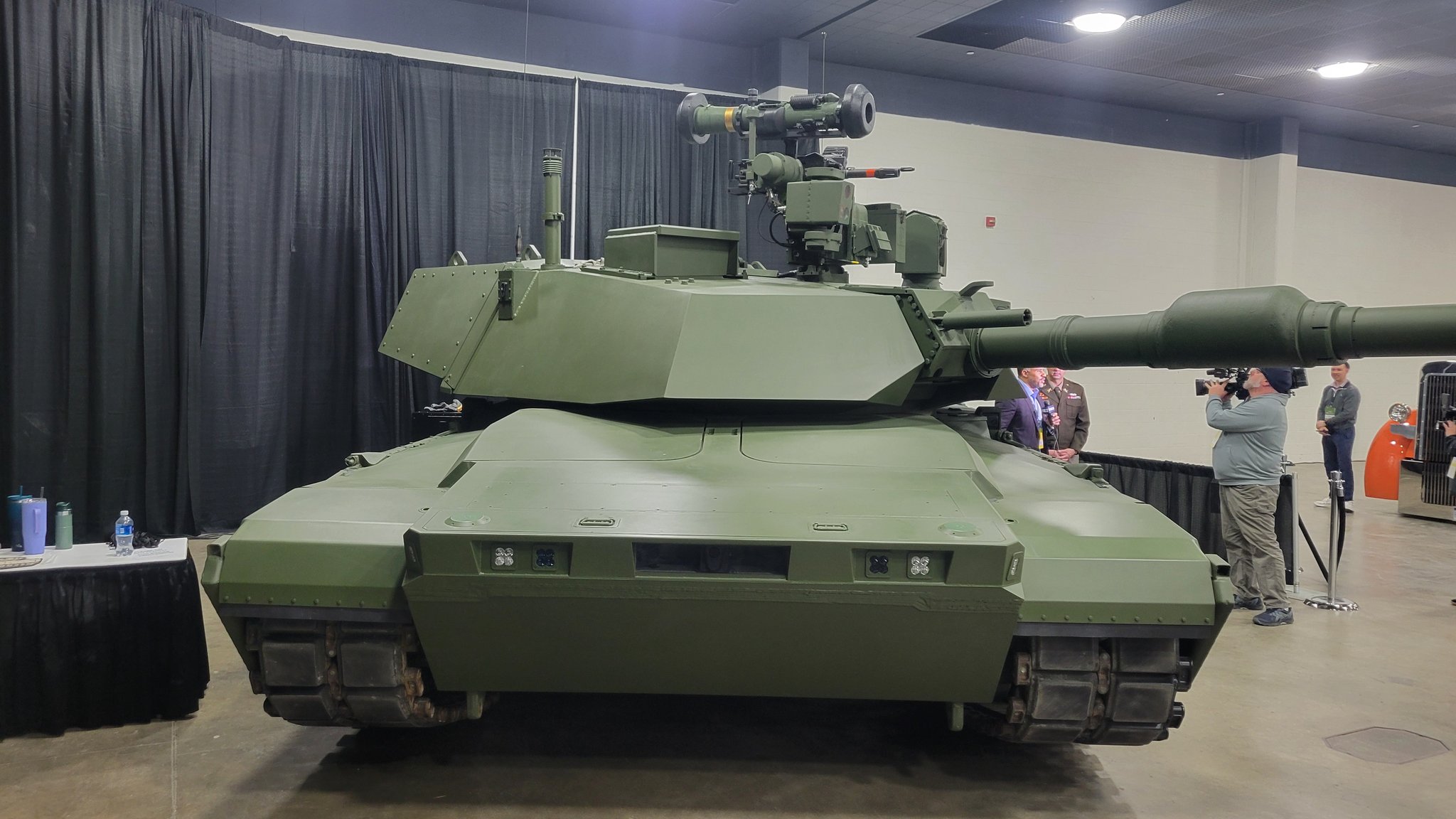
Front profile of the M1E3 prototype. [image source]
The M1 TTB set an example for an Abrams with a 3 man crew, though the technology was inadequate at the time (mainly reliability issues with the autoloader). With new technology, this is better achieved with a focus on making the tank more habitable for the crew according to Colonel Howell. This includes configurable ‘stations’, with roles to be decided by recruits; the tank is able to be operated by less crew for driving and firing. The main objective of the stations is about giving “a rich user experience to an 18 year old today that’s been playing games… War Thunder, Halo, Call of Duty… how can they take that experience [and] put that on this platform”. This includes an ‘Formula 1 style cockpit’ with a gamepad controller for steering, plus commercial software to create user interfaces similar to those seen in video games. Amenities include a 110v outlet for a laptop charger or coffee machine, and cupholders that can fit ‘big gatorade bottles’ to make the space more liveable.
The new M1E3 also makes use of the Department of Defence’s Modular Open Systems Approach (MOSA). This framework allows seamless integration of new subsystems by adopting widely used standards and ensuring that individual components can be replaced without redesigns or complete software overhauls.
[source]
3.2 Hull
All three crew are relocated within a heavily armoured compartment to avoid risking the crew at the turret position. It appears that the crew enter via two sliding hatches on the front. The armour consists of advanced composite materials that can be supplemented with modular depleted uranium panels to protect against kinetic threats. The underbody is ‘V-shaped’ to protect against mines and IEDs.
[source]
3.2 Engine and Tracks
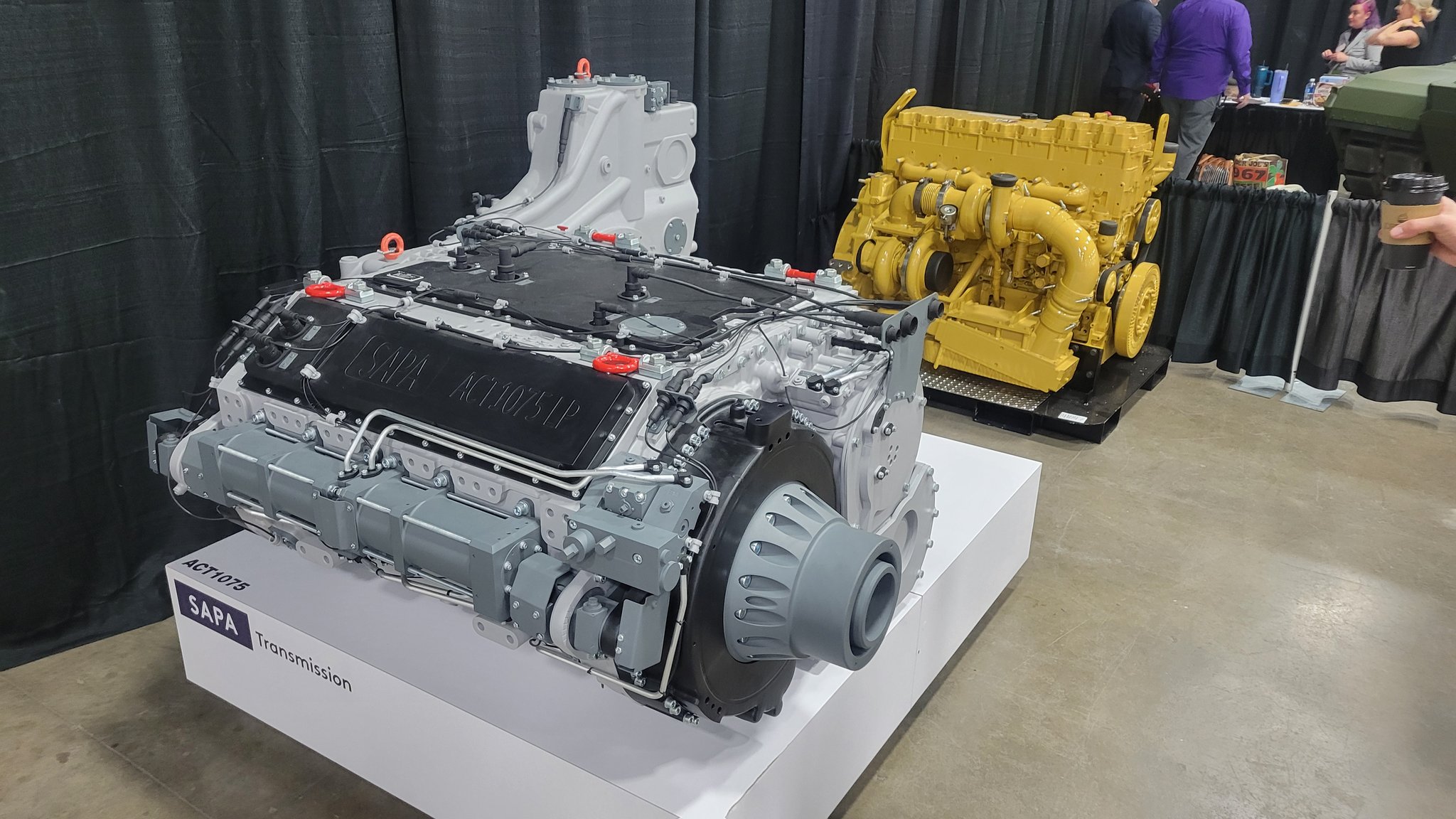
The M1E3 transmission (left) and Caterpillar C13D diesel engine (right) on display [image source]
The prototype uses the standard AGT1500 gas turbine engine, but this is expected to be replaced with a parallel hybrid diesel and electric engine. This is one of the most controversial aspects of the design change, which has advantages and disadvantages. The main concern is over the torque band efficiency, which controls the ability for the tank to quickly start moving. The gas turbine was excellent at this, but standalone diesel engines have not been successful in recent tests though the hybrid electric motor could help to achieve this.
The advantages include the fuel efficiency increase, reported to be about 40%, which is important as this is one of Abram’s biggest drawbacks compared to most other battle tanks. The electric motor provides resilience in case the diesel motor is disabled. Nicholas Moran, a.k.a ‘The Chieftain’, notes that it could also integrate with the system to offer quiet driving modes or detuning the diesel engine when idle to power electronics instead of using an Auxiliary Power Unit.
Torsion bars are replaced by external suspension units which solves a common breakage with the Abrams. This also explains why the first road wheel is now evenly spaced.
3.3 Turret and Remote Weapon System (RWS)
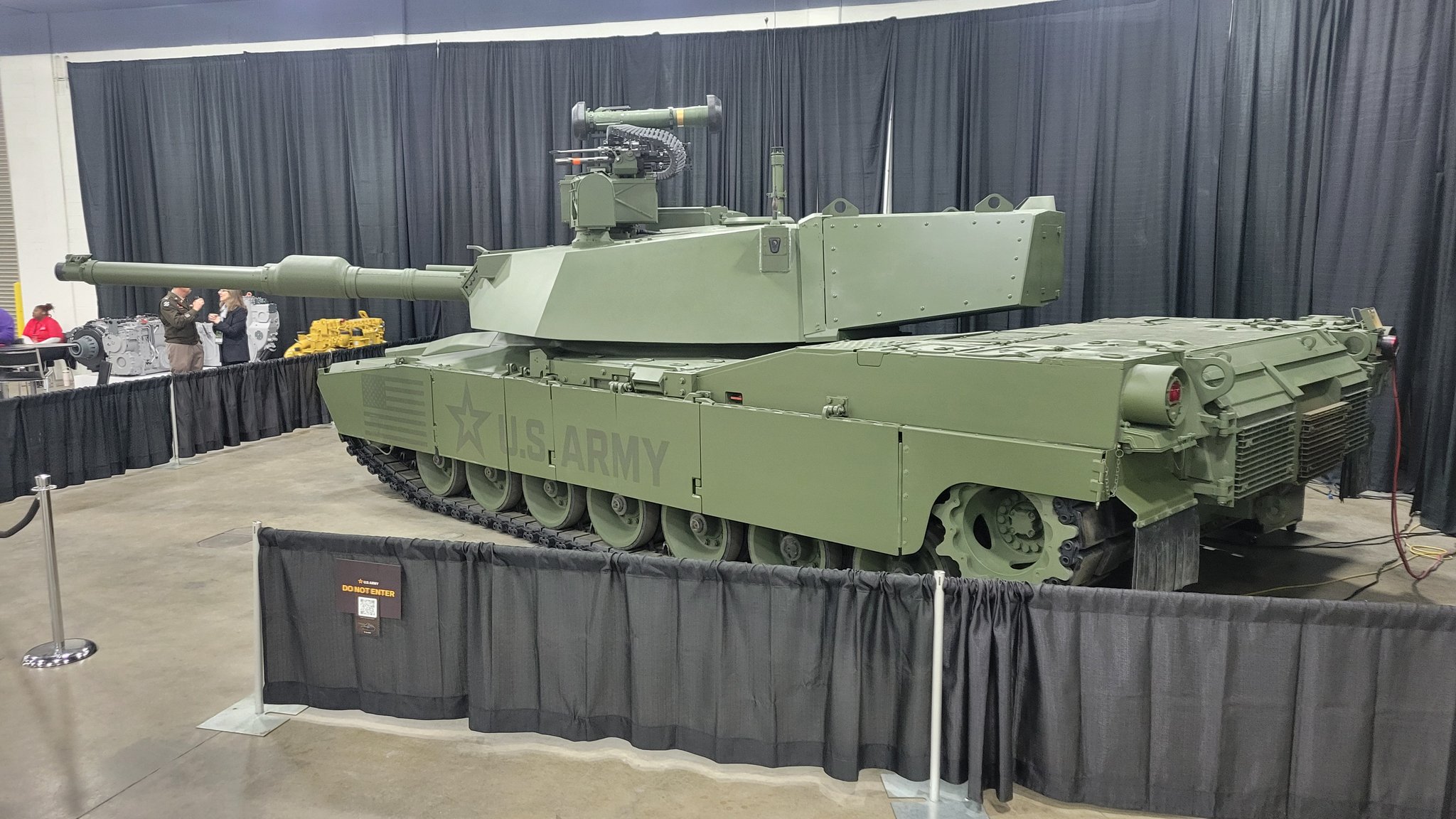
Side profile of the M1E3 prototype. [image source]
Much of the turret design indicates a transition away from open ground tank battles to engagements in more dense and complex terrain. Visually, the turret is moved forward which improves shorter range and hull down engagements. The rear hump is also lower which allows for better response to rearward threats and also slightly expands field of view. The turret has a new panel which indicates an autoloader on this prototype. There is also a fume extractor on the barrel, which is unnecessary for an autoloader, but it could be a surplus part taken for this display. It is clear that this design is likely to change; there are no active protection system (APS) sensors and kinetic interceptor launchers on this model even though they are being tested on M1A2’s in service.
According to Colonel Howell, the goal is for the crew “to operate the tank, not the turret.” The autoloading 120mm smoothbore cannon will be completely automated for target acquisition and firing, though at present it only has automatic target acquisition. Provisions exist for crew to take over the technology, or fight degraded with a position in the turret with hand cranks for aiming and loading. An independent battery circuit could potentially be integrated in the long term according to Nicholas Moran.
The RWS shown on display is the Electro Optic Systems (EOS) R400 Mk2 with an EchoGuard radar that allows for panoramic drone detection and tracking. It is shown armed with a Javelin launcher, a Mk19 40mm automatic grenade launcher and a 7.62mm machine gun. The Javelin is strange as it is unclear whether it would be reloaded, but it could be for a single redundancy engagement option if the main cannon cannot engage the target. This area of the tank is very likely to change, with the armament mix expected to be better tailored for countering drones in the future.
[source]
3.5 Weight
The weight goal is 60 tonnes, which is a significant decrease compared to other variants. For example, the SEPv3 weighs about 70 tonnes, or over 80 including the Trophy APS and a plough. SEPv4 was expected to weigh over 90 tonnes with reactive tiles (ARAT), APS, and a mine roller. One of the promises of the M1E3 programme is to properly integrate these addons, reducing weight and improving the compatibility with logistical infrastructure. This includes mobility on the battlefield, namely over bridges, and also transport to the battlefield. The reduced weight and size allows transport with railways and tunnels, and permits deployment via C-17 aircraft, a significant consideration for purchase by foreign militaries.
4.0 Other Prototypes: What will the M1A3 look like?
4.1 M1A2 SEPv3 / M1A2C (2017)
The M1A2 Systems Enhancement Package (SEP) v3 is the most updated Abrams that is currently in service. The next increment, the SEPv4, was intended to be developed in 2023, however this was scrapped in favour of the M1E3 MBT programme. It includes upgrades such as:
- Auxiliary Power Unit (APU) to quietly power electronics when idle
- Vehicle Health Management System (VHMS)
- Line Replaceable Modules (LRMs)
- Ammunition DataLink (ADL) to program airburst rounds
- Improved counter-IED armour and Next Generation Armour Package (NGAP) for the hull
- Abrams Reactive Armor Tile (ARAT) for the turret
- Trophy Active Protection System (APS)
- Improved Forward-Looking Infrared (IFLIR) sensors
- Low-Profile CROWS (LP CROWS) for wider FOV and targeting in both open and closed-hatch positions
Most of these technologies are expected to be integrated into the M1A3 even though some are not present on the M1E3 prototype.
4.2 AbramsX (2022)
AbramsX was unveiled by General Dynamics Land Systems in October 2022. Apart from being a visual far cry from the M1E3 prototype, it is remarkably similar with a crew of three, an autoloading 120mm cannon, RWS, hybrid diesel electric engine, and a modular software interface named KATALYST. The main differences are the armament mix, including the prototype autoloading XM360 smoothbore cannon, which is a lightweight version of the M256 120mm cannon on the Abrams, and a 30mm XM914 chain gun. The latter could potentially be integrated with the EOS R400 RWS. It is highly likely that the M1A3 will incorporate most of these features, though the prototype cannon and appealing exterior may not be considered since the programme is being fast tracked.
[source]
4.3 PERCH (2025)
Precision Effects & Reconnaissance, Canister-Housed (PERCH) is an integrated loitering munition launcher for the M1A2 SEPv3, which is currently undergoing trials by General Dynamics Land Systems. It allows the launching of AV’s Switchblade 300 and 600 loitering munitions from the Abram’s sponson compartment in the loader box. This allows for engaging targets outside the cannon’s range, or highly maneuverable targets in complex terrain. A demo on October 26-30th 2025 successfully tested over-the-horizon targeting from the Switchblade missiles for a complete obstacle breach using the tank. It is unclear at this point if this technology will be incorporated by the M1E3.
5.0 Conclusion
To conclude, the M1A3 Abrams is still an evolving concept though the official release of the M1E3 prototype telegraphs some of its expected features. The key takeaway of the prototype is not its design, which is far from final, but rather the changes to the philosophy surrounding it. Improving the ease of operating the Abrams makes it a strong contender in the market since the Abrams is a proven platform. The M1E3 still does not address the Abram’s vulnerabilities, especially armour, which points to the platform as an export option rather than a direct counterpart to modern Chinese tanks and anti-tank threats. That said, software is now the new technological frontier between the United States and its adversaries and it is clear that the U.S. Army recognizes this given the change of course from the M1A2 SEPv4 to the M1E3. Ultimately, the U.S. Army’s willingness to show that the hardware does not need much improvement reaffirms the Abrams’ continued lifespan.
Special thanks to Travis Butson for his detailed analysis and valuable contributions to this article.