
1.0 Introduction
The March 2026 decision by U.S. intelligence, military and law enforcement officials to withdraw a national assessment doubting a foreign role in Havana Syndrome illnesses has reignited debate over the issue. The aboutface follows the surfacing of new information and more accusations of a U.S. government cover up.
By way of background, in late 2016, U.S. diplomats stationed in Havana began reporting a series of mysterious health incidents, forming the first recognised cluster of what would later be termed Havana Syndrome. Individuals described sudden, often intense neurological symptoms: sharp headaches, dizziness, tinnitus, and cognitive difficulties that could linger for months, sometimes years. At first, the events seemed isolated, but soon similar cases appeared in other countries across Europe, Asia, and the Americas. [source]
Over time, many government employees and family members were affected. The incidents raised alarms inside the government and in the public for their potential implications for national security, raising questions of who and what may have caused this pattern of AHIs (Anomalous Health Incidents). Since 2016, more than 1,500 U.S. officials have reported symptoms in over a dozen countries. [source, source]
One outstanding example is Chris, a retired lieutenant colonel who spent 20 years working on highly classified spy satellite programs and who described his Havana Syndrome moment to 60 minutes: “I woke up with a full-body convulsion,” Chris recalled. “The worst pain I have ever felt. It felt like a vice gripping my brainstem.” According to his account, the syndrome left lasting damage to several organ systems. He now takes two neurological medications every day as a result. The Department of Veterans Affairs has classified him as 100% permanently and totally disabled. [source]
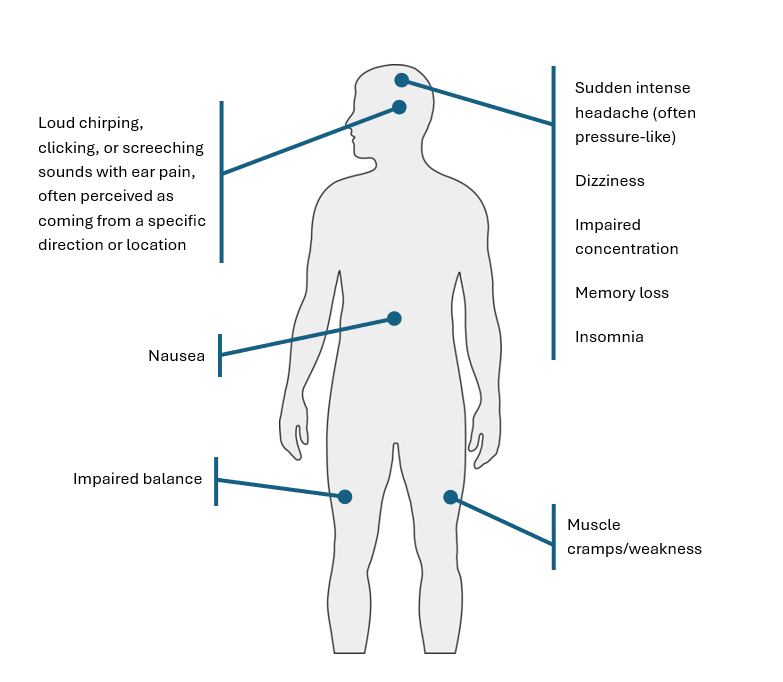
Recorded symptoms of Havana Syndrome. [source, source, source]
———————–
For additional Grey Dynamics products on Havana Syndrome, see:
Havana Syndrome – Devil’s Advocate on China’s Role (2025)
Havana Syndrome: Foul Play or False Symptoms? (2024)
Havana Syndrome: Chemical Agents or Mass Psychogenic Illness? (2024)
2.0 Locations
Pre-2016
While the first widely recognised incidents occurred in Havana in 2016, investigations have identified earlier cases that appear to fit a similar pattern.
In the late 1990s, NSA counterintelligence officer Mike Beck and his colleague were deployed to a hostile country on a routine security mission. Beck reported acute symptoms like dizziness, hearing loss, headaches and debilitating cognitive issues. Years later, both men developed the same rare, early-onset form of Parkinson’s disease. [source]
In 2014, in an unclassified memo marked “For Official Use Only,” the National Security Agency noted that the country visited by Beck possessed a microwave-based weapon capable of damaging the nervous system without leaving evidence: [source]
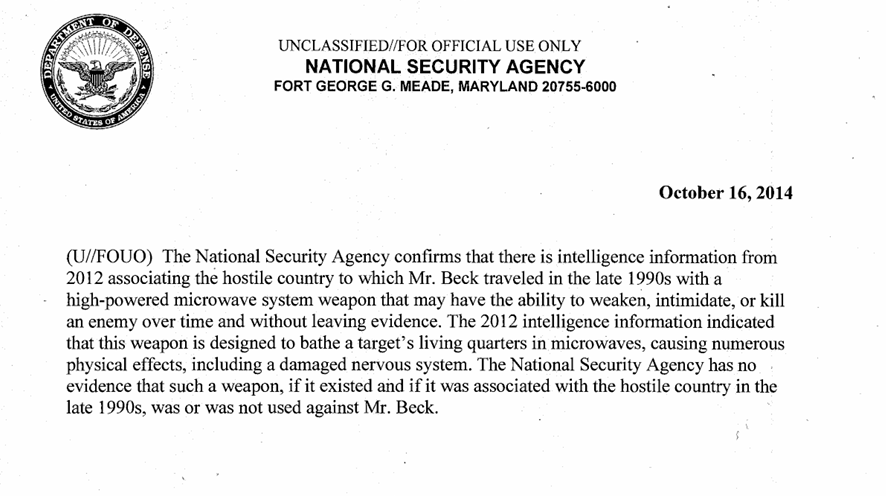
Beck continued to work for the NSA until 2016, when the progression of his disease eventually forced him to retire. The following year, during renewed federal inquiries into AHIs, Beck told investigators that he believed he had been exposed to a microwave-based weapon and it was slowly killing him. Beck died in late January 2026. [source, source]
A report by The Insider in 2024 stated there were likely incidents in 2014 in Frankfurt, Germany: [source]
“A US government employee stationed at the consulate there was knocked unconscious by something akin to a strong energy beam.” The individual later received a diagnosis of traumatic brain injury and was able to identify a Russian GRU Unit 29155 operative. [source]
Post-2016
While earlier cases may have occurred, the first cluster of incidents that defined and brought worldwide attention to the phenomenon emerged in Havana, Cuba in late 2016. Affected U.S. and Canadian diplomats reported sudden symptoms while inside their homes and hotel rooms, including the Hotel Nacional. The initial 21 recorded incidents in Cuba were characterised as starting with peculiar grating sounds that appeared to come from a specific direction. A study of these 21 victims in the Journal of the American Medical Association in February 2018 concluded that the individuals “appeared to have sustained injury to widespread brain networks without an associated history of head trauma.” [source, source]
In August of 2017, the U.S. expelled two Cuban diplomats in retaliation for their perceived responsibility. Two months later, Trump stated he believed Cuba was responsible for the attacks. Cuba’s Vice Foreign Minister Carlo Fednandez de Cossio told Reuters in 2023 that “The unfortunate thing is the U.S. government leveraged [Havana syndrome] to derail bilateral relations…and discredit Cuba.” [source, source]
As reports continued into 2017–2018, similar cases began surfacing far beyond Cuba. In China, the first incident emerged at the U.S. consulate in Guangzhou. Diplomats described the symptoms striking them inside their apartments and offices. U.S. personnel later reported incidents in Russia, Georgia, Poland, Taiwan, Australia, and parts of Central Asia, such as Kyrgyzstan and Uzbekistan. Europe saw notable clusters in Vienna – even children of embassy staff were affected across apartments, offices and hotels. In Berlin, several U.S. officials sought medical treatment after sudden episodes, and additional cases were later reported at the embassy. [source, source, source]
3.0 Theories
3.1 Pulsed Radio Frequency (RF)/ Microwave Electromagnetic Radiation (MW)
One of the most persistent theories is weaponised, directed energies, delivered in short, pulsed bursts. These types of energies can be concealed and require only moderate power, capable of travelling through air and through the walls of buildings. Those in its proximity can feel a “microwave auditory effect” in which rapid thermal expansion in brain tissue generates pressure waves perceived as sound. [source, source]
Scientific panels, including one led by David Relman in the National Academies of Sciences (NASEM), concluded in 2020 that RF energy was the “most plausible” explanation for the sharpest, most acute cases. Additionally, studies by Douglas H Smith, lead author of the U.S. government-requested University of Pennsylvania (Upenn) study, considered pulsed RF/MW as “a main suspect.” [source, source, source]
“Everything fits. The specifics of the varied sounds that the diplomats reported hearing during the apparent inciting episodes, such as chirping, ringing and buzzing, cohere in detail with known properties of so- called “microwave hearing,” Beatrice Alexandra Golomb, Professor of Medicine at the University of California, stated in 2018. [source]
David Relman also spoke to 60 Minutes in March referring to how Russian researchers have spent decades developing pulsed microwave technologies capable of disrupting neural activities in ways that could produce the sensations victims described. [source]
More recently, CNN and a joint investigation by The Insider, Der Spiegel, and CBS’s 60 Minutes revealed that U.S. undercover agents secretly purchased a portable, Russian-made pulsed-RF device from a criminal network. According to these investigators, the Pentagon tested the device on animals, and observed injuries similar to those reported by affected U.S. personnel. [source, source]
Shortly before this story of the DHS purchasing this device, a case was revealed in which a Norwegian government scientist, skeptical of Havana Syndrome, decided to build a device capable of emitting microwave energy to test on himself. He suffered neurological symptoms similar to those of Havana Syndrome, and, according to The Telegraph, had brain damage as a result. A source familiar with the event told The Washington Post that the device was not identical to the one that the U.S. government covertly acquired. [source, source]
3.2 Foreign Adversaries
Russia
In relation, many across the government and scientific panels claim the incidents were caused by the deliberate actions of hostile states targeting U.S. personnel overseas. One of the most significant lines of inquiry has focused on a covert Russian military intelligence formation known as GRU Unit 29155, a unit widely associated with covert action operations abroad, including sabotage, destabilisation efforts, and assassinations. [source]
In April 2024, a year-long investigation by The Insider, Der Spiegel, and CBS’s 60 Minutes reported evidence suggesting that members of Unit 29155 may have been involved in Havana syndrome incidents. Operatives were reportedly present in several locations shortly before U.S. personnel experienced Anomalous Health Incidents, as well as allegedly geolocated near residences/workplaces of affected officials. The reporting also claimed that senior officers in the unit received awards or promotions related to research into “non-lethal acoustic weapons” described in Russian military literature as devices using sound or radiofrequency energy. [source]
These activities resemble tactics long associated with Russia’s intelligence playbook and strategic culture, particularly controlled ambiguity and plausible deniability. Operating often below the threshold of an open conflict, conducted through covert means of intermediaries, allows Moscow to exert pressure while avoiding direct responsibility. [source]
However, the notion these incidents resulted from offensive operations by foreign adversaries have been rejected over the years.
Notably, the CIA and Office of the Director of National Intelligence, released reports in 2022, 2023, and again in 2025, claiming that Havana syndrome is ”very unlikely” the result of the work of a foreign adversary, suggesting it is more likely associated with medical or environmental explanations. [source, source, source]
That said, the assessment has not been unanimous or consistent within U.S. intelligence agencies. The Department of Defense (now Department of War) maintained a far more forward leaning posture than other agencies, notably the CIA, continuing research into directed energy mechanisms. They also funded medical care for affected personnel. [source, source, source]
More recently, in March 2026, senior U.S. intelligence, military and law enforcement officials endorsed withdrawing the 2025 assessment that rejected the involvement of foreign adversaries, signalling a reassessment of earlier conclusions in light of emerging evidence. [source]
China
While early analysis of Havana Syndrome has largely focused on Russia, China presents as a suspected yet underexplored actor. Its rapid advancements in cognitive warfare and directed-energy research do not necessarily prove operational use. However, it does demonstrate that China is actively developing technologies that – at least in theory – could produce symptoms similar to those affected by U.S. personnel.
The PLA’s NeuroStrike initiative, unveiled in late 2023 explores ways to infiltrate the brain using a mix of neuroscience, AI and brain-computer interfaces. The program focuses on weakening cognitive performance and inflicting lasting damage on the brain. These intended effects, along with confusion, memory issues and disorientation, match the reported symptoms of Havana Syndrome. [source, source, source]
China has also demonstrated progress in directed energy research through Hurricane-3000, a high power microwave system capable of producing extremely strong electromagnetic pulses. [source, source]
In 2023, U.S. officials observed Huawei and ZTE technicians entering suspected Chinese intelligence sites on Cuba, and the Biden administration confirmed that Beijing was building a SIGINT facility on the island, 90 miles from U.S. shores. Furthermore, China has also spent decades embedding itself in Cuba’s telecom infrastructure. [source, source, source]
Although many of these developments came years after the first cluster of incidents in 2016, they reveal a pattern that China is focusing and growing its capacity to conduct kinetic forms of cognitive warfare. Additionally, they likely represent only the visible edge of a much older research pipeline.
3.3 Alternative Explanations: Crickets? Stress?
One of the earliest and continuing explanations focused on environmental noise. A 2019 analysis by Alexander Stubbs and Fernando Montealegre-Z concluded that a recording captured by one U.S. person posted in Cuba matched the call of the Caribbean short-tailed cricket. Nonetheless, the report acknowledged the health problems are “beyond the scope of this paper” and further studies are necessary in regards to the psychogenic and possible physiological explanations. [source]
This interpretation matched an earlier now declassified State Department assessment that was based, in part, on a study by the JASON Advisory Group, an independent organisation of scientists that has advised the US government since the Cold War. The Group assessed insect noise as the most plausible source of the recorded audio sample. They concluded “no plausible single source of energy…can produce both the recorded audio/video signals and the reported medical effects” concluding with “high confidence” the audio sources were from an Indies short tailed cricket. [source]
On the other hand, the report stated “it cannot be ruled out that the perceived sounds, while not harmful, are introduced by an adversary as deception so as to mask an entirely unrelated mode of causing illness.” [source]
Psychogenic explanations, especially mass psychogenic illness, were also proposed. Medical sociologist Robert Bartholomew argued the episode resembled historical outbreaks of stress-related illness in cohesive groups under threat – otherwise known as a “nocebo” effect, where the anticipation of a harmful event causes such symptoms. In January 2022, the CIA issued an interim report on approximately 1,000 cases, stating most could be explained by natural causes such as stress or undiagnosed medical conditions. [source, source]
4.0 CIA Cover-Up?
The recent investigative reporting by 60 Minutes introduced new evidence and claims that reshapes the debate. While the CIA and other official U.S. agencies repeatedly assessed that it is unlikely a foreign adversary is responsible, interviews with victims, investigators, and former officials suggest a far more contested internal picture.
A former CIA officer who was assigned to the agency’s Anomalous Health Incidents task force told 60 Minutes that, upon joining, he was informed the objective was to “bring down the temperature” around the issue. He also described senior officials mocking the victims’ symptoms, which eventually led to his resignation. [source]
Dr. David Relman, who led two government-commissioned scientific panels on AHI, told CBS that his findings – which identified pulsed RF/microwave energy as the most plausible explanation – were “downplayed,” “dismissed,” or even “buried” by parts of the government. Victims interviewed were struggling to even obtain medical care or formal support. [source]
The reporting also cited classified evidence that appears difficult to reconcile with several public assessments, particularly video footage of officials experiencing symptoms. The video shows two FBI agents at a table with their families on vacation. A man with a backpack proceeds to walk in, and everyone simultaneously grabs their head as if in pain. Another video inside the U.S. embassy in Vienna allegedly shows two people collapsing at the same time while walking toward a secure facility. [source]
Mark Polymeropoulous, a former senior CIA officer who was disabled after an incident in Moscow, called the agency’s handling of the issue “a massive CIA cover up,” a claim echoed by numerous other high-level CIA personnel. [source, source]
In January 2026, Polymeropoulos stated “If the [US government] has indeed uncovered such devices, then the CIA owes all the victims a f**king major and public apology for how we have been treated as pariahs.” [source]
CNN reported during the same time that Homeland Security Investigations agents in 2024 secretly bought a pulsed RF device for an eight figure sum using Pentagon funding. According to the officials, the device contains Russian components, fits inside a backpack, and emits the kind of energy long suspected in most severe Havana syndrome cases. The device was allegedly obtained through a Russian criminal network. [source, source]
A former CIA operations officer stated while he hopes the new evidence is a step forward, “early leaks about the type of device and a DIY scientist building and testing the device on themselves, the idea of an organised crime group offering a sample (that includes Russian components) for eight figures to HIS, the youngest member of the federal law enforcement and intelligence communities with a mixed record of successes and experience levels, leaves open the possibility that taxpayers were taken for a hoax.”
They further stated: “The first time I read about the issue, my immediate reaction was “Its the Russians.” Totally consistent with their modus operandi… Their intel services have always had a mission focused on disruption/agitation that equals collection.”
5.0 Blood Markers
For years, U.S scientific assessments, including the National Institutes of Health, stated there was no significant evidence of brain injury in Havana Syndrome cases. [source, source]
In December 2020, a CIA deputy chief of station, Sam, experienced a sudden onset of Havana Syndrome symptoms inside his home in an undisclosed Central Asian country. His wife and young son reported the same sensation moments later. After reaching the embassy, an on-site medical unit began examining the family, performing numerous blood tests. [source]
The tests revealed that plasma neurofilament light chain and glial fibrillary acidic protein, two proteins specific to the brain, had leaked into their bloodstream. The Insider refers to this as a “diagnostic sign that each had suffered a traumatic event to the brain.” Sam’s biomarkers were roughly three standard deviations above average. [source]
This is comparable to a secondary blast effect from an improvised explosive device. While neither him or his family showed any external injuries, the evidence suggests something “catastrophically violent” had taken place on the inside. [source]
During this time, when the CIA-assembled Global Health Incident Cell (GHIC) was investigating Havana Syndrome, it stated there was no evidence to suggest any of these injuries are real. However, according to multiple former CIA officers, GHIC was dominated by a small group of analysts with “predetermined conclusions.” Operations officers were apparently told not to task stations or pursue leads, and evidence was routinely dismissed as “not fully developed.” Former officers describe the culture as dismissive and politicised. [source]
6.0 Why the Resistance?
The emergence of new information and intensification of the criticism of U.S. agencies’ handling of the incidents is significant, however, definitive conclusions still remain elusive. If allegations of minimisation or mismanagement are true, a central question arises: why would officials downplay or obscure a potential threat?
The CIA has historically maintained a strong record of supporting its personnel; the handling of Havana Syndrome thus contrasts sharply with its typical character. Current speculation often focuses on the possible existence of classified information regarding the phenomenon that may be precluding a more forward-leaning response. U.S. whistleblower complaints assert the existence of such classified documents and that they are being covered up. [source, source]
To the extent that key aspects remain classified, this may reflect, among various possibilities, efforts to protect intelligence methods and sources, avoid exposing intentional internal failures, or manage the geopolitical risks associated with attributing responsibility of attacks on diplomats and national security personnel to a hostile foreign actor.
If the incidents were attributable to a foreign adversary – most commonly suspected to be Russia – publicly acknowledging responsibility could trigger severe diplomatic consequences that the U.S. is not prepared to face. Publicly acknowledging it without definitive, absolute proof, can be even more detrimental.
Greg Edgreen, who led the investigation for the DIA, stated that in the case of proving foreign involvement, “the bar for proof was set impossibly high.” He further stated he saw a tendency in the investigations to avoid certain lines of inquiry they “did not want to have to deal with,” thus avoiding exploring “any of those avenues.” [source]
7.0 Conclusion
Despite years of investigation, it is clear the cause of Havana Syndrome remains unresolved. Evidence is still scattered, interpretations are very often contradictory, and no single explanation has been definitively confirmed. Nonetheless, the recently revealed information and accusations against U.S. intelligence agencies are likely to increase pressure for further action.
Aside from these continuing uncertainties and obscurities, the notion that U.S. authorities obtained a device that we now know produces very similar effects to those of Havana Syndrome – from Russian criminal networks – raises extremely troubling implications in itself. The spread of these advanced capabilities in the hands of non-state, illicit actors, is profoundly alarming.