
1.0 Introduction
Center 795 (military unit 75127), created in December 2022 is a highly secret, fully autonomous establishment that combines elite members from the GRU, FSB and others. The unit’s relatively small 500-person structure brings together a very wide range of specialised teams, enabling it to conduct everything from military operations in Ukraine to covert missions abroad, including kidnappings, assassinations, sabotage and agent handling.
Center 795 was established to stay completely hidden. The prior intelligence and operational failures of GRU Unit 29155, which led to that unit’s outing in the international press, pushed the desire for tightened tradecraft – encrypted communications, disguises, aliases, and compartmentalised structures. It was meant to be harder to trace, harder to expose. However, once again, Putin’s attempt to create a covert action infrastructure capable of operating abroad compromised itself – in a rather shameful way. This exposure has come amid a backdrop of wider Russian intelligence compromises, including the July 2025 open source analysis of a FSB SIGINT structure through publicly visible commendation medals.
Two operatives—Alimov (a Russian speaker) and Durovich (a Serbo-Croatian speaker)—communicated over secure encrypted channels. However, neither could understand each other’s language. In their minds, inputting Durovich’s field reports and Alimov’s entire operational instructions into Google Translate was a solution to the problem. The inputs were flagged by the FBI and, with the help of The Insider and Der Spiegel’s investigations, the entire center was exposed—its structure, operatives, and recruitment pipeline—and the two operatives were arrested. [source]
2.0 Formation
Prior to the creation of Center 795, for many years, GRU Unit 29155 served as Russia’s principal covert arm abroad. It was, and to an extent still is, a key tool for Moscow’s shadow war against the West. The unit was responsible for some of the Kremlin’s most aggressive operations in Europe and allied states – including the attempted assasination of Sergei Skripal in the U.K., the failed 2016 coup attempt in Montenegro, the WhisperGate malware campaign against Ukrainian institutions, and many other covert action operations.
However, repeated operational blunders gradually turned Unit 29155 into an international liability. The unit became known for sloppy tradecraft and public failure, an embarrassment for the Kremlin and something Moscow has little tolerance for. [source]
.jpg#/media/File:Forensic_tent_at_The_Maltings,_Salisbury.jpg)
While the unit was in no way disbanded, there was some restructuring within Russian intelligence services. The unit’s founding commander, General Andrei Averyanov, was tasked with running a new department – the Service for Special Tasks (SSD) which now runs Unit 29155 alongside Unit 54654. The establishment of this department is a reflection of the Kremlin’s broader expansion and deepening of its aggressive covert action apparatus. [source]
As the Insider and Der Spiegel noted, leadership decided that Averyanov’s unit needed competition over reform. In December 2022, Center 795 was created under the Military Unit number 75127, reusing the identifier of a previously disbanded unit that had once been stationed near the Chinese border.
“In general, this is in the spirit of Putin: to create parallel structures so that there is a spirit of some competition,” a high-ranking source in the Russian security forces explained to The Insider.
The organisation of Center 795 also reveals a broader strategic shift in Russian force design. Consisting of roughly only 500 personnel, it consolidates an unusually wide range of capabilities under a single organisation. This reflects what Russian military planners describe as a “full-cycle” approach to irregular warfare – focusing on tighter integration and combined capabilities. While this could be perceived as modernisation, it may equally reflect institutional overstretch. A GRU source told The Insider:
“You cannot stuff all the specialties of the GRU and the FSB into a single structure of five hundred people. That is not how it works. There are reasons why the General Staff directorate employs thousands of people. Without scale, you cannot maintain genuine specialization, you cannot handle truly complex tasks.” [source]
Cover – Kalashnikovnikov Concern
Unlike Unit 29155, which was formally embedded in the GRU structure, Center 795 was given a corporate cover mechanism, keeping with Russia’s longstanding preference for plausible deniability. The chosen front was the Kalashnikov Concern – a ‘private’ Russian arms manufacturer owned by Rostec and considered Russia’s premier defense manufacturer. The unit’s training regimen would be disguised as routing “test shooting,” a normal activity associated with Kalashnikov’s weapons-production work.
Kalashnikov was the original manufacturer of the AK-47 assault rifle. Additionally, the company produces about 95% of all small arms in Russia, and according to their website, exports to over 25 countries around the world. Alan Veleryevich Lushnikov is, according to the U.S. Treasury, the largest shareholder (roughly 75%) and nominal president of the Kalashnikov Concern. The company is U.S.-designated and Lushnikov is the subject of U.S. and U.K. sanctions. [source source]

3.0 Organisation
3.1 Place within Russian Government
3.1.1 Location
Center 795’s operational base is located in Patriot Park, Kubinka, Moscow Oblast. The facility is a Kalashnikov training facility, specifically in a two-storey administrative building called TMU-1. The coordinates of the location are: 55.567477, 36.830149.
Satellite imagery indicates that this area was constructed around 2015, a year after Russia’s annexation of Crimea. Adjacent to the facility is the recruiting and training center of the Rubicon unit. Rubicon is Russia’s elite drone unit. On 22 May 2025, a Ukrainian Liutyi drone targeted this base. [source, source, source]
Additionally, a neighboring building in the compound is labelled “Ростех” (Rostec) on 360 Earth Maps. If this is indeed operated by Rostec, the co-location suggests likely direct coordination or logistical interaction.
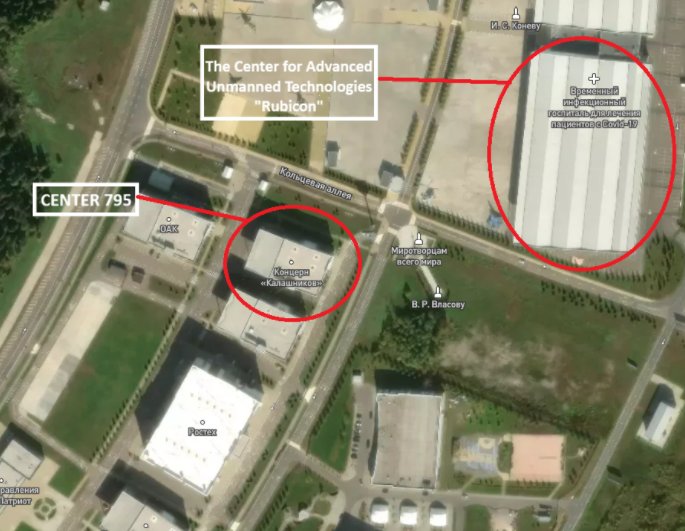
Imagery obtained by 360 Earth Maps.com. [source]
3.1.2 Command Structure
Center 795 is under direct authority of Chief of the General Staff Valery Gerasimov, positioning it outside the usual chains of command of the GRU or FSB. A single, self-contained structure like this one is designed to carry out every stage of an operation internally, while keeping its departments compartmentalised from one another to uphold operational security. The unit is led by Denis Fisenko, former FSB Alfa officer and ex Deputy General Manager for special projects at Kalashnikov Concern. [source]
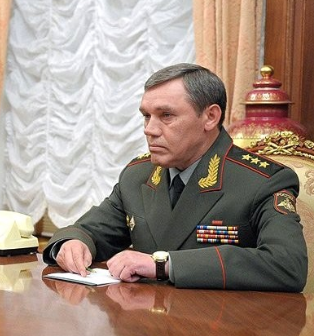
Valery Gerasimov.
CENTER 795 HEADQUARTERS (approximately 63 personnel)
- Chief of Staff: Drozdov
- Coordination Department: inter-agency hub. Manages intelligence sharing and target deconfliction with FSB, GRU and other external services
- Signals and automation: encrypted comms backbone
- Situational centre: intelligence fusion node
- Internal security: counterintelligence, state secrets protection, personnel leak monitoring
- Legal/finance/admin: administrative cover. Routed through Kalashnikov concern corporate structure for concealment
3.1.3. Internal Organisation
1st Directorate: Intelligence
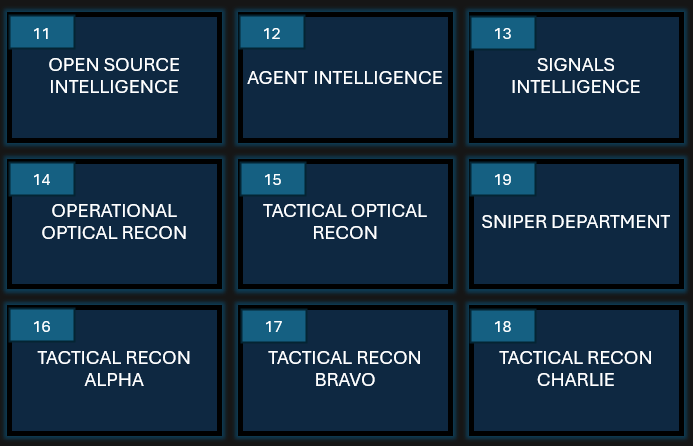
This is the largest department within Center 795. It runs nine departments, covering a broad spectrum of intelligence collection.
Department 12 is considered the most sensitive, running human assets and informants abroad. This department is almost entirely staffed by Unit 29155 veterans. The 13th handles SIGINT, and has a full suite of radio-technical intelligence equipment including satellite intercept stations.
The sniper department is found in the Intelligence Directorate instead of the Assault, indicating its role as a precision elimination unit over battlefield support.
Departments 16,17 and 18 form three parallel ground reconnaissance teams that are similarly equipped—with PKM MGs and RPG-7s, for example—allowing equal capability for the same target while remaining completely compartmentalised from each other. [source]
2nd Directorate: Assault
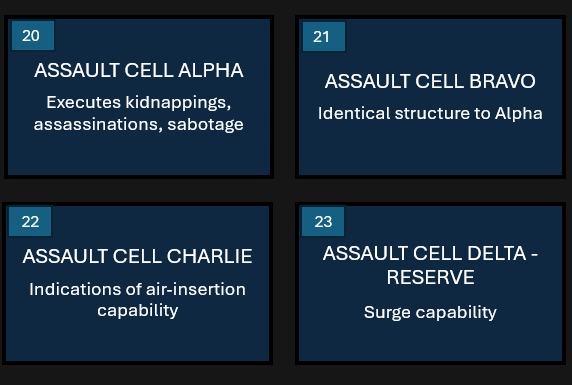
The Assault Directorate of Center 795 comprises four covert Combat Application departments. It is a compartmentalised model, in that each department is completely unaware of the next department’s operations. Furthermore, all departments contain four autonomous strike groups. This directorate is headed by Lt. Colonel Alexander Polonsky, an ex-Kalashnikov.
According to the Insider, these groups utilise weapons like the Tiger-M SpN, PKM MGsx12, RPGx12, SVDS sniper rifles, and VSSM silenced rifles. Assault Cell Charlie includes members of the FSO Presidential Security Officers, which specialise in parachute insertion and close protection, along with airborne Spetsnaz alumni. [source]
3rd Directorate: Combat Support
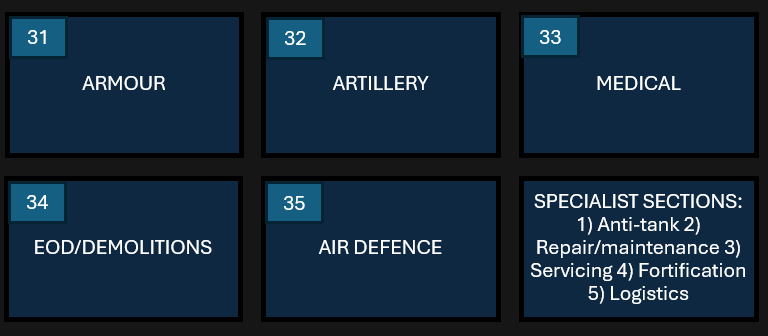
The Combat Support Directorate demonstrates the unit’s conventional warfare capability. The five departments within this field are supplemented by five specialist support sections. In Department 33, The Insider identified the head as a naval diving specialist, possibly suggesting a maritime/underwater operations capability. Department 35 serves as protection for unit assets and positions from air attack. [source]
3.4 Key Figures
Col. Denis Fisenko: Head of Center 795
Fisenko, aged 52, is a veteran of FSB’s elite counterterrorism unit, Alpha, and commanding officer of Center 795. He is threetime Order of Courage recipient, a Russian champion in combat weapons shooting, and the author of materials for the FSB’s special operations training regimen.
Aside from serving in the Spetsnaz, he also holds significant corporate experience, being a Deputy General Manager of the Kalashnikov Concern for Special Projects. Within this, he managed the ZALA Aero division, which produces UAVs currently deployed by Russian forces in Ukraine. Fisenko travelled on joint private jet flights with Andrei Bokarev, indicating personal trust from the unit’s principal sponsors. Bokarev is a prominent Russian industrialist and co-owner of Transmashholding. Earning an equivalent of $40,000 a month from running these departments; Fisenko is one of the trusted billionaires in the Russian state. [source]
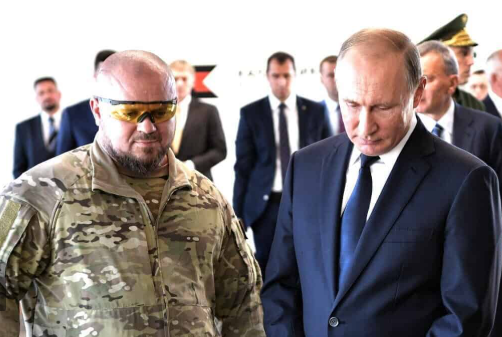
Denis Fisenko and President Vladimir Putin.
Dmitry Drozdov: Chief of Staff
Drozdov, born 3 June 1972, is a former member of the Belurusian KGB’s elite counterterrorism unit, Alpha, and now serves as Chief of Staff of Center 795. He entered the Center through the Kalashnikov Concern. Drozdov—along with Radkevich, the intelligence chief—had no previous links to Russian military/security services. This was likely deliberately done for added discretion. [source]
Zriachev Nikolai Mikhailovich: Deputy Head for Combat Training
Former FSB Alpha officer and paratrooper. Zyrachev previously worked as head of the warehouse at the Kalashnikov shooting center. [source]
Chepizhak Yuri Federovich: Deputy Commander for Support
Born on 12 July 1974, Federovich is a Colonel and serves as Deputy Commander for Support, likely coordinating the units enabling functions, like medial, logistics, maintenance and others.
Andrei Bokarev: Covert Principle Backer/Transmashholding/ Kalashnikov
Bokarev is a Russian billionaire industrialist and, according to The Insider, is the “ideological architect and principal backer” of Center 795. He is best known for co-owning Transmashholding (TMH), Russia’s largest producer of rolling stock for railways and subway systems, with oligarch Iskandar Makhumudov. Additionally, he has been a key player in the success of Ural Mining and Metallurgical Company (UMMC). [source, source]
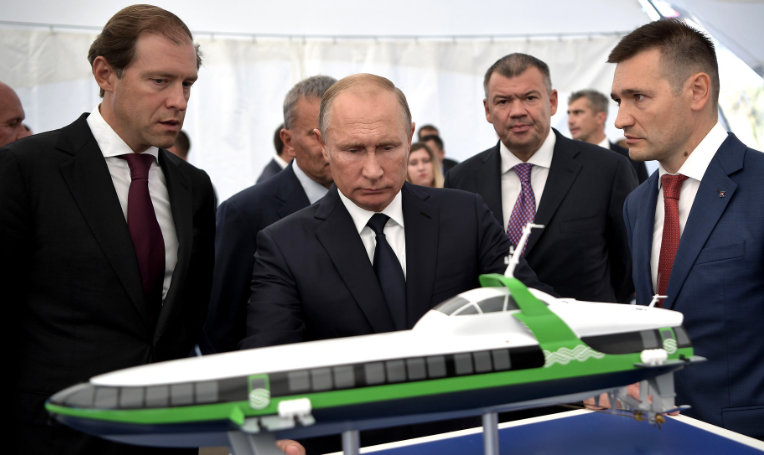
Andrei Bokarev stands behind Putin on the right.
In 2014, he and his partner acquired a 75% controlling stake of the concern. While he formally divested in 2018, The Insider reports that the financial trails suggest this was more restructuring than a genuine exit to obscure his continued control. Tax declarations show a constant continued income from Kalashnikov. His name is also still listed on the payroll of the company. Through the revenue of both Kalashnikov and TMG, Bokarev finances Center 795 – a structure that is likely also used to obscure funds directed by the state. [source, source]
According to the Insider’s 2023 investigations, his family relocated to France, where he holds properties in Paris, Saint-Tropez, and Ramatuelle via the French real estate holding company Société Civile Immobilière, some of which transferred to his children. His 14 year old daughter Elizaveta Bokareva is the popular singer ELSEA. Grigory Leps, a pro-war performer, frequently performed with her. Leps is her godfather and close friend of Andrei. [source, source]
Sergei Radkevich: Head of Intelligence Directorate
Radkevich served in Belarusian intelligence under the alias “Sergei Baskhimdzhiev” and passed through corporate roles at Kalashnikov prior to serving as Head of the Intelligence Directorate in Center 795. [source]
Alexei Ilyushin Alexandrovich: Deputy Head of Intelligence Directorate
Ilyushin is a multilingual GRU-linked polymath – fluent in four languages including Danish and Norwegian. He wrote textbooks for Russian military academies and authored a military terminology dictionary, as well as building a GRU university recruitment program. France expelled Ilyushin in 2014 after DGSE caught him trying to bribe someone close to President Francois Hollande. Following this, he resurfaced as a supposed nanotechnology specialist, stating he oversaw projects for the development of new lithium-ion-based energy storage systems” as well as “terahertz-range radiation sources for the detection and neutralization of explosive devices.” [source]
Alexander Polonsky Sergeevich: Head of the Assault Directorate
Kovalev Anatoly Fedorovich: Head of the 12th Department of Operational-Agent Intelligence
Sergei Chemezov:
Chemezov is Rostec’s CEO. A former KGB officer, he served alongside Putin in East Germany. He is considered one of Putin’s closest defence-industrial allies. As the Kalishanikov Concern has a blocking minority stake reserved for Rostec, Chemezov effectively acquired his own private army. However, according to sources close to the Insider, Chemezov did not initially intend to sponsor a unit that would be used for political assassinations abroad. He believed the unit’s remit was limited to supporting the war in Ukraine, and the exposure of targeting dissidents overseas created a political liability for him. [source]
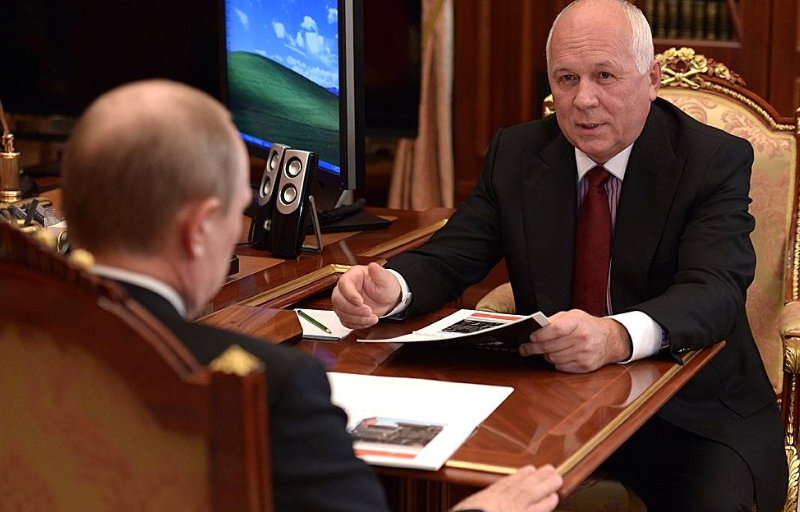
Putin and Chenezov in 2014.
Allimov Denis Nazarovich: Operations Specialist
Alimov is a 42 year old former FSB Alfa operative who became a senior officer in Center 795. Alimov is the infamous operative that brought the unit to exposure. He previously served in OMON (riot police) and later in Alfa’s counterterrorism and counterintelligence work, maintaining close ties with Ramzan Kadyrov.
After joining Center 795 in 2023, he handled primarily domestic errands like locating Kadyrov’s missing dissident nephew. In the following years, Alimov worked on building recruitment pipelines abroad, and increasingly took on the role of organising kidnappings and targeting dissidents overseas. [source, source]
3.5 Recruitment
3.5.1 Methods
A defining feature of Center 795 is its authority to poach personnel from any Russian security body – the GRU, FSB, Rosgvardia, the FSO, and even elite airborne Spetsnaz. In particular, the center drew heavily from the FSB’s Center for Special Operations. They did so without always getting the consent of the relevant agency, showing the center’s comparatively higher status within Russia’s internal security hierarchy.
The civilian recruitment track is a deliberate and key feature of Center 795’s recruitment pipeline. By recruiting personnel through corporations like the Kalashnikov Concern, it gives the unit a deniable intake mechanism for bringing in experienced operators without leaving a Russian institutional and military footprint. [source]
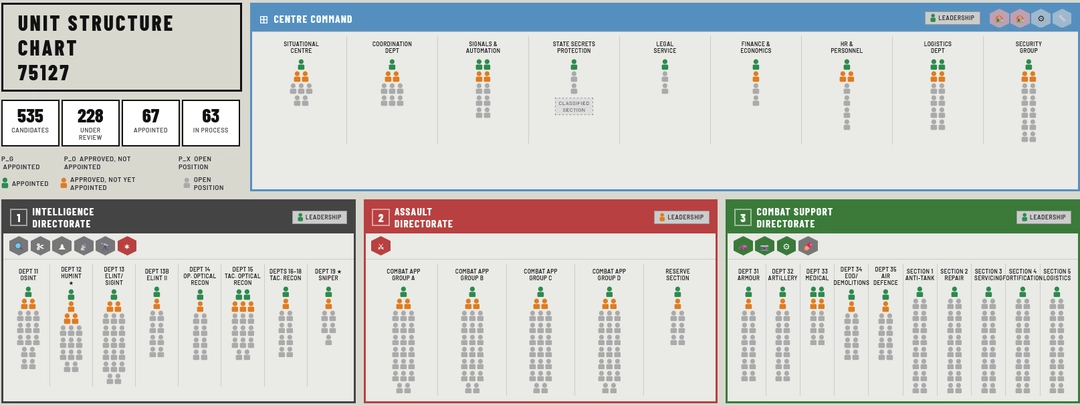
Image by The Insider. Contains excerpts from a presentation by Center 795 prepared for Vladimir Putin in 2023.
3.5.2 Requirements
The Insider describes the selection process as rigorous. According to internal spreadsheets and leaked correspondence, roughly one-third of all applicants were rejected outright for failing to demonstrate their “unique” value. Those who passed received exceptionally high salaries, roughly USD $7,800 per month. [source]
4.0 Equipment
4.1 Weapons
- Sniper Rifles
- SVDs
- ASKVK .50 x 12
- Submachine guns
- VSS, silent 9mm x 12
- Anti-Tank weapons
- RPG-7
- Other non-vehicular heavy weaponry
- PKM MGs
- D-30 howitzers
4.2 Vehicles
- UAV’s
- Orlan-10, Orlan-30X5 as delivery platforms
- Takhion x10
- Eleron 3×15
- Kam AZ-5350 support vehicles
- Tiger M SpN
- T-9OA main battle tanks
- BM-30 Smech MLRS
5.0 Tactical-Operational Information
5.1 Exposure
5.1.1 The Operational Weak Link: Denis Alimov
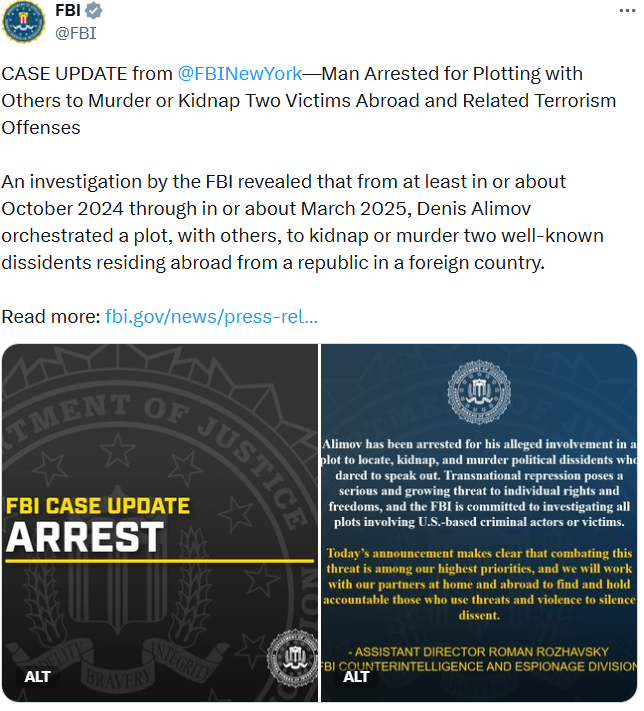
The operation that ultimately exposed Center 795 began when Denis Alimov was tasked with recruiting assets to assassinate Chechen dissidents, singling out the Zakaev family as high value targets. The patriarch was Akhmed Zakaev, the acting prime minister-in-exile of the unrecognized Chechen Republic of Ichkeria, and vocal opponent of Ramzan Kadyrov. The family had spent years in exile, and several of Akhmed’s relatives were living across Europe and the U.S.
Alimov offered USD $1.5 million for each target killed or deported to Russia.
His primary asset was Darki Durovic, a Serbo-Croatian speaking individual who lived in the United States. Alimov advanced USD $60,000 to Durovic, and told him that three captured/killed targets could bring in more than USD $10 million.
Rather than routing communications through secure translators or even just using linguistically aligned operatives, they began passing instructions through Google Translate, entering field reports and operational guidance into the service so each could understand the other.
The use of Google Translate—an American multinational company with data processed on servers under U.S. jurisdiction—allowed investigators to access the two men’s inputs in real time and to obtain a warrant against them.
A source close to the investigation told The Insider, “it was even better than a wiretap because it arrived transcribed.” It was also reported Durovic had even used search engines to obtain guns in Podgorica, Montenegro.
In a further tradecraft lapse, Durovic travelled to Russia via Turkey in July and October 2024 under his real name, leaving a clear record of his journeys for investigative discovery. When questioned by the FBI, he denied ever visiting Russia, unaware that the Bureau already had his flight data. It was decided by the authorities to allow him to continue his activities under surveillance, likely to collect more intelligence. [source, source]
5.2 Core Purpose
Center 795 serves as a covert arm that integrates a variety of capabilities under a single command. It is designed to handle a wide range of intelligence and paramilitary operational activities. Working under corporate cover through Kalashnikov Concern and placed within Rostec infrastructure, along with recruitment of personnel from Belarus, the center was established to maintain a high degree of plausible deniability. The publicly available information suggests it was established as a more effective successor of Unit 29155, but also likely intended to create competition between similar units. Their primary activities span: [source]
- Assassinations
- Sabotage
- Covert intelligence support to proxy networks
- Information and psychological operations
- Abductions
- Military operations: battlefield intelligence, sabotage, special operations
- Clandestine agent handling
5.4 Staffing
Center 795’s staffing exposes the depth of Russia’s current personnel crisis concerning sensitive positions. The unit recruited its chief of staff and intelligence chief directly from the Belarusian KGB so it would not trigger Western counterintelligence systems. It signals that Russia’s own officer corps is so thoroughly burned that Moscow can no longer field senior officers abroad without raising flags.
The situation inside the 12th Department is even more revealing. The department, responsible for running human agents abroad, is staffed “almost entirely by veterans of Unit 29155,” the same unit whose identities, social media footprints and even home addresses are cataloged by security services across the West. Recycling these operatives likely demonstrates that Russia lacks personnel that is both uncompromised and seasoned enough to manage clandestine operations, and is forced to reuse officers who are at high risk of being identified, surveilled, or even apprehended if they travel abroad. [source]
5.1.2 Arrests
U.S. federal agents in March 2025 arrested Durovic, after which the FBI continued exploiting Google Translate logs and mapping the full scope of the plots. A European partner law enforcement agency was monitoring individuals in Alimov’s orbit – including Serbian mercenary recruiters Dejan Beric and Davor Savici – which likely pulled Durovic into an existing surveillance stream.
What remains inexplicable is Alimov’s decision to travel abroad just a year later, even after Durovic’s arrest had placed the entire operation and networks under scrutiny. Colombian migration officers, working under an Interpol Red Notice issued at the request of U.S. federal prosecutors, on 24 February 2026 detained Alimov at Bogota’s El Dorado International Airport. He arrived on a flight from Istanbul, posing as a tourist en route to a beach resort in Cartagena. Alimov tried to buy a burner phone the day before departure to Bogota, but the precautions were meaningless: the accumulated exposure was, of course, already fatal.
He now faces charges of murder, kidnapping conspiracy, material support to a terrorist organisation and financing terrorist organisations; each carry potential life sentences. [source, source]
6.0 Conclusion
Center 795’s future is uncertain, but publicly available information suggests that it is trending downward. The unit was badly compromised by Alimov and Durovic’s operations, with the unit’s entire structure, command, mandate, recruitment and personnel exposed. Its operational security collapse has stripped much of its deniability and put its officers under active surveillance. While the Kremlin may try to rebuild or rebrand it, the leak has effectively burned the unit’s networks and methods, making it unlikely that the unit will continue operating in its current form.
The key question is what lessons, if any, have been internalised. The operational failures of Unit 29155 did not translate into meaningful reform or a capability that effectively prevents the repetition of similar failures. Whether this level of exposure of Center 795 will result in a change in approach by the Kremlin is uncertain.
The exposure of GRU Unit 29155, Center 795, and the FSB SIGINT infrastructure demonstrates how sub-par tradecraft and weak OPSEC detrimentally collides with an era of ubiquitous technical surveillance (UTS). Routine operational slips, like reused identities, digital traces and logistics data, become linkable when almost every action leaves a persistent digital footprint, empowering OSINT investigators and analysts to an extent never seen before.