
1.0 Introduction
U.S. legislation prohibiting fully automatic firearms has left few individuals seeking to bring automatic rifles to the general public. That said, full-auto fire is a dream of many civilian hobbyist shooters, and for criminals it harkens back to the Prohibition era in which gangsters rampaged through cities using ‘Tommy guns.’ This joint demand has sparked significant innovation in the American firearms industry, with several after-market modifications designed to increase the rate of fire of legally-owned semi-automatic rifles and pistols.
2.0 How select-fire mechanisms work
To understand how these devices overcome a semi-auto restricted firearm, a brief explanation of a firearm’s fire control group is needed. The M16/AR-15 fire control group will be used as an example, since all of these conversions exist for this platform. A parts diagram is provided below:

M16 full-auto fire control group. Red: Trigger, Yellow: Disconnector, Blue: Hammer, Green: Auto sear [image source]
2.1 Semi-Auto Fire
In the example above, pulling the trigger (red) releases the hammer (blue), which strikes the firing pin and detonates the cartridge in the chamber. The bolt carrier retracts, ejecting the cartridge and returns to load the next round from the magazine. However, with just a trigger and hammer, there is nothing preventing the hammer from ‘riding’ the bolt carrier on return, moving together and striking the firing pin with insufficient force. This requires a disconnector (yellow), a spring loaded piece connected to the trigger to hold the hammer while the trigger is still pressed (i.e. ‘disconnect’ the trigger). Then, when the trigger is released, the disconnector releases the hammer back onto the trigger sear (surface between the red and blue) to reset the trigger after each shot.
2.2 Full-Auto Fire
When set to full auto fire, the auto-sear (green) is positioned to interact with the bolt carrier and hammer, allowing the hammer to drop once the bolt carrier is fully forwards. This makes sure the hammer is not released prematurely to cause a misfire or an out-of-battery detonation where the cartridge is fired before being fully chambered. For the M16, the rear of the bolt carrier has extra material compared to the AR-15 to hit the auto-sear on full return and set off the hammer.
3.0 Full Auto Conversion Units
3.1 1990: The “Hell-fire” Trigger
The Hell-fire trigger is one of the earliest and also least known commercial rifle trigger upgrades, created around July 1990. It is a spring loaded bar clamped to the back of the trigger guard which pushes against the back of the trigger to reset it for the user. As the design is completely external, it works on numerous firearms including AR-15 derivatives, AK pattern rifles, the HK G3, and even the Ingram MAC-10 as featured in the product’s commercial. According to the advertisement, it can be tuned to adjust the rate of fire, likely by adjusting the spring tension applied to the trigger. [source]

An advertisement from the 1990s for the Hell-fire Gen 2 [source]
3.2 Bump Stocks
The first bump stock was originally designed for the Ruger 10/22 by Bill Akins around 2005. The design features a monolithic stock and pistol grip piece that moves separately from the receiver on a set of springs. Once the trigger is pulled, the rifle moves backwards into the stock and a ledge on the pistol grip pushes the finger off the trigger. When the rifle returns due to the springs, the trigger is pushed against the finger, ‘bumping’ the rifle to fire the next shot. This part was ruled by the ATF as converting the firearm into a machine gun, however later and more prominent designs removed the springs so the shooter had to move the rifle forwards with the offhand for legality. Bump firing can be achieved on a semi-auto rifle while loosely holding the rifle on the hip, but consistent automatic fire and shouldering of the rifle is achieved when using a bump stock.

Operation of a bump stock on an AK type rifle. Note how the finger remains fixed while the rifle moves forwards in the stock to actuate the trigger. [image source]

Closely related to rifle bumping is the Auto Glove, a pair of gloves designed in 2017 with an electric motor inserted to pull the trigger for you. Despite the advantage of working on any firearm, the device never saw widespread use as the ATF quickly shut it down, given that the AutoGlove replaced ‘the traditional “trigger” of that weapon’. [source][source]
3.3 Forced Reset Triggers (FRTs)
The FRT is the brainchild of Thomas Allen Graves, who started work on ‘positive displacement trigger reset’ technology in the 1970s. However, it was only in 2020 when he sold the patent to Rare Breed that a drop-in AR-15 FRT unit would be a commercial success. FRTs work by pushing the trigger forwards for the user after a shot is fired, similar to the Hell-fire trigger, except this is achieved internally within the trigger group. The significant advantage over bump stocks is that the rifle doesn’t have to move, and compared to the Hell-fire, it works with the fire selector to provide safe, semi-auto, and forced-reset settings.
3.4 Drop-in Sears
Drop-in sears are parts easily inserted into the firearm to convert it to full-auto fire. For the AR-15, the piece presses down on the disconnector only when the bolt is fully closed, letting the hammer drop again to achieve full-auto fire. This will restrict the weapon to full-auto fire only as it circumvents the fire selector. They can take many forms, from a 3D printed ‘coat-hanger’ to being made from an actual coat-hanger.
The most relevant drop-in-sear is the Glock ‘switch’ because of its prevalence in street crime (see section 4) and the legal battle that Glock faces due to its creation (see section 5). This device is mounted on the rear of the slide to override the trigger bar on the Glock pistol, forcing the striker to drop with each cycle. They are typically CNC machined pieces, with a physical push button ‘switch’ to set the fire mode, but they can also be 3D printed units with or without the button.


3.5 Binary triggers
Franklin Armory released the first binary trigger in 2015, a drop-in trigger for the AR-15 that can be used to simulate automatic fire. It functions like a semi-automatic trigger, but another shot is fired when the trigger is released. Designs for these triggers vary between manufacturers, but they typically involve two disconnectors that alternate between the trigger stages.
3.6 Trigger Cranks
In 2013, GatCrank started producing a manually operated crank assembly that essentially turns a firearm into a gatling gun. These are more of a gimmick than an automatic fire conversion, but there are trigger guard mounted cranks and complete AR-15 pistol grips that offer this functionality. For both, one revolution will fire three shots which can reach up to 700rpm when wound as fast as possible, close to the original automatic fire-rate of the M4A1. [source][source]
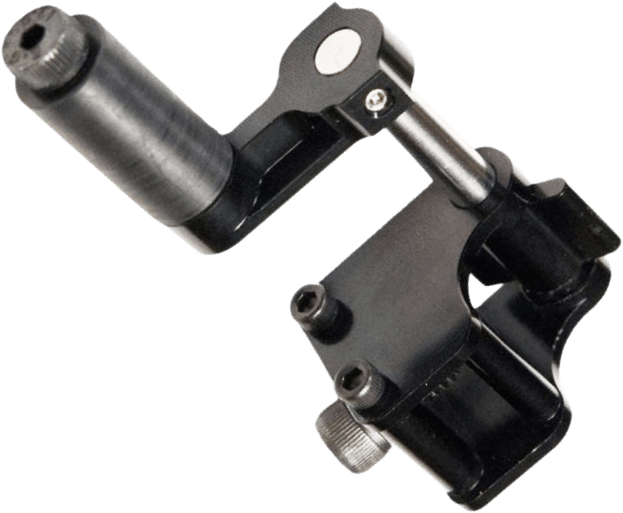
The GatCrank Turbo XL which mounts to the bottom of the trigger guard and features a paddle that spins to hit the trigger. [source]

Freedom Ordnance’s FG-15 Trigger Actuating Grip which uses a piston (in between the four silver hex screws) to push the bottom of the trigger plate up to simulate a trigger pull. [source]
4.0 Popularity in Crime
4.1 Why full-auto?
Full-auto fire is rarely seen in military combat, only suited for suppressive fire, and is inappropriate in police and special forces units. Controllability, accuracy, and rapid ammunition depletion are some of the key reasons why it is unpopular. However, criminals are always looking to adapt weapons for full-auto fire, likely to make up for a lack of shooting skill, for suppressive fire, and for intimidation. Machine guns first found popularity with organized crime during the Prohibition era, where the select-fire Thompson submachine gun that was sold directly to the public became infamous for killings like the Saint Valentine’s Day Massacre. This led to the National Firearms Act (NFA) in 1934, which required registration and taxation on automatic weapons, as well as defining machine guns under US law. Since then, the prohibition on the transfer and possession of machine guns registered after 19 May 1986 made them a costly collector’s item, ranging anywhere from five to six figures at auctions. With the rise of full auto conversion units, criminals are able to convert semi-auto firearms easily and cheaply, which makes their adoption straightforward.
4.2 1993: The Age of the Hell-fire
The Hell-fire trigger upgrade has seen infamy in two major shootings in 1993: the Waco Siege and the 101 California Street Shooting. From 28 February to 19 April 1993, the ATF raided the Mount Carmel Center near Waco, Texas on suspicion of illegal weapon stockpiles being held at the location by a religious cult, the Branch Davidians. David Koresh, the leader of the cult, reportedly told law enforcement that Hell-fire triggers were used on their semi-automatic weapons, according to the 1995 book “No More Wacos” by David Kopel.
On 1 July 1993, Gian Luigi Ferri entered the Pettit & Martin law firm in San Francisco with two Intratec TEC-DC9 pistols equipped with Hell-fire’s and a Norinco M1911. He shot and killed 8 individuals, wounding 6 before committing suicide. The motive for the attack is unknown, but is suspected to be from a personal grudge against lawyers from the firm.
4.3 2017: The Las Vegas Shooting
The bump stock gained notoriety from the Las Vegas Shooting on 1 October 2017, when Stephen Paddock opened fire on a festival crowd from the Mandalay Bay hotel. Over 1,000 rounds were fired in ten minutes, killing 60 and wounding 413. After he committed suicide, investigators recovered 24 firearms from his room, including 14 AR-15 rifles equiped with bump stocks. Discussion over a bump stock ban was widespread in the media and, in March 2018, they were banned by President Donald Trump by being classified as machine guns. However, after a federal lawsuit in 2024, the Supreme Court ruled that bump stocks did not meet the definition of a machine gun under the NFA and effectively removed the ban.
4.4 Present day: The Glock Switch and Street Crime
The Glock ‘switch’ and drop-in auto sears for the AR-15 have become synonymous with street crime in the US. The ATF reported recovering 814 auto sears from 2012 to 2016, but from 2017 to 2021 this number increased to 5,454. This increase is partly due to the marketing of these devices online as inexpensive add ons, particularly from Chinese retailers such as Wish.com and Ali Express. The popularity of 3D printing also allowed for these devices to be produced at home, since instructions and files can easily be found on the internet.
[source]
5.0 Legality and Future
5.1 ATF Controls
Out of the full auto conversions listed above, only drop-in auto sears are illegal under federal law since the parts themselves must be registered as machine guns. They are legal if they were registered before 1986, when the ATF closed the registry after realising what these parts were capable of doing. These are extremely rare and are mostly sought after by collectors; one sold at auction in 2018 for $34,500. Despite these controls, ordinary citizens and criminals are often seen using similar newly imported or 3D printed parts, as their sale is ubiquitous online and the ATF is unable to investigate individuals without a warrant.
5.2 Statewide legislation
Apart from auto-sears, various states have outlawed many, if not all, of the other devices listed above. Some states have blanket bans on any device designed to increase rates of fire, whereas others have specific bans on these individual conversions. As of November 2025, the following states have these prohibitions on civilian sales:
- Forced Reset Triggers: CA, CT, DE, HI, IL, MA, MD, NJ, NY, OR, RI, WA, DC
- Bump Stocks: CA, CO, CT, DE, FL, HI, IL, MD, ME, MN, NV, NJ, NY, OR, RI, VT, VA, WA, DC
- Binary Triggers: AL, CA, CT, DE, FL, HI, IL, IA, MD, MN, NJ, NY, RI, VA, WA, DC
- Trigger Cranks: CA, CT, DE, FL, HI, ME, MN, NJ, NY, RI, DC
[source][source][source][source]
5.3 No more automatic pistols?
In May 2025, the Trump Administration settled a lawsuit between the ATF and Northern Texas District Judge Reed O’Connor on FRTs, allowing Rare Breed Trigger to continue selling FRTs, provided that they did not develop one for pistols.
In October 2025, the state of California passed a bill prohibiting the sale of new Glock semi-automatic pistols in response to the rise of Glock ‘switches’ in crime across the US. The ban does not cover the possession or sale of used Glock pistols. Glock recently decided to discontinue the majority of their pistol line-up in favour of the new V-series, which is designed to be non-convertible. Glock is also under pressure from several state and city lawsuits alleging liability for gun violence and deceiving customers over the safety of their products.
6.0 Conclusion
There will always be a desire to convert weapons for full-auto fire, whether for fun by hobbyists or for nefarious purposes. Crimes involving these conversion units are on the rise, but the weapon is only as deadly as the intentions of the person behind the gun. The ability of firearms, particularly pistols, to be easily converted is not an advantage to professionals who rely on firearms for work, making actions like that of Glock USA seem reasonable to prevent criminal use. The legislature’s handling of the Rare Breed Triggers case is a signal that the full-auto rifles are likely to remain available in the U.S. market until interpretations of 2nd Amendment constitutional rights change.