Executive Summary
Jama’at Nusrat al-Islam wal Muslimeen (JNIM) has consolidated its position as a critical threat in the Arab Maghreb and West Africa. The Al-Qaeda (AQ) affiliated organisation has continued to proliferate through violence in the last seven years, expanding its zone of influence and area of operations in northern and central Mali to the western and southern parts of the Sahel.
Military administrations in the Sahel are currently struggling to contain the large-scale offensive campaign of the terrorist organisation, which targets government officials and unarmed civilians alike. In addition to a fast operational tempo and mass-casualty attacks, the Salafi-Jihadi group is also merging traditional guerrilla tactics with emerging capabilities in drone warfare.
Among the immediate risks posed by the group are the expansion of its operations from Burkina Faso into the Gulf of Guinea and from Mali into Nigeria. Overlapping issues–including ethnic tensions, absence of state control, and widespread banditry–are highly likely to enable the presence of the extremist movement as a shadow government in local communities.
1.0. Situational Report of JNIM
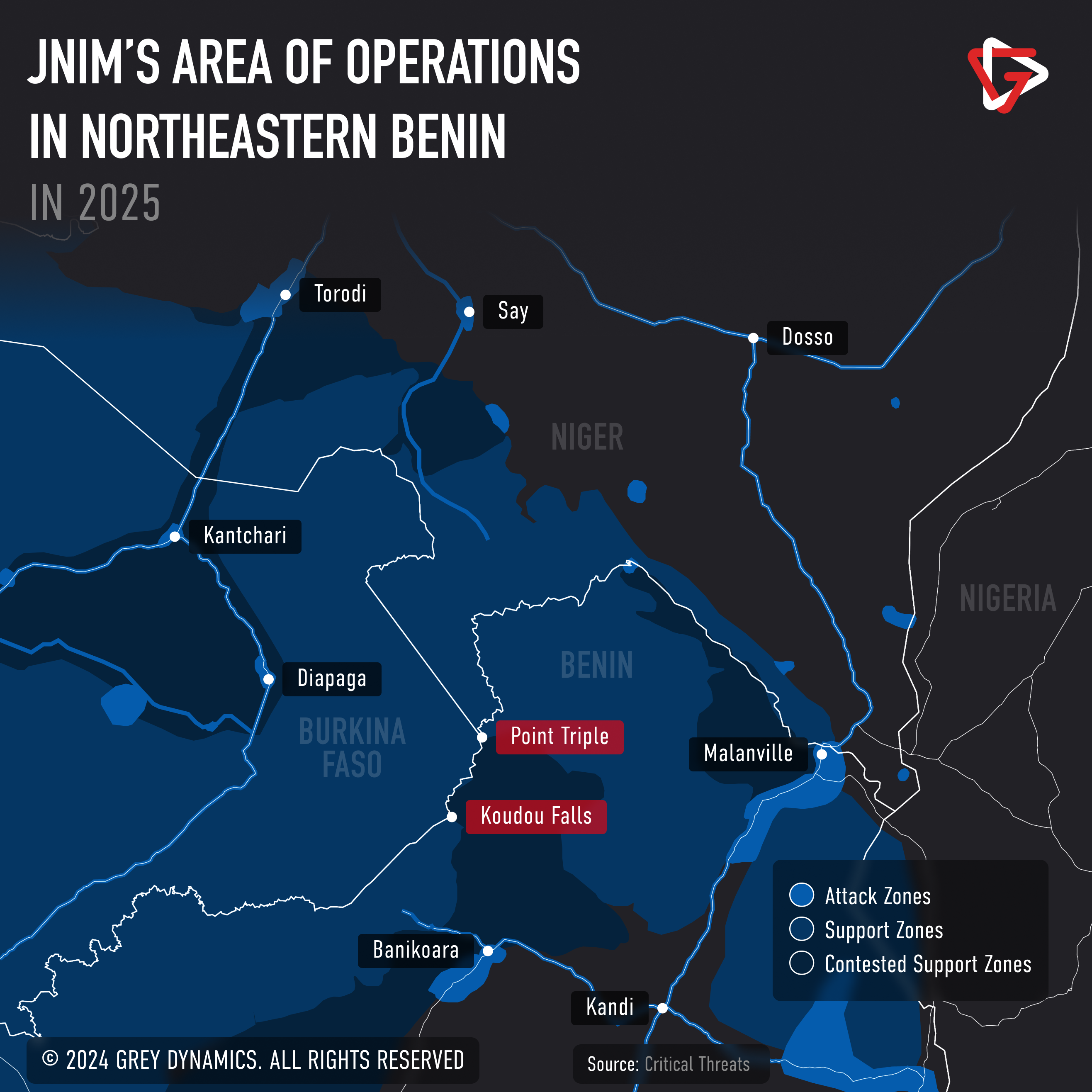
Jama’at Nusrat has several fronts open in the Sahel. On one side, it is deliberately trying to destabilise both the Burkinabe and Malian military regimes, as the group has clearly expressed in official statements after its attacks. On the other hand, it has intensified its offensive in Benin, including an attack in April 2025, considered the group’s deadliest strike in said country. [source, source]
Its movements in Benin are also replicated in Togo, where the Salafi-Jihadi militants are increasing operations in a coordinated effort to secure their rear supply lines against counterterrorism operations from both militaries. Jama’at Nusrat has affected westward and southward movements towards the Guinea Gulf through the porous borders of Burkina Faso [source]
In addition to the multi-front insurgency offensive against government forces, JNIM is also targeting the Islamic State Sahel Province (ISSP) in the tri-border area of Mali, Niger and Burkina Faso. Emerging alliances with Tuareg-Azawad militant groups has given Jama’at Nusrat the upper hand in the local dynamics of jihadist groups. [source, source]
The Institute for Economics and Peace’s 2025 Global Terrorism Index catalogues JNIM as one of the four terrorist groups responsible for the most deaths worldwide last year. During 2024, the group’s attacks resulted in the deaths of 1,454 people, representing a 46% increase compared to 2023. Additional data from the index report reflects that the attacks had the highest lethality rate, with an average of ten deaths in every attack. Jama’at Nusrat is responsible for the second-deadliest attacks of the previous year. [source]
2.0 Operational Area of JNIM
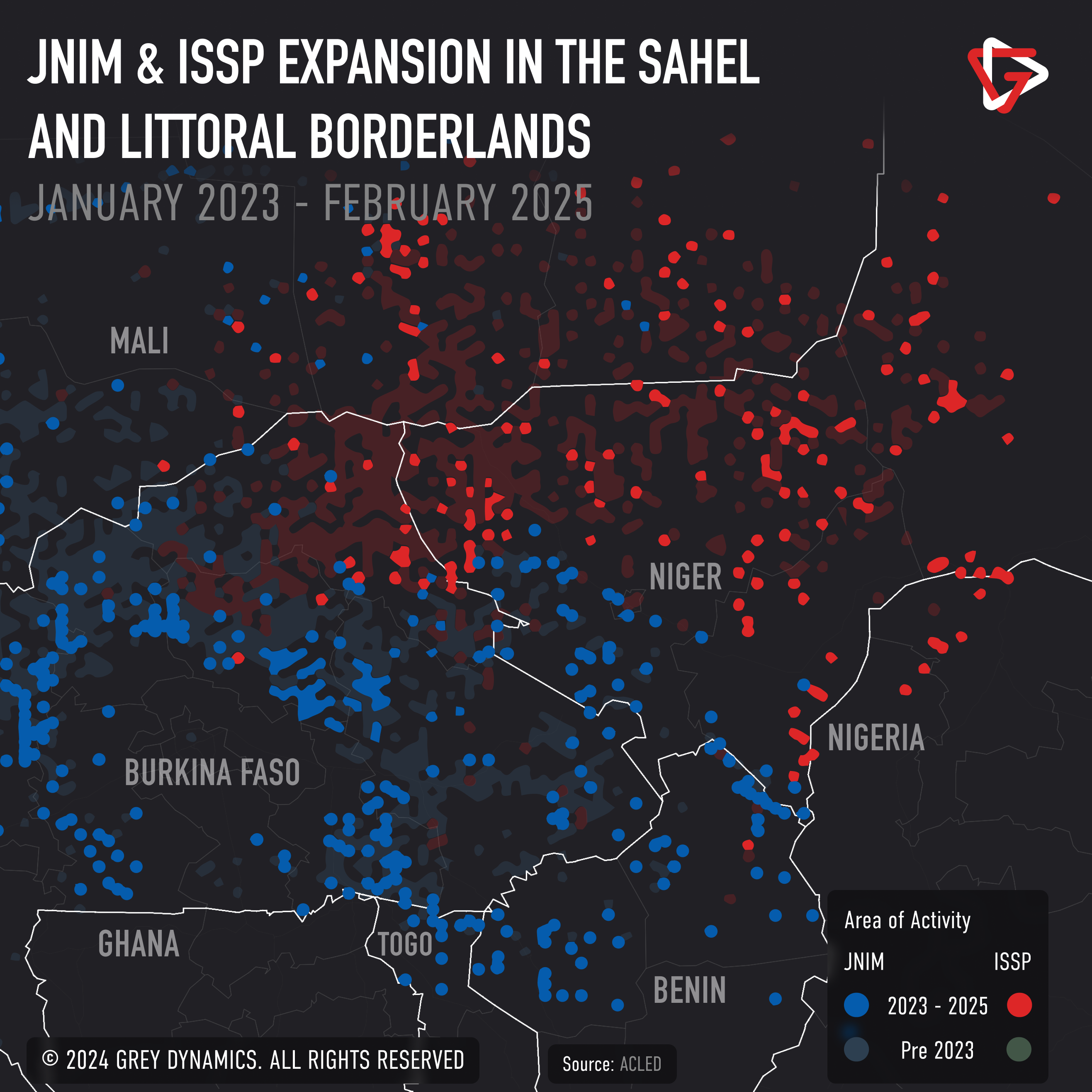
Jama’at Nusrat has significantly expanded its operational footprint across the Sahel region since its foundation in 2017. Initially concentrated in the northern provinces of Mali, the merger of Al-Qaeda and Ansar Dine with Al-Mourabitoun and the Macina Katiba solidified from 2017 to 2025, forming corridors that extend from Mali into Niger through Burkina Faso and serving as the groups’ staging grounds. [source]
In Burkina Faso, the extremist Salafist-Jihadist organisation has become the most active armed group, with a recorded presence in 11 of the country’s 13 regions. Burkina Faso’s situation is spilling over into West Africa, as jihadist militants are expanding their operations into the littoral states of Benin and Togo to consolidate their supply routes and southern flanks. [source]
Mali faces the same challenges as its neighbours in the Sahel. Jama’at Nusrat currently exerts influence in Koulikoru and Segou regions, as well as Timbuktu. Western Mali is the theatre of operations where they concentrate the majority of their kinetic strikes, but the group also has an extended presence in the south and the centre of the country [source, source]
Regarding the rest of the countries in the region, the terrorist organisation operates in the triple border of Niger as an armed actor with significant exposure. Ghana and Senegal also have documented the presence of the group, but as an economic actor involved in illicit economies. These include: artisanal mining, livestock theft, forced taxation and human trafficking. [source]
3.0 Current Tactics of JNIM
3.1 Political Insurgency
The Salafist-Jihadist’s constant evolution is not limited to territorial gains but also includes efforts to embed itself within local communities as a legitimate administration. Inside the borders of their established strongholds, the militants exploit the power vacuum and act as a parallel government. Despite not having a structured system, the organisation collects religious taxes and regulates social behaviour. [source]
These actions have allowed Jama’at Nusrat to consolidate physical control and diminish state authority in these areas. Furthermore, the group targets critical infrastructure, such as main roads or major bridges, to disrupt government operations and assert its influence. Among other targets of the group are elementary schools, which allows the militants to replace secular education with their ideological framework. [source]
Currently, the terrorist organisation seems focused on maintaining control over rural areas while avoiding assaults on urban centres. Despite last year’s attack on Bamako, documented tactics in 2024 and 2025 strongly indicate that Jama’at Nusrat al-Islam wal Muslimeen (JNIM) is seeking to isolate urban areas through guerrilla skirmishes and terrorist attacks on main roads and military positions. [source]
3.2 Unconventional Warfare
JNIM employs a combination of guerrilla strikes, conventional manoeuvres, siege tactics and advanced warfare that can shift according to the geographical location. These can go from large-scale military assaults (Burkina Faso, 2025), to deliberate ambushes on main roads (Central Mali, 2022) and small raids on remote outposts. (Western Mali, 2024). [source, source]
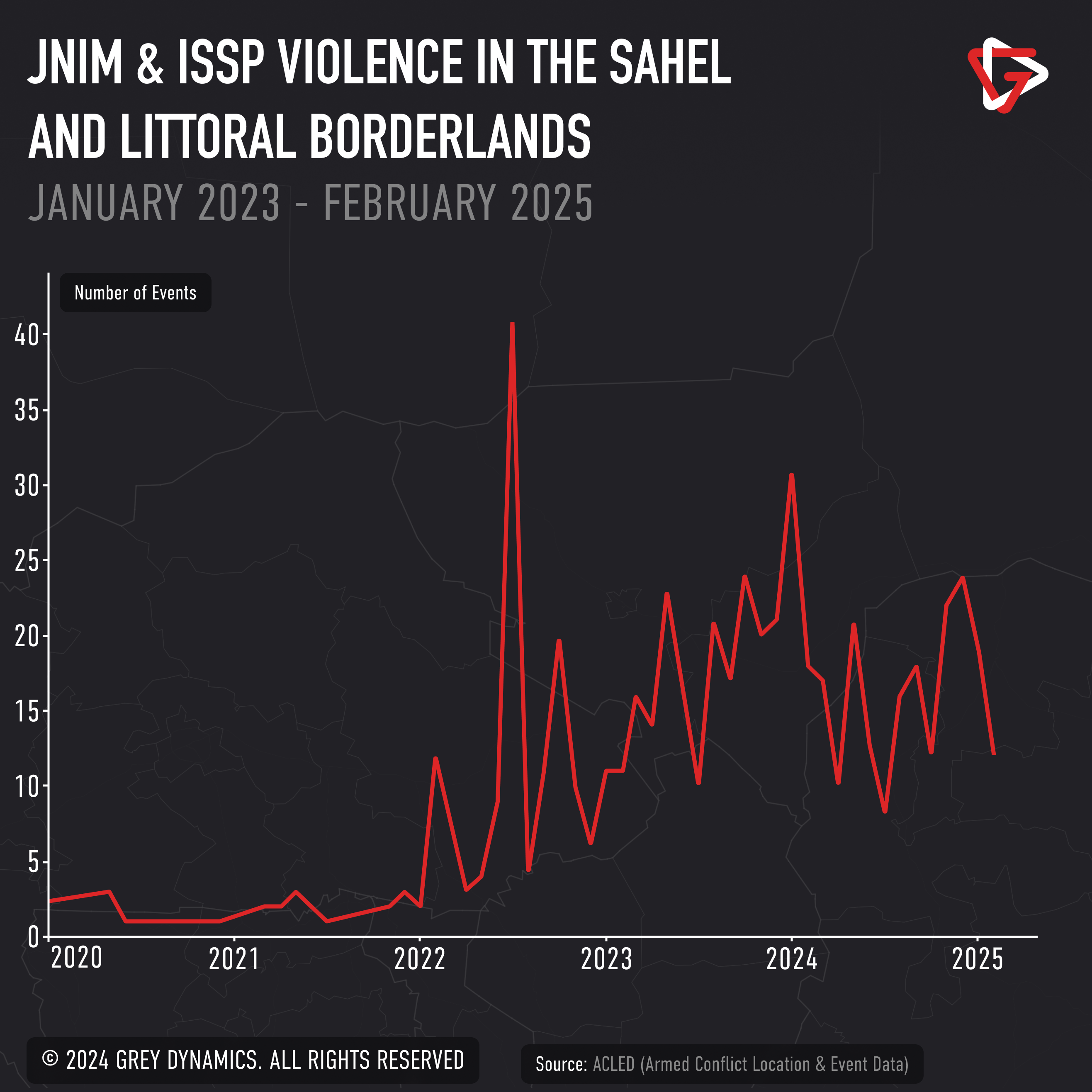
Over the years, the organisation has become more emboldened in the scope and reach of its attacks, as well as their operational tempo. Between 2023 and 2025, JNIM significantly intensified its operations, increasing the lethality of its attacks by a factor of three. Armed Conflict Location and Event Data (ACLED) suggest the group could quintuple their lethality by the end of the year. [source]
Parallel to the significant increase in operational tempo, the terrorist organisation also developed capacities in advanced warfare. The Salafist-Jihadi militant group is currently using commercially available quadcopter drones. Their mission varies, as the drones have been used both for aerial surveillance to kinetic strikes (through homemade attachment of high explosive ordnance). [source, source]
JNIM’s emerging employment of drone warfare came along with the development of its own countermeasures. Komlan Avoulete, a local researcher and geopolitical analyst, told Africa Report that the terrorist organisation “adapted their tactics to mitigate the effectiveness of state-deployed drones”. Including dispersion tactics seen in professional armies. [source]
4.0 JNIM Organisational Structure
JNIM is not a single organisation but a coalition of multiple independent Salafi-jihadist groups with different identities. These militias include Ansar Dine, Katibat Macina, al-Mourabitoun, and the Al-Qaeda Sahara Branch. There are four areas of operation driven by local dynamics shaping the actions of the component groups: Northern Mali, Central Mali, Eastern Burkina Faso and the Niger Borderlands. [source]
Each area has a different organisational structure that varies according to the interests and objectives of the bigger group operating in the area. Ansar Dine, for example, competes with other Tuareg separatist groups to become a key player in northern Mali and southern Algeria, while the Macina Liberation Front prefers religious dominance over political power and weaponises the rising extremism in Fulani communities to fuel recruitment. [source, source]
Said loose structure within the coalition makes it more difficult to analyse the group’s strategy and objectives, leading to misperceptions about leadership dynamics and political support. However, the consensus in intelligence circles is that the senior leadership of the different outfits that comprise JNIM are avoiding urban centres at all costs while waging unconventional from remote locations in border areas. [source]
5.0 Final Assessment on JNIM
JNIM is almost certain to expand its activities in Burkina Faso, Mali, and Niger. Moreover, the terrorist organisation is highly likely to continue its expansion into neighbouring countries such as Togo. Côte d’Ivoire, Ghana and Benin could also be reached by the jihadist movement. Jama’at Nusrat is also highly likely to further advance its capacities in motorised assaults and drone warfare as their offensive campaign expands through the countryside.
The Sahelian regimes are unlikely to translate operational victories near urban centres into tactical advantages; the jihadists are highly likely to exploit this circumstance to harass the civilian population sympathetic to the government in bigger cities while consolidating their place as a parallel administration in remote locations through religious coercion and armed presence. Furthermore, critical infrastructure is also highly likely to continue to be targeted by the terrorist organisation.
Although public sentiment in the capital cities remains hostile towards jihadists who are perceived as instigators of violence and instability, atrocities committed by both Malian forces and Russian contractors in the countryside may increase the perceived legitimacy of the terrorist organisation among unarmed civilians in contested locations. Fulani and Tuareg communities in the Sahel are also likely to maintain their support to Jama’at Nusrat.