
1.0 Introduction / Summary
Project Grayburn is set to be one of the most lucrative small arms contracts in the world over the next few decades. It aims to replace the SA80 weapons family—Britain’s initially controversial, but widely successful, service rifle—under an initiative announced in 2024 by the Ministry of Defence (MoD). It is the first major service rifle replacement project among NATO members since the US adopted the Sig Sauer M7 rifle, with a novel 6.8mm Common Cartridge, as part of the Next Generation Squad Weapon (NGSW) Programme in 2024. This puts Grayburn at the forefront of the debate within NATO over following the US in adopting the more powerful 6.8mm Common Cartridge or continuing to use 5.56mm as a standard.
To facilitate understanding of Grayburn and its implications, this article explores the history of the SA80, revealing a turbulent relationship between the US and its allies in common weapon systems, and considers the potential candidates and specifications for Grayburn. The finer details of this weapon system remain vague, but we discuss some specifications that have surfaced in publicly available information.
2.0 History of the SA80
2.1 Enfield’s Bullpup design: Thorpe E.M.1. and Janson E.M.2.
The L85 rifle is the final product of the ‘Small Arms of 1980’ or SA80 programme from a long fascination with the ‘bullpup’ rifle concept by the Royal Small Arms Factory in Enfield (RSAF). Starting with the .280 calibre Thorpe E.M.1. and Janson E.M.2. prototypes after World War II, these rifles were tested against the American experimental T25 Lightweight Rifle in 7.62x49mm. The trials established that the T65 7.62x49mm round, the predecessor to 7.62x51mm NATO, was ‘not suitable for [British] Army Field Forces use because of its excessive recoil, blast, flash and smoke’ and ‘the British .280 round is [instead] preferred’. However, the US Board of Ordnance disagreed with this sentiment, rejecting any replacement less powerful than the .30-06 Springfield M1 Garand.
Despite this, the E.M.2. was adopted in 1951 by the British as ‘Rifle, No. 9 Mk. I’ but its service life was cut short by the election of Winston Churchill later that year. Churchill was sceptical of the project, a product of the opposing government, so it was agreed with the US for both countries to postpone a new rifle until a NATO standard rifle and ammunition was realised. The risk of running out of proprietary rifles and ammunition was plausible, especially with a Cold War looming, so it was sensible to share weaponry with allies that can support the nation with their industrial capacity.
[source]
2.2 Enfield’s Persistence
In 1954, 7.62x51mm became the NATO standard round, and Britain followed its close ally Canada with a domestically produced FN FAL, formally designated as the L1A1 SLR. The Americans had chosen the Springfield M14, narrowly winning over the FN FAL because of its ease of domestic manufacturing. However, the 1960s saw a shift in attitude: the war in Vietnam quickly proved that the M14 was outmatched by the 7.62x39mm Kalashnikov because it handled poorly on automatic fire and depleted ammunition quickly. Thus, Eugene Stoner’s lightweight .223 Armalite AR-15 design came into fruition and later became as synonymous with “rifle” as the AK.
Enfield continued developing the bullpup in the early 1970s, culminating in the new 4.85x49mm calibre XL64-XL68 rifles. This design, drastically different from the EM-2, provided the foundation for the L85 rifle with its Armalite AR-18-inspired sheet metal receiver, bolt carrier group and gas system. During trials in 1972-74, the new 4.85x49mm cartridge was again determined to be a better cartridge than the American counterpart, the M193 5.56x45mm cartridge, in use with their M16 service rifle. However, the 1976 NATO agreement to standardise calibres meant that 5.56x45mm became official, so Enfield created a 5.56mm version of the XL64 called the XL70E3. Further refinement led to the XL85 and XL86 rifles that are now adopted as the L85 and L86 respectively.
2.3 The L85’s Troubled Start
The L85A1 had a rocky start, with the first Gulf War in Iraq being the proving ground for the rifle. Soldiers reported several issues with the design aspects and the material choices for the rifle that were not foreseen for combat in adverse conditions. The plastic butt pad easily shattered, the poor case extraction often led to stovepipes (failures to eject), firing pins were prone to snapping, and the aluminium magazines easily jammed or fell out of the rifle uncommanded as the release was not guarded. This was on top of the ingress of sand into components and poor-quality control that quickly decommissioned rifles from the fight. To remedy this, British Aerospace (BAE) acquired Heckler & Koch in 1997 to completely overhaul the design of the L85A1 into the L85A2:
- Cocking handle: Changed to a ‘teardrop’ shape for better case deflection to prevent stovepipes.
- Ejection port: Widened to improve case ejection.
- Magazines: Standard issue magazines are now the redesigned ‘HK Steel’ magazines. All steel construction prevented the issue of the plastic magazine follower becoming stuck and the body bending out of shape with the earlier aluminium magazines. Some plastic Magpul EMAGs have also been seen in use as they were reliable.
- Hammer: More mass on the hammer for the A2 variant to reduce the probability of light strikes.
- Firing pin: Profile redesigned to a thicker and more conical shape rather than the needle shape of the A1.
- Bolt: A more hardened steel is used, and the extractor is much thicker and curved for reliability.
[source]
Many of these changes were implemented in time for the war in Afghanistan, where the rifle proved to be more than capable. Older soldiers may have reminisced over the ‘full powered’ SLR, but many commended the L85A2 for being far more effective due to its better handling and SUSAT optical sight. This was not the end for improvements, as the new L85A3 iteration in 2018 extended the service life of the L85A2 beyond 2025 into 2030. The main difference, apart from its Flat Dark Earth (FDE) Cerakote, is a free-floating barrel to improve accuracy. This required a redesign of the handguard into a more modern, M-LOK variant that outshined the quad-railed Daniel Defence handguard seen on some L85A2 variants. A new optic was chosen, the Elcan Spectre 4x with a piggyback reflex sight, since a full-length picatinny rail replaced the original weaver system that the SUSAT mounts to.
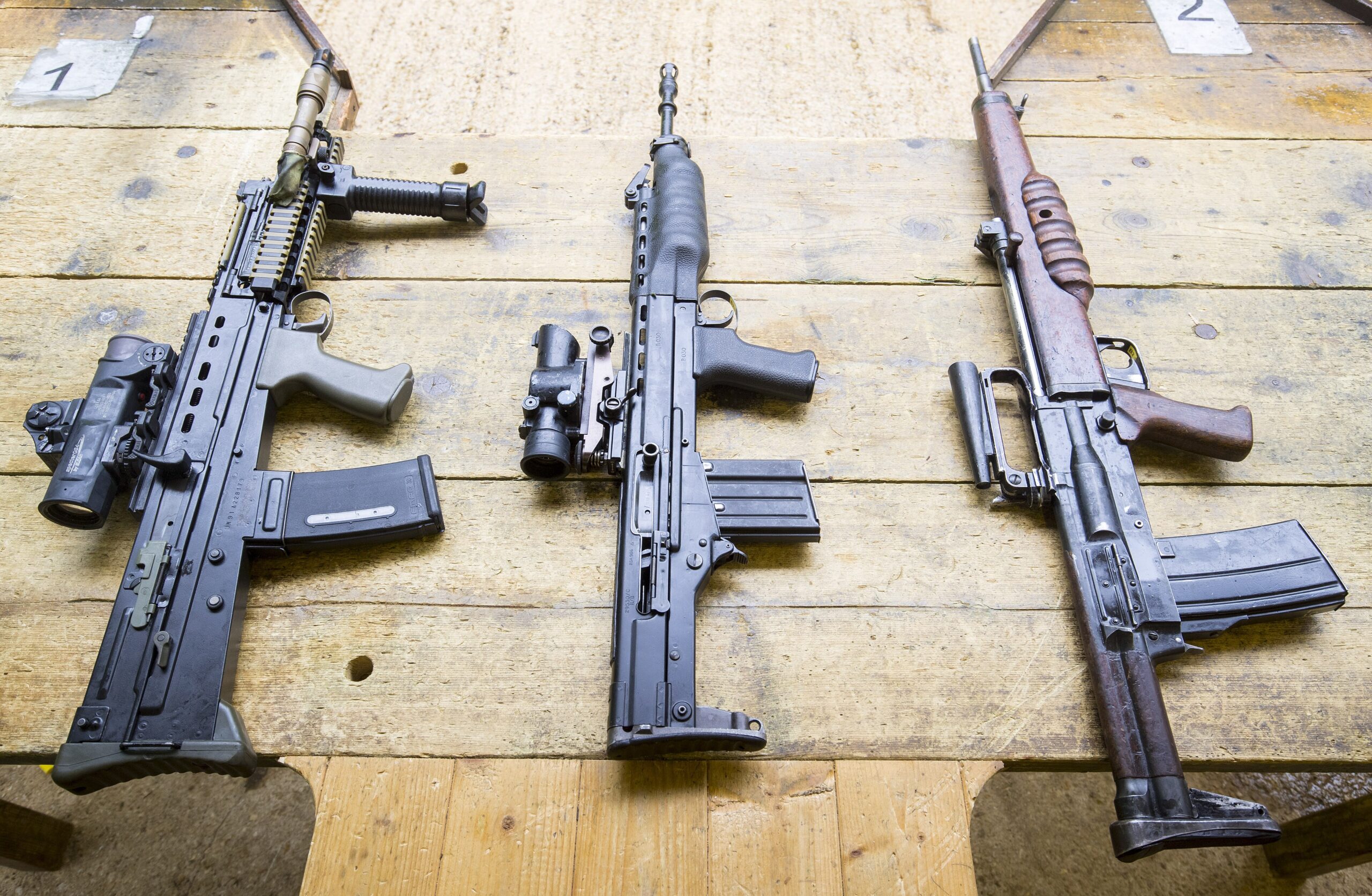
Left to right: the 5.56mm L85A2 fitted with Elcan Spectre 4x, Daniel Defence Handguard, and Magpul EMAG; the 4.85mm XL64E5; the .280 Janson EM-2 [image source]
3.0 America’s NGSW Programme: The future of small arms?
3.1 Political Crossroad for Britain
While some argue that the American Next Generation Squad Weapons Programme is a ‘step backwards’ in terms of calibre and doctrine, for the British it was a leap backwards given their brief adoption of the .280 (7mm) intermediate cartridge. In both cases, when the British developed a superior cartridge to the American counterpart, they were both dropped for political reasons, such as the American .30 calibre dogma or NATO standardisation. Britain in 2023 already adopted a new 5.56mm rifle in small quantities, the Knight’s Armament Company KS-1, as an ‘Alternative Individual Weapon’ for the Royal Marines Commandos and Ranger Regiment. However, Grayburn represents a major political crossroad over the issue of whether Britain should stick to the current NATO calibres, choose their own cartridge, or follow the United States with their newly developed 6.8x51mm Common Cartridge.
3.2 Goodbye, 5.56mm?
The 6.8mm NGSW programme is the product of two main arguments against the 5.56mm as an effective cartridge. The first is that the increasing prevalence of body armour in conflict is making 5.56mm ineffective against targets. The second is the capability gap between the 5.56mm round and the Russian 7.62x54R cartridge, responsible for about 21% of Allied casualties in Afghanistan. Studies have concluded that infantry engagements during the Afghanistan war were taking place at longer ranges than expected, and the new 6.8mm projectile is proven to far exceed the potential of 5.56mm due to its better terminal ballistics and therefore penetration of armour at range. For the United States, it is seen as especially important to upgrade in the arms race with China and Russia, both identified as ‘near-peer’ threats in terms of small arms fire and armour capability.
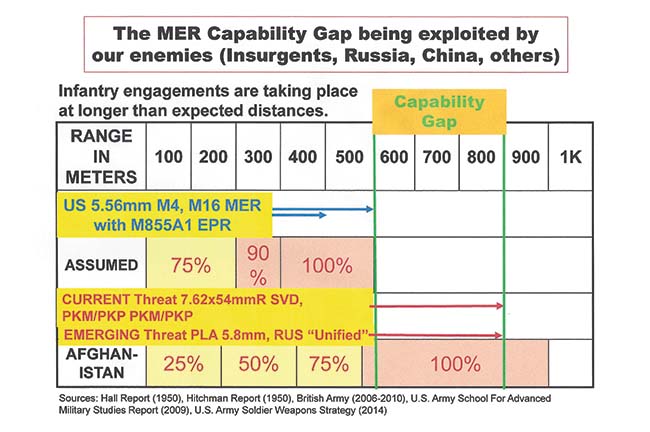
The Capability Gap between current issue weapons and threats. [source]
3.3 Britain needs a new rifle, not a new cartridge
In contrast, the MoD has a much different need for a rifle than the US Army. The main call for the replacement of the SA80 is because it is reaching the end of its service life, where the component parts of the rifles are becoming increasingly obsolete. These are quite different goals than the NGSW programme; a new rifle is needed out of necessity, not a desire to shoot new ammunition. The prime determinant of which rifle is considered will be the budget that the MoD proposes for procurement, which is expected in 2026 according to Beretta Defence Technologies Military Group manager Jack Cadman. What the exact procurement priorities are will also inform the extent that it will be a ‘next generation’ weapon.
The 6.8mm Common Cartridge also has a significant issue in terms of its feasibility. The 6.8mm General Purpose (GP) projectile is owned by the US Department of Defence, while the hybrid case technology, which is crucial to delivering the target ballistic performance, is owned by Sig Sauer. The US aims to completely replace the 5.56mm NATO with the 6.8mm, but the UK and NATO allies are likely to hold on to 5.56mm unless clear advantages are shown for making sharing agreements to use this technology. This is because the 6.8mm Sig M7 is, at present, not a perfect solution: many soldiers are unhappy with the significant weight increase and reduced ammunition count which harks back to the M14 rifle. There are concerning issues around the lifespan of the M7’s rifle components, with one Army captain declaring that there was ‘barrel and rifle[ing] gouging occurring in all samples that had greater than 2,000 rounds through the system,’ which is not even past the ‘break-in period’ of the average military rifle.
In the meantime, the UK could turn to a more powerful 5.56mm derivative (a ‘wildcat’) without the investment of acquiring the entire 6.8mm package. In an interview with Jonathan Ferguson, Keeper of arms and artillery at the Royal Armouries Museum, he suggested that the 6.5 Grendel and 6.8 Remington SPC are notable options for replacing the 5.56mm. Both cartridges provide a flatter shooting and more lethal cartridge than the 5.56mm NATO at mid-long range while retaining the same STANAG magazines. This means much equipment like magazines and webbing could remain the same, keeping costs down, while being a decent compromise between 5.56mm and 6.8mm in terms of lethality. Unfortunately, it will face the political and logistical ramifications of being a non-standard NATO cartridge if it were chosen, but likewise for the standard 5.56mm, there may have to be a clear plan from the US if NATO must transition to 6.8mm.
[source][source][source][source]
4.0 Potential Candidates for Grayburn
Several small arms manufacturers have already come forward with their latest offerings for the British Army despite the lack of details from the MoD. Candidates include Beretta Defence Technologies’ new AR platform (NARP) and their Sako-made M23, Sig Sauer has offered the MCX in 5.56mm as seen in use with many specialist units in the UK, or the 6.8mm SPEAR LT (M7), and Heckler & Koch can provide the HK416 or HK433 series in 5.56mm. All companies are actively heeding the MoD’s requirements and are ready to accommodate new calibres, but notably these are all conventional style rifles and not bullpups.
In September 2025, SA80 weapon drills were completely overhauled and now closely mirror the US Army’s malfunction clearing (e.g. ‘Tap, Rack, Bang’). This indicates a likely plan to transition to a conventional rifle layout since SA80 specific steps have been omitted from training. Tender details released on 15 January 2026 are still vague in some areas. For example, the choice of calibre is still debatable, as it only specifies ‘sufficient lethality to defeat current and emerging body armour.’ It also seeks ‘signature reduction technologies’, i.e. suppressors, and day optics with in-line night vision compatibility which brings the service rifle into the contemporary age. One significant detail is the outline for a replacement for each of the five variants, including the compact L22 Carbine for vehicle crew. This potentially rules out the Sig SPEAR LT, as the short barreled rifle (SBR) variant is only one inch shorter in barrel length and recent models do not fold. More likely, Sig might offer the MCX since a folding compact version named the ‘Rattler’ already exists. HK could offer their HK416C (C meaning ‘Compact’) and likewise Beretta could provide 11.5” folding stock NARPs.
Most of these offerings are commercial products, so Grayburn is unlikely to be a weapon system designed from the ground up. This is evident from how the companies are positioning themselves with manufacturing, where the competition is instead about their ability to build rifles quickly and cheaply. Beretta has already unveiled plans for their industrial strategy, offering a 5%, 20% or 100% domestic manufacturing option for the rifle’s components subject to acquiring other smaller contracts and the ability to export. Sig Sauer’s UK division has partnered with Accuracy International, one of the UK’s largest rifle manufacturers, to utilise their infrastructure to scale up production. Ultimately, if lessons were learned from the L85, the most attractive offering will be one that can offer not only the best rifle but also the framework to support it through its lifetime.
[source][source][source][source]
5.0 Conclusion
Project Grayburn is not only about delivering a capable fighting rifle, but also about developing a local manufacturing base that can support its duration in service. The procurement strategy delivered in 2026 has partly informed the significant goals of the program, though the chosen calibre and how craving the appetite is for a new and innovative rifle is still debatable. On top of this are plans to replace the SUSAT weapon sight (Project Upham), and several other squad weapons in Projects Cairns, Troubler and Shamer – all of which remain to be seen how they will be funded. What is clear now is that there are many companies aiming to be the one that can easily start manufacturing in the UK, provide a world-class rifle and support all at a budget that follows the same utilitarian approach of the L85. How ‘next generation’ will this rifle be, if at all? At the moment it is unclear.