
1.0 Introduction
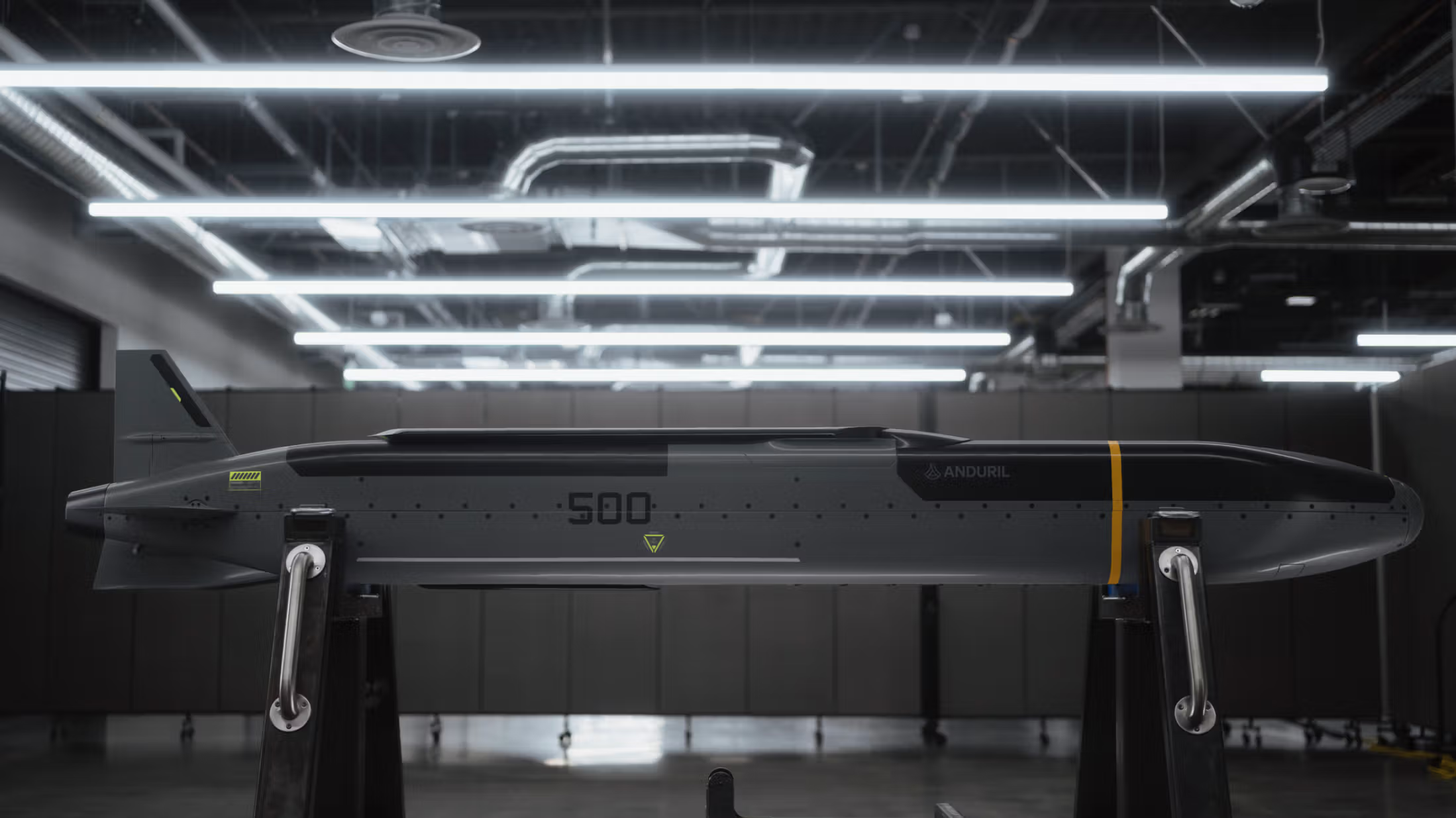
The Barracuda-500 is a cost efficient autonomous air vehicle (AAV) developed by Anduril Industries. The missile, once ‘hyper-scaled’, aims to cost only $216,000 per unit, which is miniscule compared to the closest $1.5-2 million alternatives, the Tomahawk and JASSM missiles. Initially, the low cost and high configurability was the aim of an Air Force project for a low cost test vehicle, but these factors have made the missile an attractive option for bolstering air defences. Taiwan and Poland have both made agreements to domestically produce the missile, while the U.S. could greatly benefit from supplementing their anti-ship capability gap using these low cost missiles.
2.0 Development
2.1 The Enterprise Test Vehicle (ETV) project
In June 2024, the Air Force Armament Directorate (AFLCMC/EB) and the Defence Innovation Unit (DIU) announced the Enterprise Test Vehicle (ETV) project. The ETV programme aimed to select a mass-produceable and highly modular test air vehicle for innovating subsystem upgrades that does not need to be recertified for flight tests. Off-the-shelf components were preferred rather than rare materials with long lead times, and the DIU required a range of 500 nautical miles, a minimum speed of 100 knots and the demonstration of an air-delivered variant.
Anduril Industries was one of the four companies selected from a pool of over 100 to compete in the program, alongside Integration Solutions for Systems, Inc., Leidos Dynetics and Zone 5 Technologies. The first Barracuda-500 autonomous air vehicle (AAV) was successfully flight tested in September 2024, demonstrating the surface launch, 30 minute flight, and the AI assisted targeting and automatic terminal guidance to a GPS target. Anduril officially announced the Barracuda family of missiles in December 2024 and, by April 2025, the EB and DIU advanced the Barracuda-500 in the ETV program for testing its adaptability against Weapon Open System Architecture (WOSA) standards. Anduril claims the Barracuda, compared to competitors, can be produced 50% more quickly, made with 50% fewer parts, and requires 95% fewer tools, though not stated.
[source][source][source][source]
2.2 The Barracuda-500’s Strategic Role
The Barracuda-500 is unique because it combines features of a cruise missile and loitering munition while being low cost. Cruise missiles such as the Tomahawk and JASSM already exist in the U.S. inventory, but both systems are priced between $1.5-$2.0 million for each, and could take at least 20 months to replenish under typical munition production timelines. In particular, the $3 million AGM-158C Long Range Anti-Ship Missile (LRASM) from the JASSM family is currently short-numbered, with only 450 missiles in U.S. inventory compared to 3,650 AGM-158 JASSM-ER. The Center for Strategic and International Studies (CSIS) predicted in all 24 wargame simulations of a Chinese invasion of Taiwan a depletion of LRASMs within one week of combat. Furthermore, some analysts predict the US will run out of all JASSM missiles within a few months of a conflict based on the demand for precision missile strikes against the Islamic State outpacing supply for years after.
The Barracuda can easily supplement these systems as a cheap munition, used in large-scale attrition attacks against air defences, or as a disposable UAV for surveillance and targeting support. It is not a replacement for the Tomahawk and JASSM – both have vastly superior ranges and payload sizes which are compared in section 3.1 – but rather a new strategic option for anti-ship strikes from airborne platforms.
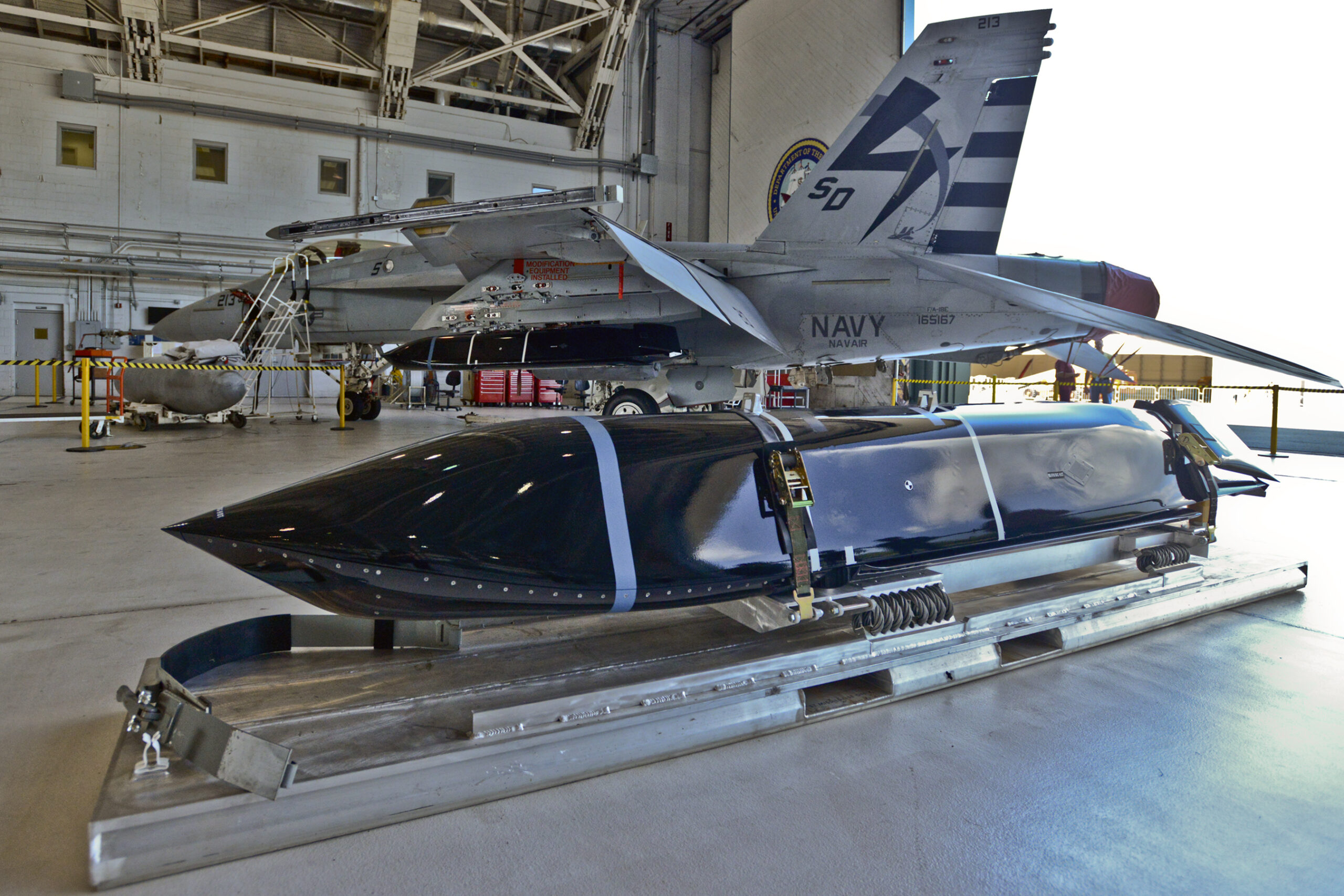
The AGM-158C LRASM as deployed on the F-18E/F [image source]

3.0 Specifications
The Barracuda family consists of three models: the Barracuda-500, the Barracuda-250 and the Barracuda-100. The Barracuda-500 is the largest while the Barracuda-250 is a slimmer version designed for mounting in internal bomb bays. The Barracuda-100 is similar to the AGM-114 Hellfire and AGM-179 JAGM in profile and is a slower, but higher payload and longer ranged option over both missiles.
3.1 Technical Overview
Payload:
Barracuda-500 has a payload of 45kg, which is about one tenth of the payload of the Tomahawk and JASSM. The Barracuda-250 and the Barracuda-100 both have a 16kg payload.
Range:
According to Anduril, Barracuda-500 missiles are reported to have a range of ‘more than 500 nautical miles [926km]… and can loiter for more than two hours’. This is comparable to the JASSM-ER (Extended Range variant), while the Tomahawk and JASSM-XR (Extreme Range) have an approximately 1,000-1,500 mile (1,800-2,500km) range. The heliborne Barracuda-100 has an air-launched 222km range and the Barracuda-250 has an air-launched range of 370km, or 277km when ground launched.
Speed:
Up to 575 mph or Mach 0.75, with maneuvers up to 5g. This is approximately the same speed as the Tomahawk and JASSM, owing to the turbofan propulsion system used on all three missiles.
Guidance System & Accuracy:
Few details released but likely standard GPS and inertial navigation. Anduril’s ‘Lattice’ suite will likely configure the missile through ‘Command and Control’ and ‘Mission Autonomy’ software. ‘Command and Control’ offers AI powered insights to operators to streamline decision-making, while ‘Mission Autonomy’ allows users to model situations and programme autonomous behaviours to desired risk levels.
Platforms:
Barracuda-500: Mounted on external hardpoints of various fighter aircraft including F-15E, F-16, F-18E/F or tail launched from the C-17 and C-130 cargo aircraft via pallet (Rapid Dragon Program). Ground launched variant planned by NCSIST.
Barracuda-250: Mounted in the internal bay of F-35A/B/C and bombers, external hardpoints of fighters, or surface launched from the M270 MLRS, M142 HIMARS, and GMARS. Fits Common Launch Tubes (CLT).
Barracuda-100: Mounted to the heliborne rails of AH-64 and AH-1Z, tail launched from the C-130, or ground launched.
[source][source][source][source][source][source]
4.0 Future Operators and Use Cases
4.1 Taiwan
In September 2025, the National Chung-Shan Institute of Science and Technology (NCSIST) unveiled a Barracuda-500 variant at the Taipei Aerospace and Defence Technology Exhibition. NCSIST president Li Shih-chiang announced plans for a Taiwan based supply chain and aims to reach mass production in 18 months. Each missile is aimed to cost under $216,000, or T$6.5 million, and follows defence spending increases to 3.3% of GDP in 2026 to reach the target 5% by 2030.
While there are restrictions on US technology transfers, particularly on the Taiwanese development of ballistic missiles with a range over 300km, the plan to produce 100% of the missile domestically could be seen to maintain the US’ strategic ambiguity on Taiwan. The latest reporting in September 2025 outlines NCSIST’s plans for a ground-launched variant which are being discussed with Anduril.
4.2 Poland
Barracuda-500M missiles are planned to be manufactured for the Polish Armed Forces according to an agreement between Anduril and Polska Grupa Zbrojeniowa (PGZ) on 27 October 2025. However, the technology transfer is yet to be approved by the US government.
[source]
5.0 Conclusion
Anduril is reshaping the defence industry by providing highly scalable and adaptable technology that compliments the U.S military’s long-standing systems and strategies. The Barracuda-500 epitomises this new trend, where low-cost and rapidly deployable systems are preferred over high-cost and long lead time systems. Through this, not only is superiority achieved from attrition, but also in the ability for other NATO countries to quickly adopt and adapt these systems to their defence: ‘rebuilding America’s arsenal of democracy’.