
1.0 Introduction
Night Vision Devices (NVDs) are highly complex and expensive pieces of equipment designed to amplify near-infrared light. Starting as an aid for drivers during World War II, their use has evolved into a headborne platform for supporting night operations for shooting, navigating, spotting, and driving. In this piece, the history and military use of night vision is explored with a focus on night vision weapon sights and head mounted solutions. The technology is deconstructed, explaining each tubeʻs specifications and clarifying myths to provide a comprehensive guide on what to look for in a night vision capability.
2.0 History and Military Use of Night Vision
2.1 Generation 0
Night vision devices began as the solution to combat in the darkness, which during World War I often required large search lights to illuminate areas. The first night vision device was a modified television camera for nighttime anti-aircraft defense, invented by Hungarian physicist Kálmán Tihanyi in 1929 for the British Armed Forces. The German Army was the first military to broadly adopt night vision devices, in 1939, but only in limited quantities for tanks (the FG 1250) and infantry (the “Vampir” man-portable system). The US subsequently developed the M1 and M3 “sniperscope” / “snooperscope” for the M1 carbine, which was rare in its issuance, and the United Kingdom and Soviet Unionʻs early experimentations with night vision did not lead to adoption of any complete systems.
The technology at this point was still primitive. Devices after World War II are described as ‘active’ or ‘Generation 0’ night vision, since they required a separate infrared illumination source to light up the target. These spotlights were often set up on trucks or on beacons, were bulky and difficult to transport, and easily gave positions away to the enemy equipped with infrared viewers. The breakthrough would come with the first Generation 1 night vision device, which was powerful enough to transform the ambient light into a visible image without an external light source.
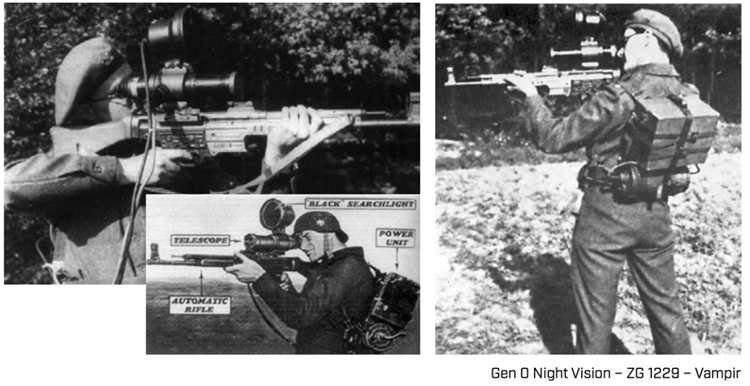
Gen 0 ZG 1229 ‘Vampir’ night vision scope mounted to the StG 44 [image source]
2.2 Generation 1
Generation 1 night vision was the first ‘passive’ night vision technology, requiring no external infrared illumination source to operate. The introduction of the AN/PVS-1 and AN/PVS-2 Starlight scopes during the Vietnam War was successful and became essential for navigating the jungle during nighttime operations. These devices, while able to amplify the ambient light by a thousandfold, still required some moonlight or clear conditions to operate, a limitation solved with the next generation devices.
Other common Generation 1 night vision devices include the Russian NSPU 1PN34 and 1PN58 night vision scopes, however these were designed around the 1970s when Gen 2 was starting to become available in the West. These scopes are still seen in contemporary conflicts and can be mounted to the AKM, PK, RPK and RPG-7 with interchangeable ballistic cams for zeroing.

Russian NSPU 1PN34 night vision scope [image source]

2.2 Generation 2
Generation 2 night vision devices were characterized by significantly improved performance of image intensifier tubes in low light conditions. Photons could now be multiplied instead of accelerated, hence a shift from image converter tube to image intensifier tube technology. These tubes also had automatic gain control, reducing brightness to avoid blinding the user and to protect the tube, and also allowed the tube to continue operating during the firing of the weapon without being rendered useless.
2.3 Generation 3
In the 1980s, the application of gallium arsenide in night vision devicesʻ photocathodes doubled the sensitivity of the light sensors, resulting in Generation 3 devices with drastically improved low light performance compared to Gen 2. By the time of the Gulf War, the adoption of the technology was the “single greatest mismatch” between the United States and their adversaries. Headborne night vision devices became essential for combat at night, and a strategic tool for weaponizing darkness in special operations. For example, the raid of Osama bin Laden’s compound in Operation Neptune Spear utilized the phase of the moon and a coincidental power outage. Some of the fundamentals of this technology remain unchanged today, mainly due to technological limitations, which has resulted in the US military advantage being diminished.
The US military in 1982 began to describe these devices using a naming scheme called OMNI Classifications. These do not directly correspond to tube specifications, but rather to the US military contracts that they were produced under. Hence, they are minimum performance specifications expected of the tube at the time of the contractʻs finalization. For example, an Omni VI tube produced in 2004, well into the timeframe of the Omni VI contract, which started in 2002, is likely to perform better than an Omni VI tube produced closer to the start of the contract. However, tubes with the same designation (e.g. ‘MX10160A’) are expected to perform the same, regardless of manufacture date. (Full information on OMNI classifications can be found in this excellent resource.)
The jumps in performance between OMNI III and IV, and then V and VI, are quite significant due to the improvements in photocathode sensitivity and halo (see 4.0). OMNI IX is the latest contract, appearing in 2019. As a side note, any tube that meets or exceeds these guidelines are considered ‘milspec’ as opposed to commercial.
2.4 Unofficial Generations
Generation 2+, or ‘Super Second Generation’, is a compromise between Gen 2 and Gen 3 tubes invented in 1989. It drastically improves the sensitivity of the tube and reduces the noise of the Gen 2 photocathodes, offering near Gen 3 performance in terms of image quality and noise at a much lower price. However, their main drawback is the low-light sensitivity: the minimum specs are still far off those of the Gen 3 gallium arsenide photocathode technology, meaning the average Gen 2+ tube is unlikely to outperform them.
Photonis brand tubes are made in Europe and were developed to a different standard than the US night vision technology. They are usually classed as high end Gen 2+ as they use unfilmed tubes like top-spec Gen 3 tubes, but not the gallium arsenide photocathodes, hence some have labelled it a ‘hybrid’ tube. Performance wise, their 4G and 4G+ tubes are top of the line milspec tubes while the ECHO tubes are cost friendly options that did not meet the same standard.
[source][source][source][source]

Comparison of a Gen 3 Omni V tube and a ‘Gen 2+’ Photonis XR5 tube. Note the overall quality of the tube will be slightly obscured by digital photography compared to looking through the physical unit. [image source]
3.0 Types of Night Vision Devices
3.1 Monocular, Biocular, Binocular, Panoramic
Monocular devices like the PVS-14 use a singular tube and eyepiece, making them a lightweight and practical option for helmet or weapon mounted setups. Biocular devices like the PVS-7 use a singular tube with two eyepieces. They are usually older devices and are being replaced by monocular night vision due to their significant disadvantages, such as poor depth perception (due to their size putting the tube further away from the eye) and the inability to aim down sights like monocular and binocular models. Binocular night vision devices (BNVD) like the PVS-31 incorporate two tubes in separate optical pods. As such, they are much more expensive than single-tube devices but offer greater field of view. Lastly, the Ground Panoramic Night Vision Device (GPNVG-18) developed by L3 Harris uses two eyepieces and four tubes angled to increase the field of view to 97 which is more than double the 40 offered by a monocular. This design was driven by pilotsʻ need for a wider field of view without compromising the image resolution, as done in other designs by stretching the tubes.
[source]

GPNVG-18’s seen in use by DEVGRU during Operation Neptune Spear. Their wide FOV makes them ideal for CQB. [image source]
3.2 Analog vs Digital vs Thermal
The night vision discussed in this history are analog devices. These work by converting incoming photons into electrons via a photocathode. Generation 0 accelerates these electrons via a photocathode to hit a phosphor-coated screen, which lights up to produce an image viewed by the user through a lens for focus. Generation 1 places multiple photocathodes and phosphors in an array to ‘multiply’ the light in the image, however this meant they were easily saturated by muzzle flash and bright lights. For Generation 2 and 3 devices, the microchannel plate simplified this setup since this piece can multiply the electrons and hence only one photocathode and phosphor is needed.
Digital night vision works similarly to thermal imaging devices. Both work by using a camera sensor designed for their respective part of the electromagnetic spectrum, which is then translated into a visible image and displayed on a screen. There are few advantages to digital night vision, mainly cost effectiveness and the ability to record video. Thermal imaging provides some advantages over analog and digital night vision. It can detect heat signatures from targets (warm blooded animals, including humans) in a multitude of weather conditions, but this is countered by a poor image for navigation. The biggest drawback of digital imaging is the low framerate and image quality compared to analog devices, but this is gradually improving. It therefore suits weapon sights and targeting devices but is unsuitable for helmet mounted setups. Recent developments in night vision technology have incorporated thermal imaging into analog tubes, creating an ‘augmented’ night vision tube with thermal imaging capabilities.

A good example showing the advantages of both technologies: night vision is better for navigation, while thermal is better for identifying warm blooded targets [image source]
4.0 Intensifier Tube Specifications
Intensifier tube specifications are usually listed on good retailer’s websites or are available on request. Brand new night vision intensifier tubes will come with a specifications sheet which indicates how the tube performed at the factory before sale. These should be inspected before purchase since tubes are made for different purposes (weapon sights, aviation) and their manufacturing quality can vary over time.
4.1 Resolution
Resolution is the ability to distinguish finer details as measured by the number of alternating black and white lines within one millimeter (hence line pairs per millimeter, lp/mm). It is more important for clip-on weapon sights than helmet mounted night vision since the human eye can not perceive a difference past a certain point compared to a magnified optic. Resolution for milspec tubes has remained the same for the last 30 years at 64lp/mm (Omni IV). Typical Gen 3 and Gen 2+ tubes will have a resolution over 80lp/mm while older Gen 3 and Gen 2 tubes will be around 50lp/mm.
4.2 Signal to Noise Ratio (SNR)
Signal to Noise Ratio (SNR) measures how noisy the image gets in darkness, with higher SNR values meaning a cleaner image in darker conditions.
4.3 Figure of Merit (FOM)
Figure of Merit is a quick assessment of a tube’s performance calculated by multiplying the resolution and SNR. The US military classifies Gen 3 devices by FOM. An issue with this measurement is it favours resolution, since it is usually a higher number than SNR, despite the differences in SNR being more perceivable than changes in resolution.
4.4 Equivalent Background Illumination (EBI)
Equivalent Background Illumination (EBI) reports the minimum brightness required for the tube to generate a visible image. Lower EBI values are better. In a very dark environment, if the minimum EBI is reached, the tube will generate a very low contrast image, whilst if the SNR limit is reached, the image will be very grainy. EBI is also affected by temperature and becomes more important in high temperature environments.
4.5 Halo
Halo determines the size of the bloom around light sources and so a lower value is usually better. The only caveat is that halo is set by the distance of the photocathode from the microchannel plate, and so tubes with a closer microchannel plate are prone to bumping into each other to cause a smear on the image. Therefore, for weapon mounted solutions the lowest possible halo value is not best despite reducing bloom from red dot sights and muzzle flash.
4.6 Gain
Gain is an umbrella term for Luminance Gain and Photocathode Sensitivity. The luminance gain reports how much brighter the tube can make the background image. Gain is inversely correlated with signal to noise ratio: a high gain tube is also very likely to be very noisy. Gain has also remained constant over the last 40 years.
4.7 Auto-gating and Gain Control
Auto-gating is an important optional feature of modern NVDs. It is commonly misunderstood as a feature to protect the device from bright light by turning it off, however Gen 1 and above NVDs have this safety feature regardless of auto-gating. Because Gen 2 and above night vision cathodes multiply electrons, they risk overwhelming the tube with too many photons around bright light. Auto-gating rapidly pulses the photocathode and microtubule to reduce the photons in the image, allowing the user to maintain a usable picture and vision behind the light source without excessive blooming. This is extremely important for urban environments and is a feature common on most Gen 3 and Photonis tubes. The only disadvantage to auto-gating is it can reduce the glow from light sources like a reflection from an animal’s eyes, which could be important for hunting.
Gen 2 and above tubes have bright light cut off or automatic brightness control. These systems within the tube protect the device and the user’s eyes from a sudden bright light like a flashlight and then reduce the light level to a preset level.
Manual / External Gain Control is an additional option which interacts with the microtubule and the phosphor. It controls the threshold to multiply the photons via a knob on the housing, allowing the user to suit the conditions by letting in more or less light to their picture. It is important to identify what purpose the tube was designed for as aviation tubes lack manual gain control.
4.8 Other Tube Factors
Tubes are prone to blemishes, which are dark spots or smears that appear down the view of the device. These vary depending on the tube’s intended purpose, with stricter thresholds for aviation tubes compared to generic ‘military’ tubes. Ghosting or Burn-Ins are caused by a tube aimed at a light source for extended periods of time and can be fixed by ‘blackboxing’: leaving the device running in a dark room to reset the phosphor screen. However, manufacturing anomalies or laser damage is usually permanent and cannot be fixed. Dust and condensation within the unit can be cleaned via purging with a gas like nitrogen or argon.
Another factor is the phosphor colour: options are green and white. These are mostly cosmetic, however the costlier white phosphor is designed to reduce eye fatigue caused by extended use.
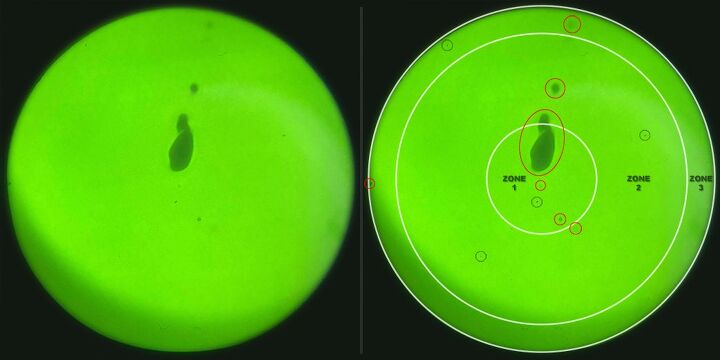
Example of blemishes in a surplus image intensifier tube. Blemishes from the factory will be much smaller and fewer in number. [image source]
4.9 Housings & Mounting
Housings for the layouts described in 3.1 are made by a variety of companies with differing quality standards and features. Options include construction material, either polymer or metal, built-in IR illuminators, manual gain knobs, and power management systems like battery alerts and automatic shutoff. Headborne setups require dovetail or bayonet mounts onto the bridge, while a picatinny interface is needed for weapon mounting. Articulating pods, for binocular night vision, allow users to adjust for pupillary distance, quick stowage, and one eye operation which can all be preferable to a fixed bridge setup.
5.0 Considerations and Recommendations
To summarize, the purpose of the night vision device will dictate the desired layout and performance level required. As a general recommendation, the PVS-14 is unbeatable for cost-effective shooting, driving, and navigating NVD and far exceeds the capabilities of biocular and digital devices. Binocular NVDs offer substantially improved field of view and depth perception, and similarly the panoramic night vision, if budget is not a constraint.
In terms of tube specs, only Halo, SNR, and blemishes are the key factors to beware of since resolution and gain remain mostly unchanged over the years. The differences between EBI are not large enough to make a noticeable difference, but are beneficial to understand. A resolution over 64 lp/mm, SNR of 28 or higher, gain over 20,000, and EBI and Halo below 1.0 is a good start for a Gen 3 night vision headborne setup. If aviation is the intended purpose of the tube, top of the line offerings are most suitable.