
1.0 Introduction
Few weapons in this world are as widely-known, versatile, and dangerous as the shotgun. Short-ranged, yet extremely powerful, the shotgun is the multi-tool of the firearms world. Originally designed with the hunter in mind, it has evolved from shooting game into a weapon capable of taking down large animals in the forest, stopping home intruders, neutralizing drones on the battlefield, controlling crowds in law enforcement settings, and breaching locked doors in tactical situations. Shotguns come in single shot, repeating action, semi-automatic, and (rare) automatic models and can handle a wide assortment of ammunition, from simple ballistic (lethal and nonlethal, single round to multi-shot charges) to incendiary to explosive. The shotgun’s performance over time has secured its place in the future among hunters, law enforcement officers, and military personnel, and new innovations in design, applications, and ammunition continue to surface each year.
2.0 History and Types of Shotguns
2.1 From Muzzleloaders to the Cartridge
The first ‘shotguns’ were the lavish ‘Haile Shotte peics’ (Hail shot pieces) owned by King Henry VIII circa 1540. These were copies of the military matchlock musket that were loaded with multiple lead shot, at the time cut from sheets, for bird hunting. The sport was also restricted to those ‘worth £2 a year’, meaning the wealthy gentry who owned land. The matchlock innovated with the first trigger, which would press a lit ‘match’ made of hemp against the powder in the pan to set off the charge. A law in 1548 attempted to ban shooting ‘hayle-shot’ as it anticipated the effortless extinction of wildfowl, and noted the futility of the load for military practice.
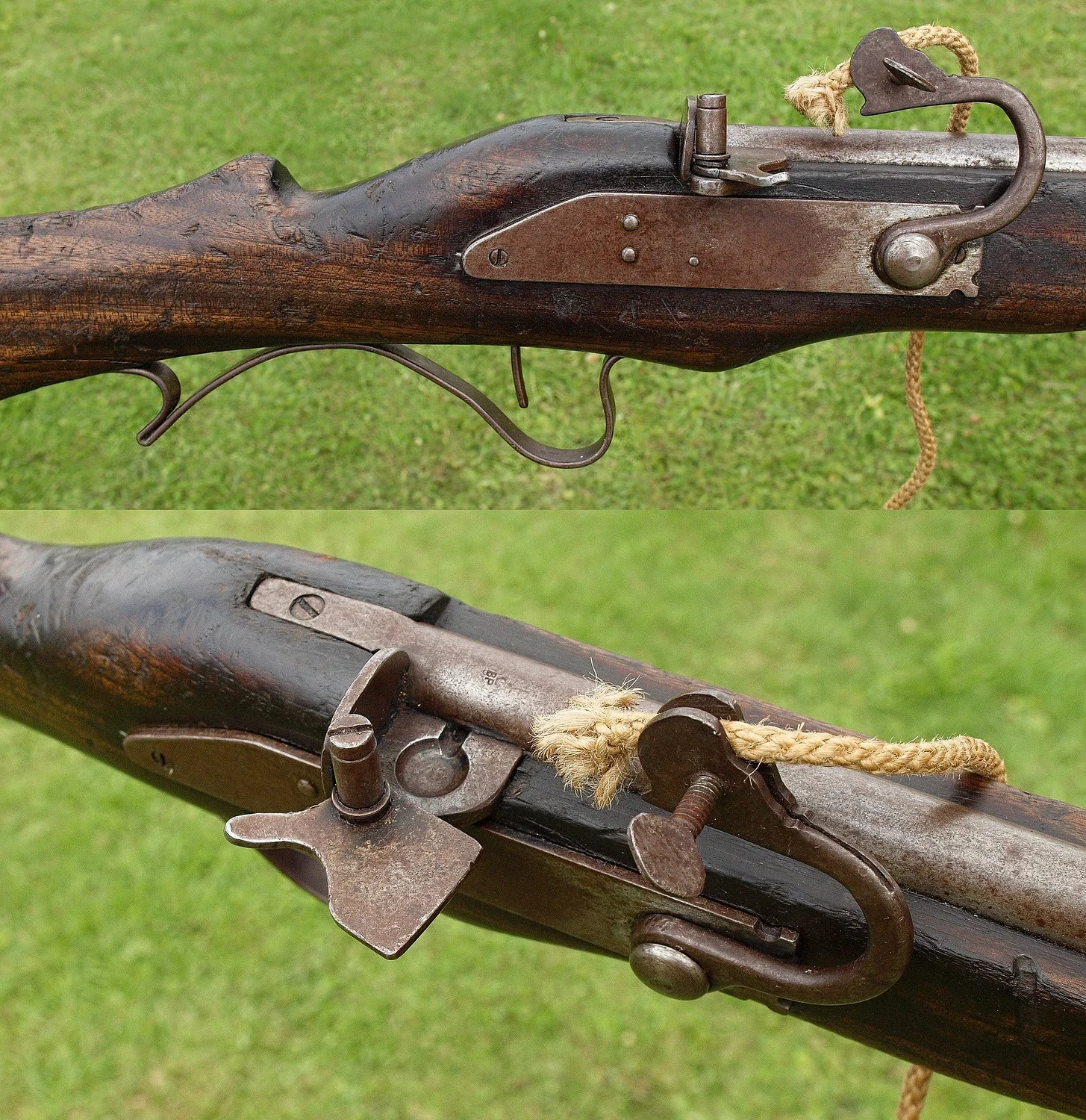
A reproduction matchlock mechanism on a 17th century musket. [image source]
The alternative design, the wheellock rifle, used a winding serrated wheel against iron pyrite to create a spark for igniting the charge. Pulling the trigger would uncover the pan, drop the pyrite onto the wheel and spin the wheel to produce a spark, setting off the charge. Like the matchlock, these were only afforded by the rich as the mechanism was complicated. The invention of the flintlock would become the most famous type of muzzleloader as it was cheaper to produce and much faster to reload. Instead of using a spinning steel wheel, it used a flint attached to the hammer to strike the steel above the pan, opening the cover and creating a spark to ignite the charge.

A brass barreled flintlock blunderbuss, circa mid-to-late 18th century. [image source]

Around the start of the 17th century, the ‘blunderbuss’ (Dutch: ‘donderbus’ meaning ‘thunder gun’) emerged which was a short barreled flintlock with a flared muzzle loaded with multiple lead balls. It is thought that the flared muzzle assisted loading, and some argue it potentially increases shot spread. By the 18th century, the British Royal Navy adopted the weapon since it suited ship boarding and defence, and pirates would follow suit. Similarly, a pistol version of the blunderbuss, known as a ‘dragon’, became synonymous with cavalry troops (nicknamed ‘dragoons’) and highwaymen who valued the weapon’s portability and ambush potential.
At the same time, the American Revolutionary War popularized buck and ball loading, which is a musket load consisting of a musket ball and three to six buckshot. By 1776, the first use of the word ‘shotgun’ was recorded in Kentucky as part of the “Frontier Language of the West.” In 1800, fulminates were discovered by Edward Howard which spurred the creation of the percussion cap. These were early primers, i.e. shock-sensitive explosives, mounted to the musket which would detonate the charge when struck by the hammer of new ‘caplock’ guns. Later, with the invention of the rifle cartridge came the shotgun cartridge, typically made out of paper to save weight over their brass alternative. Paper would continue to dominate the market until the first plastic shotgun cartridge appeared in the 1960s.
2.2 Break action
Break action shotguns are extremely popular for hunting and sporting (skeet, trap, and sporting clays). The modern hammerless double-barrel appeared around 1880 to replace older boxlock and external hammer shotguns. The ‘breaking’ of the action was revolutionary, as the lever used to open the shotgun simultaneously cocked both cylinders and ejected the cartridges. The barrels are either placed vertically as an ‘over and under’ or ‘side by side’; single-barreled break action shotguns are meant for hunting and are less common. Within break action shotguns are combination guns, which are hunting shotguns with additional barrels for firing rifle cartridges. ‘Drillings’, ‘Vierlings’ and ‘Fünflings’ are the official names in German to describe triple barrel, quadruple barrel and quintuple barrel combination guns.
[source]
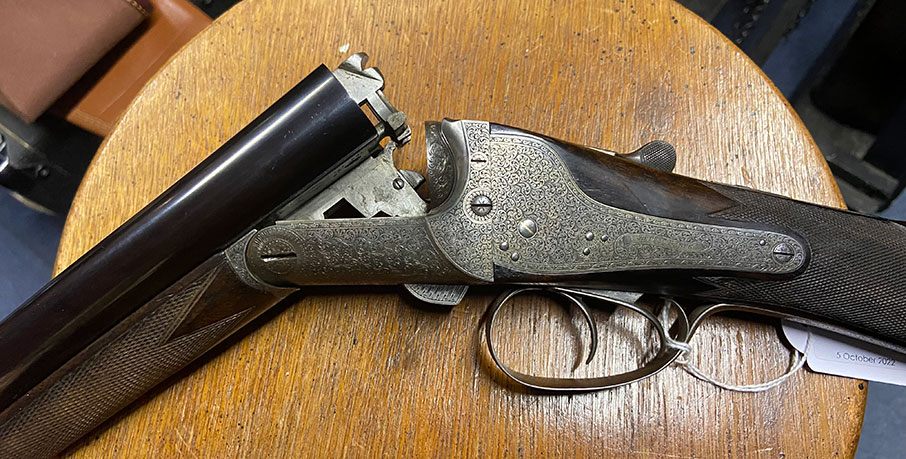
The inventor of the ‘hammerless’ breech-loading shotgun is highly contested since multiple individuals filed patents in the mid 19th century of varying designs. However, the most commercially successful was Theophilus Murcott’s 1871 patent which was later refined into the modern hammerless shotgun. [image source]
2.3 Lever action
Early repeating shotgun designs cloned lever action or bolt action rifles that were prominent at the time. In 1885, John Moses Browning developed the first working lever action shotgun, the Winchester Model 1887, for the Winchester Repeating Arms Company. The company had postponed his suggestion for a pump action model as it was well known for making lever-action rifles. However, Browning would later convince the company to produce the pump-action, which became far more popular than the lever-action.

Today, lever action shotguns are uncommon, with few companies innovating beyond the Winchester M1887. In 2016, there was some controversy in Australia over lever-action shotguns since they were initially classified as the ‘least restrictive’ firearm to obtain, but now have been banned from import. Despite its modern real-world unpopularity, Arnold Schwarzenegger would immortalize the Winchester M1887 as one of the most iconic firearms in film history by spin-cocking the shotgun in Terminator 2.
2.4 Pump action
Browning succeeded his Winchester M1887 lever action model with the pump action Winchester M1897. The design of both weapons is remarkably similar: both feature an elevator that lowers to collect the next cartridge when the action is opened, and then pivots up to feed when the action is closed. The difference was changing the rolling block to open the action, where the breach is rotated away, to a linear system operated by a pump that was far less finicky.

Above: Winchester 1897 (M97) Below: Winchester 1912 (M12) [image source]

The pump action remains popular today because it can handle all shotgun shell types, is typically cheaper and jams less frequently than the semi-autos, and boasts a large magazine capacity over the break-action. Some of the most famous ‘trench guns’ include the Winchester 1897 ‘Trench Gun’, their later Model 1912, and the Stevens 77E. Modern classics include the Mossberg 500 series, the Remington M870, and the Benelli Nova. Niche icons are the bullpup Kel-Tec KSG which feeds from two magazine tubes, and the Knights Armament Company Masterkey which is a cut down M870 mounted as an underbarrel shotgun for the M16/M4 carbines.
2.5 Bolt Action / Straight Pull / Button-operated / Lever-release
Bolt action shotguns are very rare, being popular options in the 20th century for hunting or as a beginner’s weapon since most are in .410 bore. Straight pull, button-operated and lever-released shotguns are all manually operated shotguns, but are typically semi-automatic shotguns converted for legality. Straight-pull shotguns require the action to be manually cycled, while button-operated and lever-release hold the action open with every shot and a switch must be actuated to load the next round. These shotguns are very popular in Australia as they are much easier to obtain than semi-automatic and pump-action shotguns.

One exception for the straight pull shotgun is the M26 Modular Accessory Shotgun System (MASS) underbarrel option for the M4 which is used for door breaching. This was an improved design by C-More of the Masterkey concept, offering a more purpose-built and ergonomic solution while retaining the manual action for cartridge versatility. [image source]
2.6 Semi-automatic
Semi-automatic shotguns, or ‘Autoloaders’, self-load from a magazine tube or detachable box magazine. Early semi-auto and combat model shotguns are typically gas operated, where part of the expelled gases are channeled to cycle the action based on Browning’s Auto-5 design. Modern sporting shotguns are typically inertia driven, using the recoil of the shotgun to compress a spring within the bolt which rebounds once the rearward force of the recoil diminishes to cycle the action.
The significant disadvantage of semi-automatic shotguns, especially gas operated shotguns, is that they are very selective with ammunition types. Early autoloaders like the Remington 1100 and early Beretta 300 series were designed around a 2 ¾” shotgun cartridge, but heavier loads in longer 3” and 3 ½” cartridges were only accommodated by semi-autos in the mid 1980s to 1990s. Benelli created the first ‘inertia’ gun that could shoot all three shells in 1991, making inertia shotguns more popular than gas shotguns for hunters since the system was lighter and easier to maintain. Modern gas shotguns, especially combat shotguns, have adjustable gas regulators that can be tuned depending on the ammunition used; older gas shotguns only had a relief valve for high pressure ammunition.

John M. Browning with the Auto-5. [image source]
.jpg)
Apart from the Browning Auto-5, contemporary autoloaders by Benelli and Beretta are very popular for clays and hunting. The Benelli M4 (US designation M1014) is one of the most widely used autoloaders in the military. The most famous box-fed shotguns are the Kalashnikov Concern Saiga-12K and Franchi SPAS-15.
2.7 Automatic, Select-fire, Dual-mode
Fully automatic and select fire shotguns are incredibly rare and unpopular, partly due to their recoil and controllability. The AA-12 is an automatic fire only shotgun, but the slow cyclic rate of 300rpm allows the user to fire in single shots and makes the recoil manageable.
Select-fire shotguns include the USAS-12 and the Saiga-12K when converted to full-auto fire.
Dual-mode shotguns can switch between pump action and semi-automatic fire to accommodate more shotgun cartridge types. They gain the benefit of faster follow up shots during semi-auto fire while also being able to use cartridges with insufficient recoil in pump action mode such as less-lethal rounds.
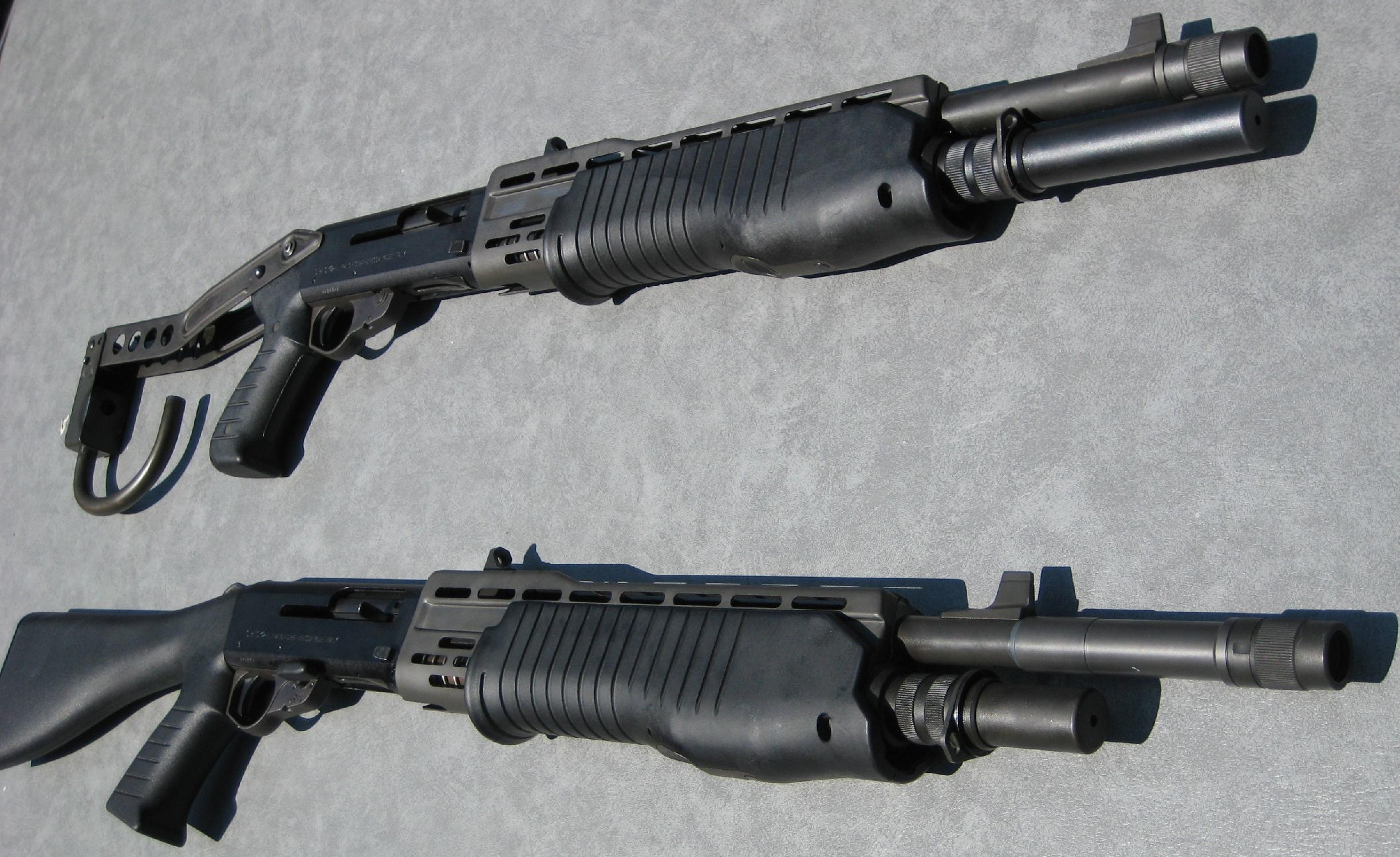
The Franchi SPAS-12 in both folding stock and hook, and fixed stock configurations. The hook pivots to the side to brace the forearm for one handed shooting out of a police cruiser. [image source]

The most famous dual-mode shotgun is the Franchi SPAS-12, which can fire in semi-automatic despite being more commonly portrayed as a pump action in Hollywood. Another is the Benelli M3 which is used by the UK Metropolitan Police’s Specialist Firearms Command MO19.
[source]
2.8 Revolver
Revolver shotguns are a niche subcategory of shotguns. In the Americas, firearms manufacturers Taurus and Magnum Research have released the Judge and BFR respectively, both double action revolver ‘self-defence’ pistols designed for shooting .410 slugs or .45 Long Colt cartridges. In Russia, the Central Research and Design Bureau of Sporting and Hunting arms, TsKIB SOO, produced the MTs-255, a double / single action 5 shot 12 gauge shotgun for hunting and a polymer folding stock variant, MTs-255-12, for police use. They also produced the OTs-62, which is a handgun variant of this weapon. Lastly, several prototype shotguns like the Pancor Jackhammer and Crye Precision SIX12 used revolving magazines but never came to fruition, hence are only widespread in video games.
[source][source][source][source][source]

Original brochure collected by the author for the MTs-255 from TsKIB SOO, based in Tula, Russia.
2.9 Honourable mentions: Smoothbore rifles and Flare pistols
The first honourable mention are Russian smoothbore rifles as they are legally classed as shotguns despite performing more like a rifle. These are civilian counterparts of Russian military rifles with paradox (partly) rifled or oval-bore barrels to circumvent the firearms law, which requires at least 5 years of ownership of a shotgun before obtaining a rifle license. The most common cartridge is the .366 TKM, designed for rebarreled 7.62x39mm semi-automatic rifles like the AKM and SKS which are made by Molot as the VPO-209 and VPO-208 respectively. Other examples include Kalashnikov Concern’s TG3 rifle chambered in 9.6x53mm Lancaster to emulate the 7.62x54R Dragunov SVD, the .366 TKM TR3 rifle to clone the AK-12, and the .345 TK and 9mm Altay cartridges as counterparts for 9x19mm carbines.
[source][source][source][source][source]
In contrast, flare guns are not defined as shotguns but rather as large caliber handguns though one particular model, the Orion Alerter Basic-4, deserves mentioning. This is the iconic bright orange plastic flare gun, which has gained notoriety due to its 12 gauge chambering and has led to speculation about its use with live shotgun cartridges. The flare gun will not accept a standard length shell but it can accept a half-sized shell; if fired, it will result in the catastrophic failure of the weapon with no damage to the target. The 12 gauge flares that are designed for the pistol will however function in a standard 12 gauge shotgun. There are also homemade or commercial metal inserts to convert flare guns to fire conventional ammunition, but this conversion defines the weapon as a firearm under law.
[source]
3.0 Short-barreled shotguns
The ‘sawed-off’ or ‘sawn-off’ shotgun refers to a shotgun with a cut down barrel, beyond the US legal limit of 18 inches, and fitted with a pistol grip instead of a stock for concealability and ease of transport. The original intent of the weapon was for Sicilian farmers protecting vineyards from wolves, hence the name lupara (“wolf-shot”). However, they became popular with the mafia and later symbolic with bank robberies during the 1960s in the UK, Australia, Canada and New Zealand since handguns were difficult to obtain.
4.0 Shotgun Cartridge Loads
4.1 Note on Calibres, Rifling and Chokes
The most common calibres for a shotgun are 10 gauge, 12 gauge, 16 gauge, 20 gauge, 28 gauge, and .410 bore. The term ‘gauge’ refers to the reciprocal of the weight of a lead ball as a fraction of a pound that could fit the bore of the gun, hence a 12 gauge could fit a 12 lead balls that collectively weigh one pound.
Shotguns are typically understood as ‘smoothbore’ weapons, meaning they lack rifling. However, shotguns intended for shooting slug rounds can have rifled barrels for improved range. Some shotguns can also be partly rifled, such as the paradox gun and the Russian smoothbore rifles, as a compromise for firing both shot and slug munitions.
Chokes are cylinders at the end of the barrel that constrict the diameter of the barrel very slightly to keep the discharged shot in a tight group. They come in different sizes that tune the spread of the shot.
4.2 Shot
Shot refers to the small pellets that are commonly used in shotgun cartridges. They are traditionally made of lead, but recent environmental and food safety pressure on quarry shooting has spurred the creation of steel shot. Shot is supported by a wad – a cup that pushes the pellets out of the barrel when the primer and powder charge is ignited. The size of the shot is a tradeoff to the amount of shot held in the cartridge, with bigger pellets having less room for more. ‘Birdshot’ and ‘Buckshot’ are collective terms for the pellet sizes; typical 12 gauge birdshot shells are #7 ½ shot for clay shooting while buckshot for larger game, military applications, and home defence is usually 00 (‘double-aught’) or #4 shot.
4.3 Slug
The shotgun slug started as a German invention in 1898 by Wilhelm Brenneke, leading to what is known as ‘Brenneke’ type slugs. These projectiles were cylindrical, with a pointed nose and ribs along the top half of the slug. They were popular in Europe, but it took an American, Karl Foster, in 1931 to develop his own ‘Foster’ type slugs that became popular in the US for hunting. Both slugs are designed to be fired in smoothbore, fully choked barrels and do not require rifling since they maintain their stability through air via their frontal-loaded weight. There is a slight rotation produced by the ribs but this is to reduce irregularities in manufacturing.
Slug rounds provide more range than standard shot, but the actual maximum range is contested by many. In general, a slug is effective between 75 to 150 yards with a minimum range of 40 yards and maximum range of 250 yards.
[source]
4.4 Flechette
Flechette rounds contain small steel darts that offer improved ballistic performance and better vegetation clearing when compared to lead shot. Unlike the artillery shells and antitank weapons they are inspired by, there are multiple flechette needles in the shotgun shell rather than a singular dart. Their velocity is also quite slow, making them ineffective against body armour despite being widely believed as an armor piercing type of ammunition. In the shell, they are surrounded by plastic pellets and are held together by a metal disc to keep the darts facing forwards and prevent the wad from surpassing them during acceleration.
4.5 Less than lethal / Utility
There are a wealth of less than lethal and utility shotgun rounds, the most significant are described below:
- Flexible baton rounds, a.k.a ‘bean bags’: a fabric bag filled with birdshot designed to incapacitate targets via the force of the projectile
- Gas: pepper and tear gas shells
- Rock salt: a predecessor to less-lethal loads, typically used by farmers to prevent poaching
- Rubber slugs / buckshot: as the name suggests, with effect similar to bean bags
- Breaching / frangible: a brittle load designed to destroy door locks while rapidly fragmenting to prevent injury to the user and targets behind the door
- Bolo: two or more steel slugs attached by wire, however it functions more like a low powered slug rather than the incapacitating throwing rope its named after
- Stinger: a non-lethal 00-buckshot shell made of Zytel fiberglass/nylon
- Blank: used for tripwire alarms, scaring wildlife, film & TV or for Mossberg’s 500 & 590 line launching shotgun conversion
- Flashbang: a reported ‘Zvezda’ (‘star’) load for the Russian 23mm (4 gauge!) KS-23 shotgun meant for disorientation
- Bird bombs / Screechers: firecracker and pyrotechnic rounds for scaring wildlife
- Taser: Taser International makes the eXtended Range Electronic Projectile (XREP) which is a wireless shock weapon fired from a 12 gauge shotgun shell
- Grenade: experimental high explosive rounds developed by London-based Special Cartridge Company, though they were unpopular due to cost and widespread adoption of 40mm grenade launchers
4.6 Exotics
Some shotgun cartridge loads are purely marketing gimmicks; this list is not exhaustive but demonstrates some of the most famous commercially available examples.
‘Dragon’s Breath’ refers to a magnesium pellet load designed for a pyrotechnic display and incendiary effect. In 2011, a YouTube video published by Kyle Myers, known then as the internet personality FPSRussia, demonstrated 12 gauge ‘Dragon’s Breath’ to over 29.6M viewers and became one of the most viral videos at the time. In the video, he also demonstrates ‘Rhodesian Jungle’ cartridges, which contain a birdshot load followed by buckshot. According to the manufacturer, they offer ‘double the punching power’ because ‘if the big pellets don’t get you, the small ones will’. In the FPSRussia video, it was claimed that the birdshot cleared the vegetation to make way for the buckshot to hit the target. There is no evidence to substantiate either claim. This particular manufacturer, Firequest International, also markets the famous ‘Piranha’ round, which contains a mixture of #12 shot and ‘dozens’ of steel nails. It is about as effective as birdshot, with similar penetration and expansion in ballistic gel tests, making it a gimmick rather than a flechette alternative.
American ammunition giant CCI offers a line of pistol cartridges with pellets called ‘Shotshell’, intended for use on varmint. They are very selective in compatibility with semi-automatic firearms and can only be successfully applied to hunting mice or snakes within 10 metres. The main drawback is that the pellets are fired in rifled barrels, resulting in inconsistent shot spread patterns and poor range.
[source][source][source][source][source]
5.0 Current Military & Law Enforcement Applications
5.1 Close quarters combat (CQC)
The ‘combat’ shotgun, those issued for military purposes, was greatly popularized by the image of the Winchester M1897 ‘trench gun’ (aka “trench broom”) in WW1. The actual use of the shotgun in the conflict was quite limited, with only 717 shotguns being recorded on the frontlines in September 1918, but the propaganda surrounding the weapon idolized it against German protests and claims of human rights abuses that the weapon posed. Nevertheless, the shotgun remained a staple in military arsenals for other purposes like guard duty and breaching, but the ability to use it for close quarters combat was never neglected by soldiers.
[source]
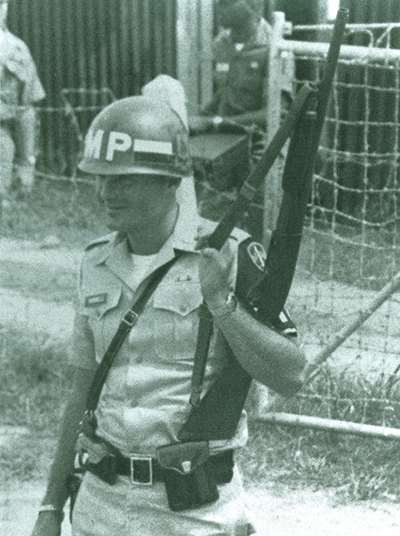
A U.S. Military policeman in Vietnam with a Steven’s Model 77E. [image source]
The shotgun has a stronger connection to law enforcement, being referred to as the ‘riot’ shotgun for its more defensive use rather than offensive capability and its applicability against crowds. Shotguns became an important back up gun in police cruisers especially as police in the early to mid 20th century carried revolvers.
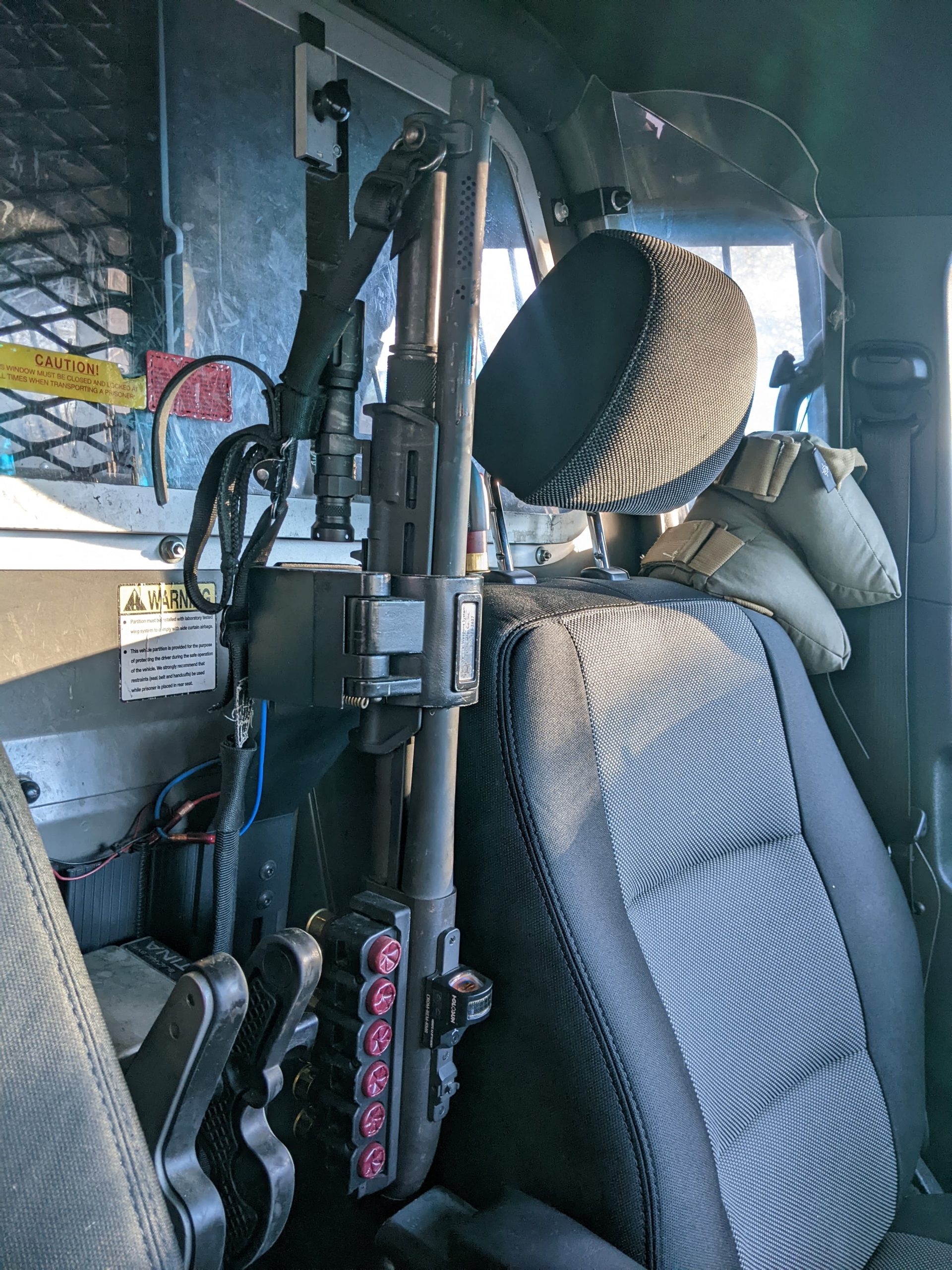
The ‘cruiser-ready’ pump action shotgun is typically carried with an empty chamber, though whether the action is locked (hammer cocked) or unlocked (hammer dropped) is up to preference. [image source]
Arguably the most famous law enforcement combat use of the shotgun is the FBI’s 1986 Miami Dade Shooting. The FBI had been investigating a two-man bank robbery crew across Miami Dade until they identified the suspect vehicle: a stolen car whose owner was rescued by law enforcement in the days earlier. After an attempted traffic stop went wrong between eight agents and two combatants, all agents had been shot and mostly taken out of the fight. In their attempt to get away, agent Edmundo Mireles Jr., who had been downed first and shot in the forearm, got up and mounted his Remington M870 shotgun on the side of a vehicle, and fired five shotgun shells at them one handed, each time racking the weapon against the floor (something he was not trained to do). This gave him the opportunity to approach both suspects with his revolver, firing all six shots and killing them both. The FBI investigation following this incident partially blamed the insufficient penetration power and slow reload of the .357 revolvers issued to agents at that time. Former US Marine Corp firearm instructor Paul Harrell, who received training and attended FBI seminars on the subject, blamed the agent’s poor marksmanship but commended the surprising accuracy attained by Mirele’s improvised shotgun shooting position.

Edmundo Mireles Jr. depicted firing the Remington M870 one handed after being shot in the arm in the 1988 movie “In the Line of Duty: The F.B.I. Murders” [source]
The late Paul Harrell’s excellent modern rendition and analysis of the 1986 Miami Dade Shooting [source]
5.2 Door breaching
In the 21st century, shotguns became a popular tool for door breaching within the US military as military operations were typically conducted in urban terrain. The common destruction of door locks in the wars in Iraq and Afghanistan led to the development of the Knight’s Armament Company Master Key and C-More M26 MASS, both underbarrel shotguns for the M4 carbine in pump action and straight pull configurations respectively.
For law enforcement, the battering ram is the standard tool in door breaching but the shotgun offers some advantages. Shotgun breaching is faster and can be applied to iron-barred windows, padlocks and sliding glass doors, while also being safer and easier to train than thermal or explosive breaching. Purpose-built breaching shotguns often include standoff chokes, which are a ported muzzle device with teeth designed to grip onto door frames and expel gases sideways away from the operator making their use even safer.
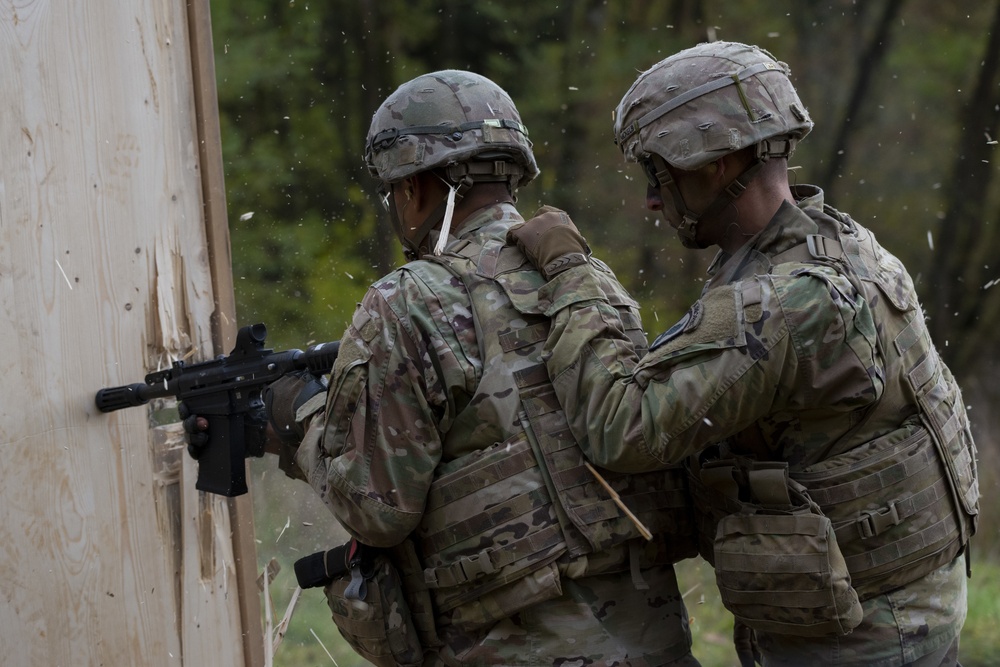
The M26 MASS being used in a door breaching exercise. Note how the operator is able to maintain a safe distance by placing the standoff choke against the door. [image source]
5.3 Crowd control
More recently, the shotgun has prevailed in law enforcement as a less-lethal weapon with the development of bean-bags and rubber shot loads. Many of these shotguns are painted bright colours and are converted only for firing these cartridges, undermining the versatility of the weapon but also increasing safety. Gas cartridges are not generally used by first responders, but have found their use in more specialized situations.
[source]

A ‘bean bag shotgun’ used by a Royal Canadian Mounted Police officer. [image source]

5.4 Anti-UAV: Drone hunting
The large-scale use of FPV drones in the Ukraine war has encouraged the shotgun to be used as the last line of defense. Smaller and bigger swarms of drones can overwhelm electronic countermeasures, leading to soldiers instinctively hunting drones with birdshot. Various small arms manufacturers are recognising this trend, pitching ‘kinetic’ devices and technologically augmented shotguns as the long term solution to drone warfare.
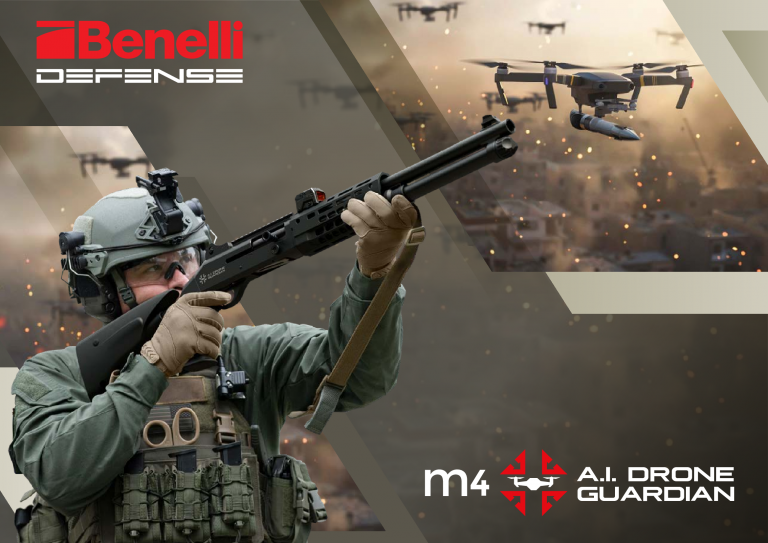
Beretta Defence Technologies (BDT) is promoting the new purpose-built Benelli M4 A.I. Drone Guardian. The ‘A.I.’ refers to the patented ‘Advanced Impact’ technology which is a redesigned barrel profile to maintain shot spread at distance. [image source]
6.0 Conclusion
The shotgun has remained steadfast in gun safes across the world because of its versatility in three key ways. Firstly, the abundance of operating mechanisms available for the shotgun make it a strong contender to the rifle in procurement, offering both manual and automatic options that appeal to various users depending on their accessibility and intended cartridge use. The second, and biggest difference to rifles and pistols, are the plentiful options in cartridge loads that give shotguns more adaptability between range and lethality. This enables the last reason, the ability for one shotgun to fulfil multiple applications, which makes solely carrying a shotgun the best choice rather than separate tools for combat, breaching, utility and hunting. Overall, the shotgun can be preferred over the rifle and pistol because it is a compromise between the two. The rifle still wins at range and the pistol at concealability, but in cases where both are less important, particularly military and law enforcement operations, the shotgun is compelling as the equally useful and deadly, jack of all trades firearm.